Quick Answer
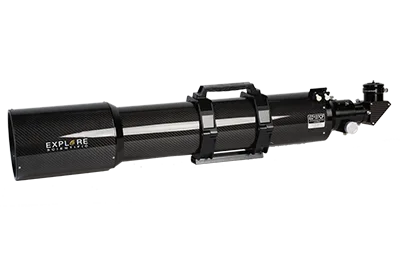
If you want crisp, high-contrast views of the moon and planets with minimal maintenance, a refractor is your best bet. If you need maximum aperture for deep-sky observing on a budget, a reflector wins. For astrophotography, a quality apochromatic refractor like the ED127 Carbon Fiber FCD100 offers excellent color correction and portability, while a reflector demands more setup but delivers more light-gathering for faint targets.
How Refractors and Reflectors Differ
A refractor telescope uses a lens at the front to bend light, while a reflector uses a mirror at the rear. This fundamental difference affects everything from image quality to maintenance. Refractors are sealed tubes that rarely need collimation, making them grab-and-go friendly. Reflectors offer more aperture per dollar but require periodic mirror alignment and can suffer from coma off-axis.
For visual observers, a 4-inch apochromatic refractor can outperform a 6-inch reflector on lunar and planetary detail because it produces a cleaner, contrast-rich image. However, that same reflector will show fainter galaxies and nebulae because it collects more light. There is no universal winner—only the right tool for your primary targets.
Apochromatic Refractors: When Color Fidelity Matters
Standard achromatic refractors can show purple fringing around bright objects. Apochromatic (APO) designs, like the Explore Scientific ED127 Carbon Fiber FCD100, use special ED glass (FCD100 from HOYA) to virtually eliminate chromatic aberration. The result is sharp, true-color images ideal for planetary imaging and wide-field astrophotography. The trade-off is cost—APO refractors command a premium over reflectors of similar aperture.
Reflectors: Aperture Economy and Deep-Sky Reach
Newtonian reflectors offer the most light-gathering per dollar. An 8-inch or 10-inch Dobsonian can reveal dozens of deep-sky objects from a moderately dark site, while a 4-inch refractor of similar cost will show far fewer. Reflectors are also easier to make in large sizes, which is why most serious deep-sky observers eventually own one. The downsides: they need collimation, can be bulky, and open-tube designs collect dust.
Trade-offs at a Glance
- Image contrast vs. light gathering: Refractors deliver higher contrast on planets and the moon due to no central obstruction. Reflectors gather more light for faint deep-sky objects. Choose a refractor for planetary detail; choose a reflector for galaxies and nebulae.
- Maintenance vs. cost per aperture: Refractors are sealed and rarely need adjustment. Reflectors require periodic collimation but offer much more aperture for the same money. If you want a simple grab-and-go setup, a refractor saves time. If you want the biggest mirror for your budget, a reflector wins.
- Astrophotography readiness: Apochromatic refractors like the ED127 Carbon Fiber FCD100 produce sharp, color-corrected images straight out of the box. Reflectors often need a coma corrector and a sturdy mount for imaging. For wide-field or planetary imaging, a premium refractor is easier. For deep-sky imaging on a budget, a reflector with correctors can work well.
Product Facts
- ED127 Carbon Fiber FCD100 Apochromatic Refractor (FCD100-127075-CF): The ED127 Carbon Fiber FCD100 Apochromatic Refractor uses genuine HOYA FCD100 ED glass in an air-spaced triplet design, housed in a lightweight carbon fiber tube. This means excellent color correction and portability for astrophotographers who need to travel to dark sites or set up quickly.
- Multi Adapter Coup. TW FSQ-1 (TKP30003): The Multi Adapter Coup. TW FSQ-1 (TKP30003) is a Takahashi adapter for connecting astrophotography accessories. Adapters like this are essential for integrating cameras or filter wheels with premium refractors, ensuring a secure and accurate optical train.
Which Telescope Type Fits You?
Best for
- Visual observers who prioritize sharp planetary and lunar views with minimal setup
- Astrophotographers seeking a portable, color-corrected refractor for wide-field or high-resolution imaging
Not ideal for
- Budget-conscious observers who want the largest possible aperture for deep-sky visual observing
- Users who prefer a low-maintenance, sealed tube but need a large light bucket—reflectors of similar size are cheaper but require upkeep