Quick answer
Choose a right angle prism when you need to fold a beam 90° or return it 180° with minimal loss; total internal reflection does the work without a coating. Choose an equilateral prism when you need to disperse white light into its spectrum or measure refractive index. The two are not interchangeable: one controls beam direction, the other controls wavelength separation.
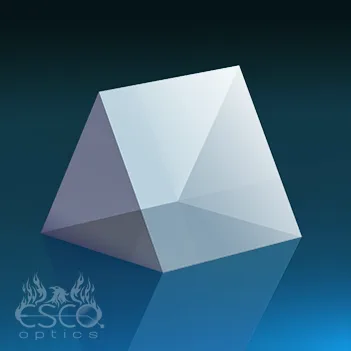
equilateral prism
How each prism bends light
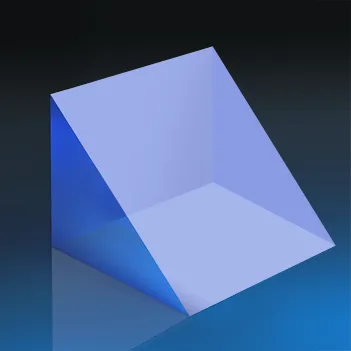
A right angle prism has two 45° faces and one 90° face. Light entering perpendicular to a leg hits the hypotenuse at 45°, which exceeds the critical angle for typical optical glass, so the beam reflects internally and exits 90° from the input. If you enter through the hypotenuse instead, the beam returns 180°—useful for retroreflection or interferometer arms. Because total internal reflection relies on the glass-air interface, no reflective coating is needed, which keeps loss low and avoids coating damage in high-power paths.
An equilateral prism has three equal 60° angles. Light entering one face refracts, travels through the glass, and exits another face. Because the refractive index varies with wavelength, blue light bends more than red—this is dispersion, and it is what separates white light into a spectrum. The deviation angle depends on the prism's index and the entry angle; at minimum deviation the beam path is symmetric and the spectrum is cleanest for measurement.
Deviation angle and what it means for alignment
For a right angle prism, the deviation angle is fixed by geometry: 90° or 180°, depending on which face you use. That predictability makes alignment straightforward—once the prism is square to the input beam, the output direction is set. For an equilateral prism, deviation varies with wavelength and incidence angle, so you cannot treat it as a simple fold mirror. You must plan the input angle and the detector or slit position together, and you may need a rotation stage to tune the output.
If your setup already has tight mechanical constraints, the fixed deviation of a right angle prism is easier to design around. If you are building a spectrometer or need to characterize a material's dispersion, the variable deviation of an equilateral prism is the point, not a drawback.
Surface quality and material choices
Right angle prisms are often specified by surface accuracy and scratch-dig because the hypotenuse must be flat enough to support total internal reflection without scattering. A poor hypotenuse surface scatters light and can reduce contrast in imaging or metrology systems. Equilateral prisms are specified similarly, but the critical faces are the two refracting faces; their polish affects both throughput and spectral resolution. In both cases, a finer scratch-dig means less stray light, which matters more in low-signal applications than in simple beam steering.
Material choice also matters. N-BK7 is common for visible and near-infrared work because it is cost-effective and has good transmission. Fused quartz is chosen when thermal stability or UV transmission is needed. If your application spans a wide temperature range, the lower thermal expansion of fused quartz can help keep alignment stable, but it costs more and may not be necessary for a bench setup.
Practical mounting and handling differences
Right angle prisms are compact and can be mounted on a single face, which simplifies brackets and reduces the number of adjustments. Equilateral prisms are often mounted on a rotation stage so you can set the incidence angle for minimum deviation or scan the spectrum. That extra degree of freedom adds alignment time but gives you control over dispersion.
Handling is similar for both: handle by the edges, wear gloves, and clean only when necessary with appropriate optics-grade supplies. Avoid touching the hypotenuse or refracting faces, since skin oils can degrade transmission and are difficult to remove without risking the polish.
Trade-offs at a glance
- Beam steering vs. dispersion: Right angle prisms redirect a beam by a fixed 90° or 180° using total internal reflection. Equilateral prisms separate wavelengths by dispersion, with a deviation angle that depends on wavelength and incidence. If your goal is to route light, choose a right angle prism; if your goal is to analyze or separate wavelengths, choose an equilateral prism.
- Alignment complexity: Right angle prisms need only be squared to the input beam for a predictable output. Equilateral prisms often require a rotation stage and careful placement of the detector or slit to capture the desired wavelength range. Budget more alignment time for equilateral prisms, especially if you need minimum deviation.
- Surface quality impact: For right angle prisms, the hypotenuse flatness and scratch-dig affect total internal reflection efficiency. For equilateral prisms, the two refracting faces affect throughput and spectral purity. Specify a tighter scratch-dig when stray light or low signal is a concern; standard quality is often fine for simple beam folding.
Relevant Esco Optics products
- Commercial Quality Windows, Circular, N-BK7 Optical Glass*: Commercial Quality Windows, Circular, N-BK7 Optical Glass: surface accuracy of 1.0–3.0 mm thickness ≤ 5λ per inch, 4.76–12.7 mm thickness ≤ 2λ per inch; surface quality 60-40 Scratch-Dig or better; parallelism <15'. If your setup needs a flat window for beam access or protection, this N-BK7 window offers a defined flatness and scratch-dig that supports consistent transmission without the beam-steering function of a prism.
- Optical Flats, Dual Precision Surface: Optical Flats, Dual Precision Surface: made from G1 grade fused quartz; low thermal expansion, abrasion resistance, and stability allow continuous use with minimal degradation; available with one or two precision surfaces. When you need to verify the flatness of a prism face or a window before assembly, a fused quartz optical flat provides a stable reference that resists wear and thermal drift.
Which prism fits your setup?
Best for
- Folding a beam 90° in a compact instrument where coating-free total internal reflection is preferred.
- Retroreflecting a beam 180° in interferometers or alignment setups.
- Applications where a fixed, predictable deviation angle simplifies mechanical design.
Not for
- Separating white light into a spectrum or measuring dispersion—use an equilateral prism instead.
- Tuning the output angle continuously without rotating the prism—an equilateral prism on a rotation stage is more flexible.
- High-dispersion spectroscopy where a diffraction grating would offer higher resolution.