Quick Answer
For UV applications, choose UV grade fused silica flat windows with flatness of λ/10 or better and parallelism of 5 arc seconds when you need minimal wavefront distortion. If your system tolerates more deviation, λ/4 flatness with 10 arc minutes parallelism offers a cost-effective alternative.
Why UV Grade Fused Silica?
UV grade fused silica is the preferred substrate for ultraviolet optics because it offers high transmission from 185 nm into the infrared, excellent thermal stability, and low autofluorescence. This makes it ideal for laser systems, interferometry, and semiconductor equipment where ordinary glass would absorb UV light and degrade performance.
Unlike N-BK7, which has limited UV transmission, UV grade fused silica maintains consistent performance across a broad spectrum. This is why precision flat windows made from this material are common in beam delivery systems and measurement instruments.
Understanding Flatness and Parallelism
Flatness, expressed in waves (λ), describes how perfectly planar the surface is. A lower value means a flatter surface, which is critical for applications like interferometer flats where any deviation distorts wavefront quality.
Parallelism, expressed in arc seconds or arc minutes, measures how parallel the two surfaces are. Tighter parallelism reduces beam deviation and ghosting, which is important in laser cavities and imaging systems.
Your choice between λ/4 and λ/10 flatness, and between 5 arc seconds and 10 arc minutes parallelism, should be driven by your system's tolerance for wavefront error and beam deviation.
Diameter and Thickness Considerations
The diameter of the window must match your optical path, but larger diameters are harder to polish to tight flatness and parallelism. Thickness affects mechanical stability and thermal performance; thicker windows are more rigid but can introduce more absorption.
When selecting, confirm that the available diameter and thickness options meet your mounting and performance requirements. If a specific combination is not listed, contact the manufacturer to check custom availability.
Decision Rules for UV Grade Fused Silica Flat Windows
- Flatness Requirement: Choose λ/10 flatness for interferometry, laser windows, or any application where wavefront distortion must be minimized. Choose λ/4 flatness for less demanding systems where slight wavefront error is acceptable. If you are unsure, opt for λ/10 to avoid wavefront issues.
- Parallelism Requirement: Select 5 arc seconds parallelism when beam deviation or ghosting must be minimal, such as in laser cavities or imaging systems. Use 10 arc minutes parallelism for general-purpose applications where slight beam deviation is tolerable. Tighter parallelism reduces beam deviation but may increase cost.
- Diameter and Thickness: Choose a diameter that fits your optical mount and a thickness that provides adequate rigidity without excessive absorption. Verify that the available options meet your system's mechanical constraints. Larger diameters may require relaxed flatness or parallelism to remain cost-effective.
Product Facts
-
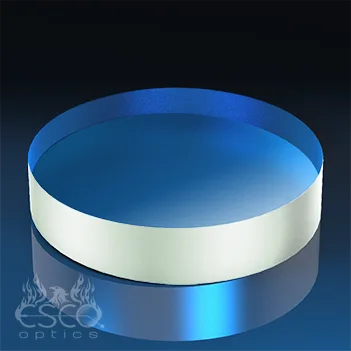
Precision Flat Windows, S1-UV Grade Fused Silica: UV Fused Silica laser quality round windows range from 0.25 waves (λ/4) to 0.10 wave (λ/10) flat. Parallel specifications are either 5 arc seconds or 10 arc minutes. This lets you match flatness and parallelism to your application's precision needs, balancing performance and cost.
Precision Flat Windows, S1-UV Grade Fused Silica
Who Should Choose UV Grade Fused Silica Flat Windows?
Best For
- Laser systems operating in the UV spectrum that need high transmission and minimal wavefront distortion.
- Interferometry and metrology applications requiring precise flatness and parallelism.
- Beamsplitter substrates and parallel plates in optical instruments.
Not For
- Visible or near-infrared applications where N-BK7 or standard fused silica offers adequate performance at lower cost.
- Applications requiring extreme environmental resistance, where sapphire windows may be more suitable.