Quick Answer
To build fine motor skills with a sensory play board, start with a structured routine that pairs visual supports with hands-on tasks, then gradually increase challenge as your child gains confidence.
Why a Sensory Play Board Works for Fine Motor Skills
A sensory play board is more than a toy; it's a tool that combines tactile input with purposeful hand movements. For children with sensory processing differences or developmental delays, the board's varied textures and manipulatives encourage grasping, pinching, and coordinated hand-eye actions.
The key is to use the board deliberately, not just as a free-play item. By setting up structured activities, you can target specific skills like pincer grip, wrist rotation, or bilateral coordination, while also providing the sensory feedback many kids naturally seek.
Choosing the Right Sensory Play Board
Not all sensory boards are created equal. Look for one that offers a variety of textures and activities—like latches, zippers, and threading elements—that match your child's current skill level. A board with too many complex tasks can overwhelm; one with too few may not hold interest.
For younger children or those just starting, a board with larger, easy-to-grip pieces is ideal. As skills improve, you can incorporate boards with smaller components or add supplementary tools like a silicone threading board to refine precision.
Common Mistakes to Avoid
One common mistake is expecting the child to engage independently right away. Many kids need modeling and joint play to understand how to use the board. Another is ignoring the child's sensory preferences—if they avoid certain textures, forcing them can cause distress.
Also, avoid using the board only during 'therapy time.' Integrating it into daily routines, like a calm-down corner or a transition activity, makes practice feel natural and less like a chore.
How to Set Up a Sensory Play Board Activity
- Choose a distraction-free space: Set up the board on a flat surface with minimal visual clutter. Have a small tray of any extra pieces nearby so everything is visible and within reach. Check that the space allows your child to sit comfortably with both feet on the floor.
- Introduce one task at a time: Pick a single element—like a latch, zipper, or threading hole—and demonstrate it slowly. Use simple language like 'open' or 'through' while you model the motion. If your child loses interest, switch to a different element rather than forcing the same one.
- Use hand-over-hand guidance: Place your hand gently over your child's hand to guide the movement, then gradually release as they gain confidence. This builds muscle memory without frustration. Avoid doing the task for them; your goal is to let them feel the motion themselves.
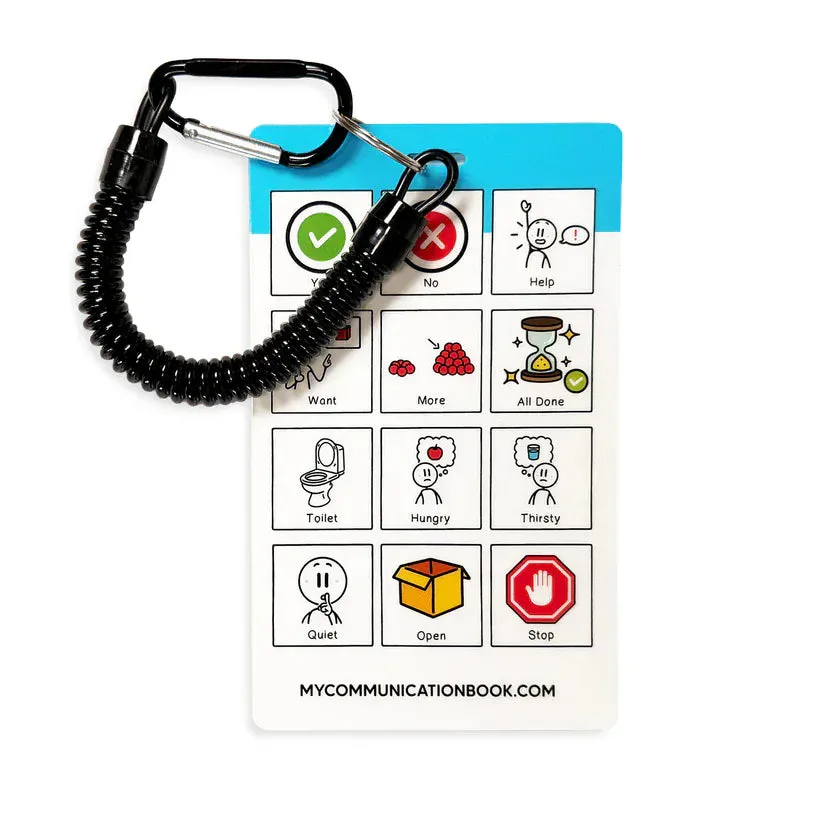
- Add a visual schedule or cue card: Show a picture of the activity sequence—like 'turn the wheel, then slide the bead'—or use a communication card with action words to help your child anticipate what comes next. Point to the card or picture before each step to reinforce the connection between the word and the action.
- End with a calming activity: After 5–10 minutes of focused work, transition to a calming sensory input like squeezing putty or pressing the board's soft textures. This helps regulate the nervous system and prevents overstimulation. Watch for signs of fatigue; it's better to stop on a positive note than to push through frustration.
Products That Support Fine Motor Play
-
My Communication Card - Every Day Words: This double-sided AAC-style communication card features 24 essential everyday words to help children quickly express needs, requests, actions, and feelings across the day. Pairing a sensory play board with a communication card lets your child label actions like 'push,' 'pull,' or 'turn' while they work, reinforcing language alongside motor skills.
My Communication Card - Every Day Words