Quick Answer
The Sigma 24-70mm f/2.8 DG OS HSM Art is a solid choice for Canon EF shooters who want a fast standard zoom with built-in stabilization and Sigma's Art-series image quality.
Why the Art series matters
Sigma's Art line is known for high-end optical performance, and this 24-70mm f/2.8 fits that reputation. It uses three SLD and four aspherical elements to control aberrations and distortion, which helps keep images sharp across the frame—especially at the wide end.
The lens is built for full-frame Canon EF bodies, though it can also work on APS-C cameras where it gives a 38-112mm equivalent range. That flexibility makes it a practical one-lens option for many shooting situations.
Built-in stabilizer vs. third-party alternatives
One of the biggest advantages this lens has over many third-party 24-70mm f/2.8 options is the built-in Optical Stabilizer. If you shoot handheld in low light—events, weddings, or travel—that extra stop or two of stability can make a real difference, especially at slower shutter speeds.
The trade-off is size and weight. This is a chunky lens, and when paired with a full-frame body it can feel front-heavy. If you prioritize a compact kit, a lighter prime or a smaller-aperture zoom might be more comfortable for all-day carry.
Sigma 24-70mm f/2.8 Art FAQ
Is this lens compatible with my Canon camera?
It's designed for Canon EF mount, so it works on full-frame and APS-C Canon DSLRs (and with an adapter on some mirrorless bodies). It won't natively fit RF-mount without an adapter. Check your camera's mount before buying—if you're on RF, you'll need an adapter.
How does the image quality compare to Canon's own 24-70mm f/2.8?
Sigma's Art lenses are known for excellent sharpness and control of aberrations. The built-in stabilizer is a key advantage over some Canon versions that lack IS. However, Canon's own lens may offer faster, more confident autofocus in some situations, and native compatibility is always a plus. If you rely heavily on fast, reliable AF for sports or action, test both if possible.
Is the autofocus fast enough for sports or wildlife?
The Hyper Sonic Motor is quick and quiet, but this is a standard zoom, not a telephoto. For fast-moving subjects, a dedicated telephoto lens with faster AF is usually a better choice. Consider a telephoto zoom or prime for action-heavy shooting.
Is this lens good for video?
Yes, for run-and-gun video the stabilizer helps, and the manual override is useful for pulling focus. But the lens is heavy, so a support rig or gimbal may be needed for long shoots. Balance your rig carefully if you're using a gimbal.
What is the aperture range and why does it matter?
The f/2.8 to f/22 range gives you a constant fast aperture for low light and shallow depth of field, while f/22 is available for maximum depth of field in landscapes. The rounded 9-blade diaphragm also helps produce smoother bokeh. Use f/2.8 for portraits and low light; f/8–f/11 for maximum sharpness; f/22 for deep focus.
Does it work with the Sigma USB Dock?
Yes, the lens is compatible with the Sigma USB Dock, which lets you update firmware and fine-tune autofocus adjustments. If you notice focus inconsistencies, a USB Dock can help you calibrate the lens.
Sigma 24-70mm f/2.8 Art at a glance
-
Sigma 24-70mm f/2.8 DG OS HSM Art Lens for Canon EF: EF-Mount lens for full-frame format with an aperture range of f/2.8 to f/22. It gives you a constant fast aperture for consistent exposure and shallow depth of field, while the f/22 minimum is useful for landscapes and long exposures.
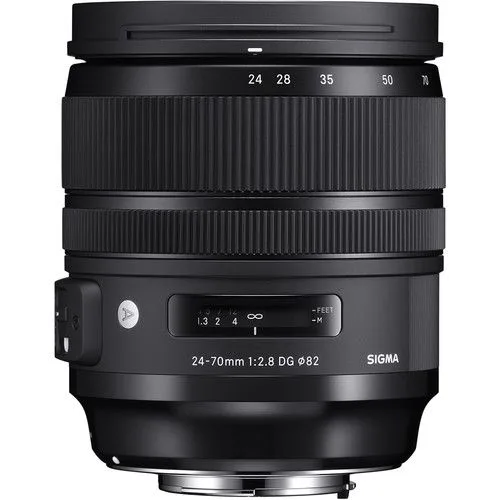
Sigma 24-70mm f/2.8 DG OS HSM Art Lens for Canon EF
-
Sigma 24-70mm f/2.8 DG OS HSM Art Lens for Canon EF: Includes an Optical Stabilizer to reduce camera shake. It helps you shoot handheld in lower light without raising ISO as much, which is a practical advantage for event and travel photography.
-
Sigma 24-70mm f/2.8 DG OS HSM Art Lens for Canon EF: Hyper Sonic AF motor with manual override. Autofocus is quick and quiet, and you can fine-tune focus manually without switching modes—handy for video or critical focus work.
-
Sigma 24-70mm f/2.8 DG OS HSM Art Lens for Canon EF: Rounded 9-blade diaphragm. Out-of-focus areas look smoother and more natural, which is important for portraits and close-up work.