Quick answer
Pajamas go on first, directly against your baby's skin, and the sleep bag goes over them as the outer layer. Pajamas handle fit and skin comfort; the sleep bag handles warmth, and its TOG rating tells you how warm. Match the pair to your nursery's actual room temperature rather than to the season on the calendar.
Why the base layer and the outer layer do different jobs
A sleeper or pajama set is the only layer touching skin all night, so its fabric and fit carry the most weight. A sleep bag sits on top and can be adjusted independently, which is why the two pieces are not interchangeable. If your baby runs warm, you change the bag's TOG, not the pajamas. If the pajamas gap at the neck or ride up, no bag will fix that.
This is also why the order never flips. A sleep bag over bare skin leaves nothing to absorb night spit-up or diaper leaks, and it makes middle-of-the-night changes slower.
Reading the TOG number against your nursery thermometer
TOG measures thermal insulation, not thickness, so two bags can look similar and still be rated for very different rooms. The number only becomes useful once you know the temperature where your baby actually sleeps — a monitor reading near the crib, not the thermostat in the hallway.
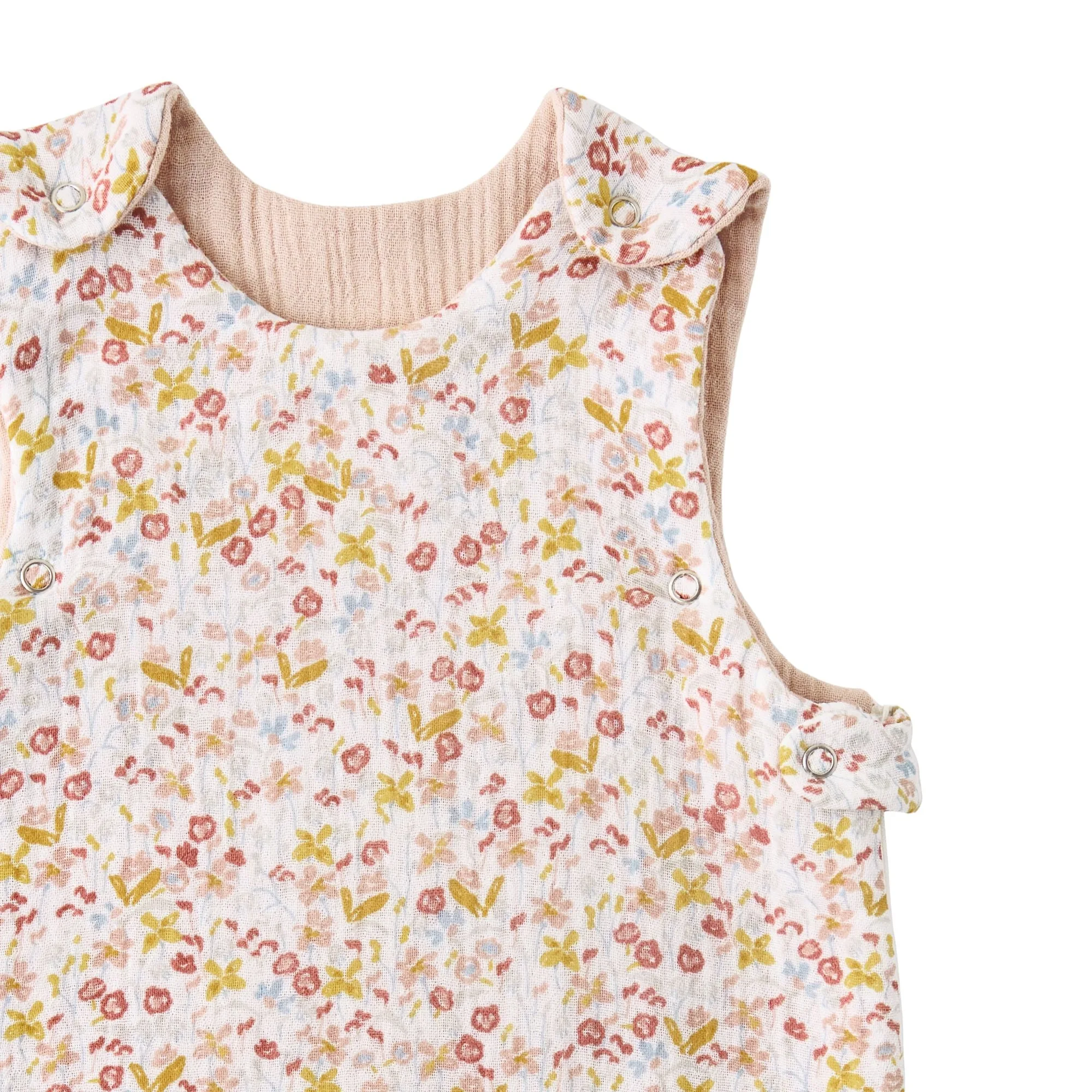
A 1.0 TOG bag is built for warmer rooms, and Pehr's 1.0 TOG Sleep Bag - Floret is designed for 75–81°F (24–27°C). In that range, a light short-sleeve sleeper underneath is usually enough. In cooler rooms, you either move to a higher-TOG bag or add a warmer base layer — but add only one variable at a time so you can tell what changed.
Matching the base layer to the bag, not just the weather
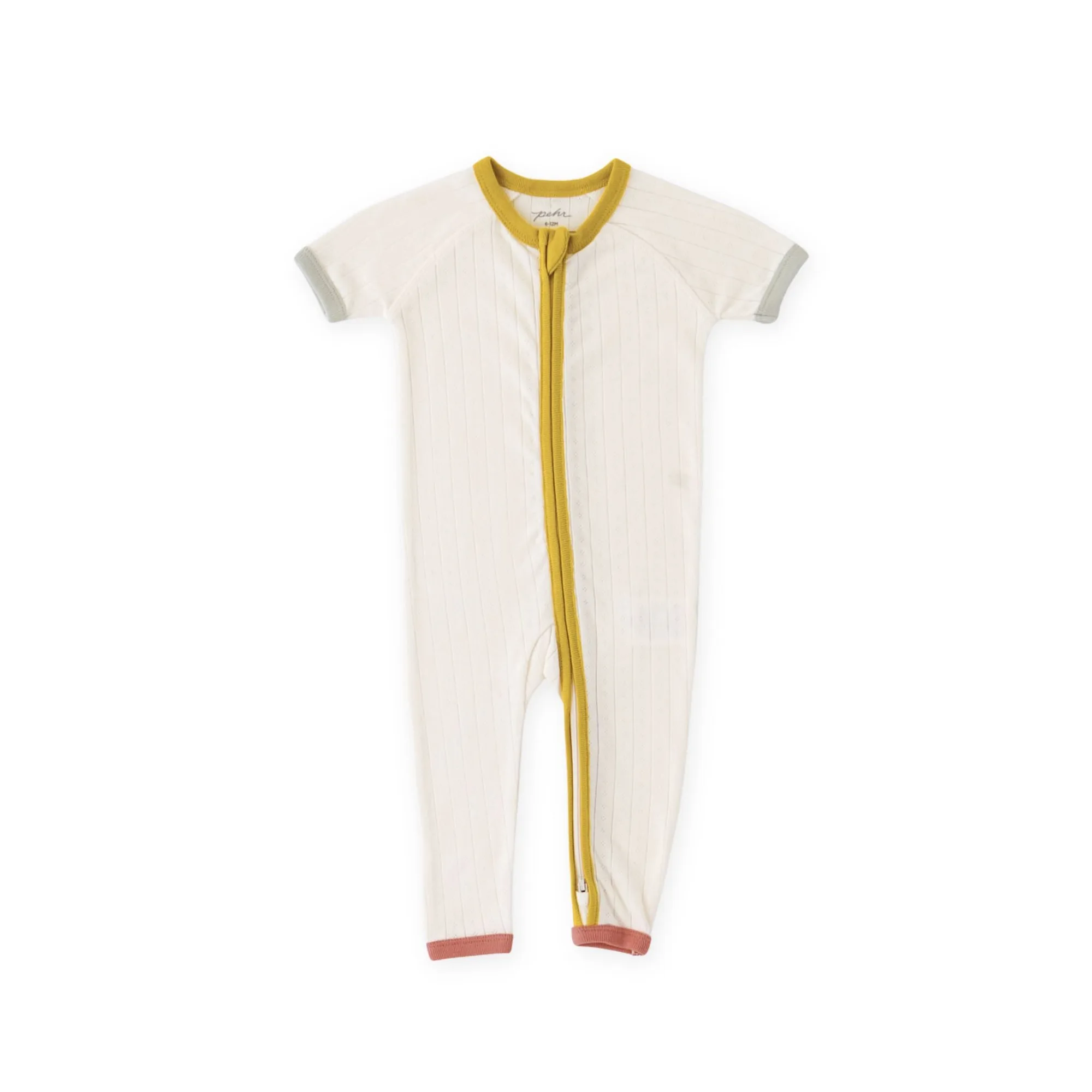
The lightest base layer in the Pehr lineup is the Pointelle Short Sleeve Sleeper - Multi, made from 100% organic cotton in a ribbed pointelle jacquard knit for breathability. It is designed to fit snug for safety and uses a two-way zipper with a protective chin guard, so you can change a diaper without undressing your baby.
That combination — a breathable short-sleeve sleeper plus a 1.0 TOG bag — is the warm-weather pairing. For colder rooms, a long-sleeve cotton sleeper under the same bag adds warmth without changing the bag's TOG. Cotton base layers are the safer default because they breathe; heavy fleece under a warm bag is how babies overheat.
Fit rules that apply to both layers
Sleepwear should be snug. Loose fabric near the face is a suffocation risk, and a bag that is too large can ride up over the chin. Check the neckline: you should not be able to fit more than two fingers between the fabric and your baby's chest.
Sleep bags are sized by age or weight, and Pehr's 1.0 TOG bag includes underarm snaps on sizes 0–9 months so the armholes stay snug as your baby grows. A side-to-bottom zipper keeps diaper changes quick without fully unzipping the bag in a cold room. If your baby is between sizes in the bag, size down rather than up.
What to do when your baby runs hot or cold
If your baby wakes sweaty or with a damp neck, remove warmth from the base layer first — that is the cheapest fix. Drop to a short-sleeve sleeper or a lighter fabric before you buy a new bag. If your baby wakes cold with cool hands and a cool chest, the base layer is the place to add, not the bag, unless your room is well below the bag's rated range.
Hands and feet are unreliable temperature signals in babies, so check the chest or the back of the neck instead. A sleep bag cannot be used in a crib with a loose blanket on top, so the bag plus pajamas is the whole system.
Trade-offs to weigh before you buy
- Warm-weather pairing: A short-sleeve pointelle sleeper under a 1.0 TOG bag is breathable and quick to change, but it only covers rooms around 75–81°F (24–27°C). Best for summer nurseries and warm-climate homes.
- Cold-weather pairing: A long-sleeve cotton sleeper under a higher-TOG bag adds warmth, but you now own two bag weights and have to store the off-season one. Buy the second bag only after you have measured your winter room temperature.
- Fit versus longevity: Snug sleepwear is safer but outgrown faster, and sleep bags sized by age need the underarm snaps on 0–9 month sizes to stay snug as your baby grows. Size down rather than up when your baby is between sizes.
Two pieces that pair well
- 1.0 TOG Sleep Bag - Floret: 1.0 TOG Sleep Bag - Floret is made from two layers of GOTS certified organic muslin cotton and designed for room temperatures of 75–81°F (24–27°C). It is the warm-weather outer layer, so it pairs with a light base layer rather than a heavy one.
- Pointelle Short Sleeve Sleeper - Multi: Pointelle Short Sleeve Sleeper - Multi is 100% organic cotton in a ribbed pointelle jacquard knit, designed to fit snug with a two-way zipper and protective chin guard. It works as the breathable base layer under a 1.0 TOG bag in warm rooms and keeps diaper changes fast.
Which setup fits your baby
Best for
- Babies in rooms around 75–81°F (24–27°C) who need a light base layer plus a 1.0 TOG bag
- Parents who want fast diaper changes without unzipping the whole bag
- Families who prefer a two-piece system they can adjust one layer at a time
Not for
- Cold rooms well below a bag's rated temperature range, where a higher-TOG bag is the better starting point
- Babies who need a swaddle rather than a sleep bag
- Anyone looking for a single-piece sleep solution with no separate base layer