Start with the issue, not the rules
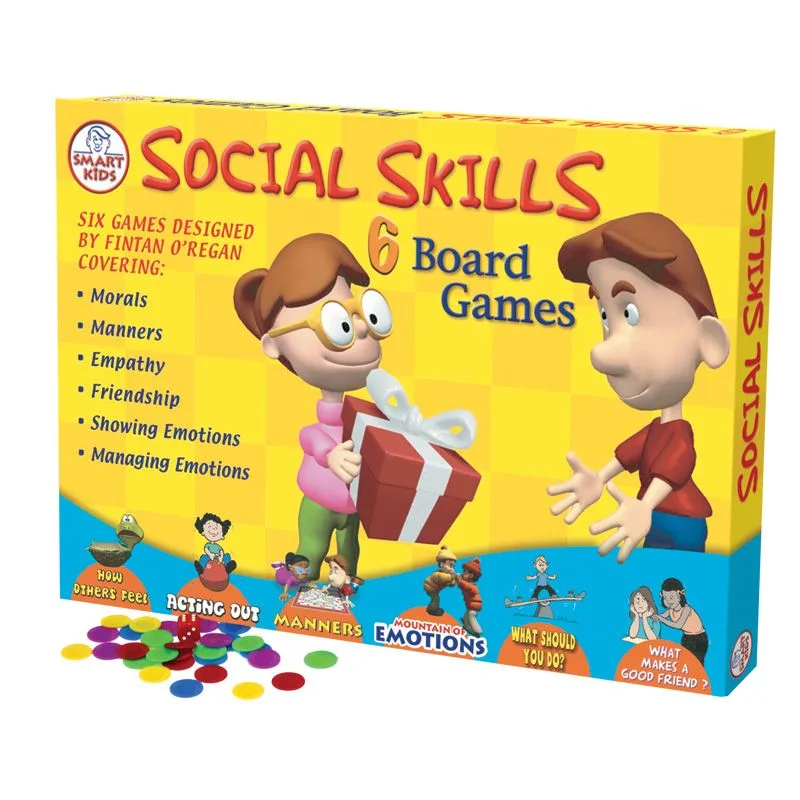
The Social Skills Board Games set works best when you choose the social issue first and let the game board carry the conversation. The set contains six separate games, each aimed at an issue children often struggle with: morals, manners, empathy, friendship, showing emotions, and managing emotions. For a small counseling group, that means you can match the board to what the group is already working on instead of playing through all six in a fixed order.
Because each game asks players to discuss solutions to socially challenging situations, the counselor's job is to keep the talk moving rather than to score answers. The catalog is explicit that there are no right or wrong answers in these six games. Treat that as your planning anchor: the value comes from children explaining their thinking, hearing each other, and agreeing on a best action together.
What the set gives you to work with
-
Social Skills Board Games - Six Board Games: Suitable for ages 6 to 10 years old. Use this as the age band when forming a small counseling group and when judging whether the discussion prompts will land.
Social Skills Board Games - Six Board Games
-
Social Skills Board Games - Six Board Games: The games target morals, manners, empathy, friendship, showing emotions, and managing emotions. These six topics let you pick a board that matches the group's current goal instead of defaulting to the same game each week.
-
Social Skills Board Games - Six Board Games: Contains six game boards, 24 counters, one die, and one spinner. Knowing the components helps you check the box before a session and set out only what the chosen board needs.
Running a small group session with one board
The sequence below follows the play activity described in the catalog: players discuss solutions to socially challenging situations, and the group or the counselor and client decide on the best action together.
- Pick one of the six issues for the session: Choose morals, manners, empathy, friendship, showing emotions, or managing emotions based on what your group is practicing. One board keeps the discussion focused.
- Set out the board with the counters, die, and spinner: The set supplies six game boards, 24 counters, one die, and one spinner. Lay out the pieces for the chosen board so play can start without sorting through the box.
- Open by naming the no-right-answer rule: Tell players up front that the games have no right or wrong answers. This lowers the pressure to guess what the counselor wants to hear and invites honest reasoning.
- Let play prompt the discussion: As players land on situations, ask them to describe what they would do and why. The catalog describes each game as players discussing solutions to socially challenging situations.
- Close by deciding on a best action together: The group, or the client and counselor, decides upon the best action. Summarize the reasoning the group used so the skill carries into the next session.
Keeping the group talking, not just rolling
- Ask for the reason behind an answer: Follow a short answer with a question about why that choice made sense to the child. The game is built around discussion, so reasoning matters more than speed.
- Invite a second viewpoint: Ask another player whether they would choose the same action. The catalog notes that the games encourage all players to communicate, listen, and participate.
- Use the counselor role to model listening: When you restate a child's idea before adding your own, you show the listening behavior the games are meant to practice.
- Keep the focus on one issue per session: With six separate boards, it is easy to drift. Staying on one issue gives the group room to go deeper on a single social skill.
Matching the six boards to your group's needs
The six topics are not interchangeable, even though the play format is similar. A group working on friendship may need a board that asks them to consider another child's perspective, while a group working on managing emotions may need practice naming what to do when feelings run high. The catalog lists the topics without assigning a recommended order or a difficulty ranking, so use your knowledge of the group to decide which board fits this week.
For a mixed group, you can rotate boards across sessions and return to one that produced a rich discussion. The set's six boards make that rotation practical without buying separate games. If you are planning a term of small group counseling activities, map one board to each week and leave room to repeat the board the group found most useful.
Group format and setting
- Social Skills Board Games - Six Board Games: Ideal for use in small groups, these games will encourage your clients and students to work together as they learn to improve their social skills. This confirms the set is designed for the small-group counseling format rather than whole-class use.
- Social Skills Board Games - Six Board Games: Together the group (or client and counselor) decides upon the best action. The decision step can be run as a group consensus or as a one-to-one conversation, which helps when a group session becomes a individual check-in.
What to confirm before your first session
The catalog does not supply preparation steps, a recommended session length, or a suggested number of players beyond describing the set as ideal for small groups. Plan your own timing based on how your group typically talks, and check the box against the listed components before the session: six game boards, 24 counters, one die, and one spinner.
The catalog also does not list certifications or additional safety warnings beyond the age range of 6 to 10 years old. If your setting requires specific compliance documentation, confirm that with the supplier rather than assuming it from the product page. For most counseling groups within that age band, the set gives you a structured way to practice social skills through play without turning the conversation into a quiz.