Quick answer
Place a foam balance beam on a flat, clear, carpeted or matted floor and introduce it during calm, supervised play. Start with your toddler stepping on and off while holding your hand, then lengthen the walking distance only as their confidence grows.
Why a foam beam suits toddler balance work
A foam balance beam gives toddlers a low, soft edge to practice weight shifting and foot placement without the hard fall zone of a wooden beam. That lower consequence is the main safety advantage, but it does not replace supervision or a clear play area.
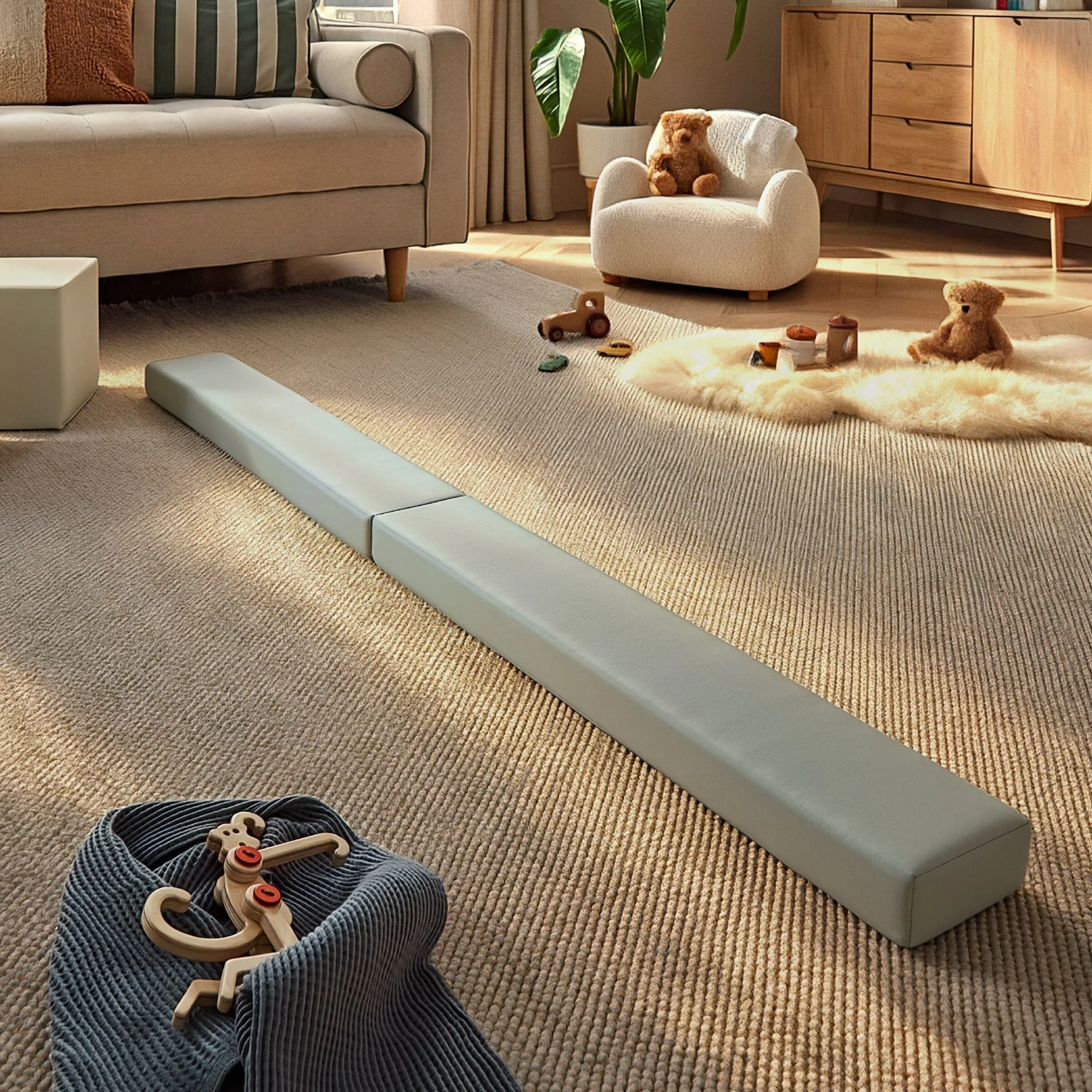
The CuddleCo Soft Play Balance Beam in Sea Salt is designed for children from 24 months onwards. That age guidance matters: younger toddlers may not yet have the coordination to step onto a narrow surface, so wait until your child is steady on their feet and can follow a simple instruction like stop or wait.
Where a foam beam works best, and where it does not
Foam beams are best on firm, level flooring with a rug or play mat underneath. Avoid thick, squishy carpet that lets the beam rock, and avoid polished hard floors where the foam can slide. If your only space is slick flooring, use a non-slip mat under the beam rather than relying on the foam alone.
These beams are not climbing frames or trampolines. They are not designed for jumping from height, rough play with siblings, or use as a bridge between furniture. Keep the beam away from stairs, sharp corners, and hard fireplace edges.
How to set up and introduce the beam, step by step
- Clear and check the play zone: Choose a flat, level area at least a step's length beyond both ends of the beam. Remove toys, cables, and furniture with sharp edges. Lay a rug or play mat under the beam if the floor is hard. Common mistake: placing the beam on a soft rug that bunches or slides. Press the mat flat and test it with your hand before your toddler steps on.
- Position the beam and test stability: Set the beam down so it sits flat with no rocking. Press along its length with your hand and check that it does not slide or tip. Keep one end near a wall or sofa only if your toddler can pass safely without grabbing unstable objects. Checkpoint: if the beam rocks or slides on your floor, move it to a different surface before use.
- Introduce the beam with hand-holding: Start with your toddler standing beside the beam, not on it. Let them touch the foam, step one foot on, and step back off. Hold their hand as they walk the full length once, moving at their pace. Common mistake: encouraging speed or a 'performance' walk. Slow, deliberate steps build more control than fast ones.
- Build short balance beam play ideas: Once your toddler is comfortable, try simple games: walk to the end and step off to a cushion, carry a soft toy while walking, or stop halfway when you say freeze. Keep each turn short, and let your child ask for more. Checkpoint: stop the game if your toddler starts rushing, jumping, or looking away from the beam.
- Store the beam safely between sessions: Lift the beam rather than dragging it across the floor. Store it flat or upright against a wall where it cannot fall on a child, and keep it out of reach if your toddler likes to use it unsupervised. Common mistake: leaving the beam in the middle of the room as a permanent obstacle. Put it away after each session so the play area stays clear.
Product facts
-
Soft Play Balance Beam - Sea Salt: Suitable for children aged 24 months onwards and designed to encourage coordination, control and creative play. Use the age guidance as a starting checkpoint, and match each session to your child's current steadiness rather than pushing ahead.
Soft Play Balance Beam - Sea Salt