Quick answer
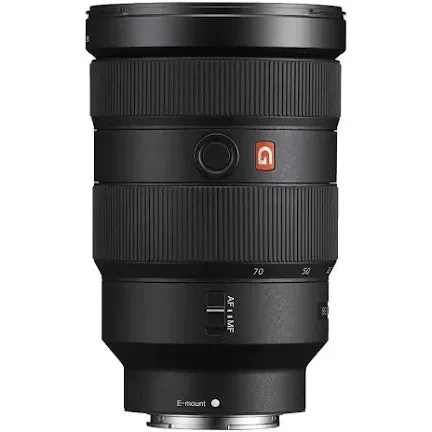
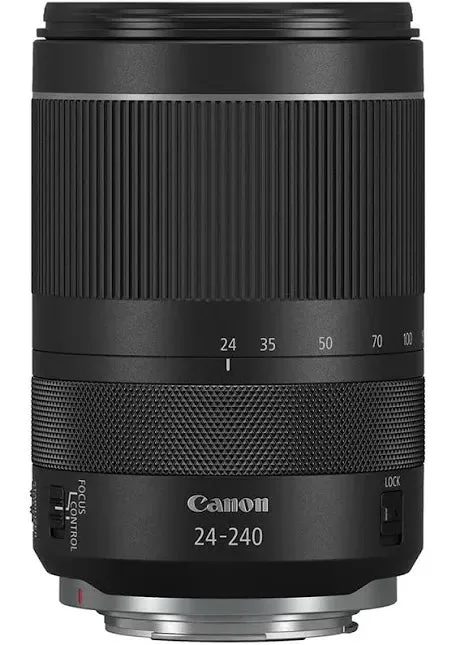
Choose the Sony FE 24-70mm f/2.8 GM if you shoot on Sony E-mount and need a fast, constant f/2.8 standard zoom for low light, subject separation, and event work. Choose the Canon RF 24-240mm f/4-6.3 IS USM if you shoot on Canon RF-mount and want one 10x all-round lens that covers wide-angle to super-telephoto with optical stabilisation. The mounts are not interchangeable, so your camera body decides first.
Mount first, lens second
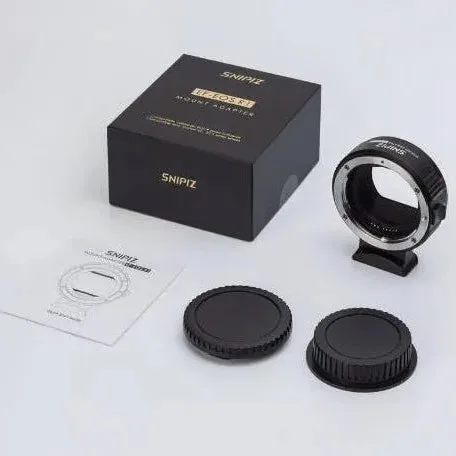
These two lenses do not fit the same cameras. The Sony FE 24-70mm f/2.8 GM is an E-mount full-frame lens, while the Canon RF 24-240mm f/4-6.3 IS USM is an RF-mount full-frame lens. Before comparing anything else, confirm your body: Sony E-mount cameras take the Sony; Canon EOS R-series cameras take the Canon. If you already own Canon EF glass and are moving to an RF body, the SNIPIZ EF-EOS R1 adaptor is a practical bridge for EF lenses rather than a way to mount the Sony lens.
Aperture and light: f/2.8 vs f/4-6.3
The Sony FE 24-70mm f/2.8 GM holds a constant f/2.8 across its zoom range, with an aperture range of f/2.8 to f/22. That constant maximum aperture lets in more light at every focal length, which helps in dim venues and gives you more control over background blur. The Canon RF 24-240mm f/4-6.3 IS USM starts at f/4 at the wide end and narrows as you zoom, so at the long end you are working with a much smaller maximum aperture. In low light, the Sony will generally let you use faster shutter speeds or lower ISO for the same framing, while the Canon asks you to add light, stabilise, or accept higher ISO.
Zoom range and what each lens is built to do
The Canon RF 24-240mm covers a 10x zoom range, taking you from wide-angle to super-telephoto in one barrel. That makes it a true all-in-one lens for travel, family events, and days when you do not want to change lenses. The Sony FE 24-70mm stays within a standard zoom range, trading reach for speed and optical consistency. If your priority is capturing a distant subject without swapping glass, the Canon's reach is the deciding feature. If your priority is a faster, more specialised standard zoom, the Sony is the more targeted tool.
Stabilisation and handheld shooting
The Canon RF 24-240mm includes an Optical Image Stabiliser that compensates for up to five stops of camera shake, and its Dynamic IS mode is designed to help with video by compensating for movement while walking. The Sony FE 24-70mm f/2.8 GM does not list optical stabilisation in the supplied specifications, so handheld steadiness depends on your body's in-body stabilisation or on your technique. If you often shoot handheld at slower shutter speeds or record walking video, the Canon's stabilisation is a real advantage. If your Sony body has in-body stabilisation, the gap narrows for stills.
Optical construction and filter size
The Sony FE 24-70mm f/2.8 GM uses one XA element, two aspherical elements, one ED element, and one Super ED element, and takes 82mm front filters. That combination of special elements is aimed at controlling distortion and chromatic aberration while maintaining sharpness across the frame. The Canon RF 24-240mm's supplied specifications do not list its element count or filter size, so if filter compatibility matters to you, check the lens directly before buying. For the Sony, budget for 82mm filters, which are larger and often more expensive than common 67mm or 72mm sizes.
Pre-owned and adapted options
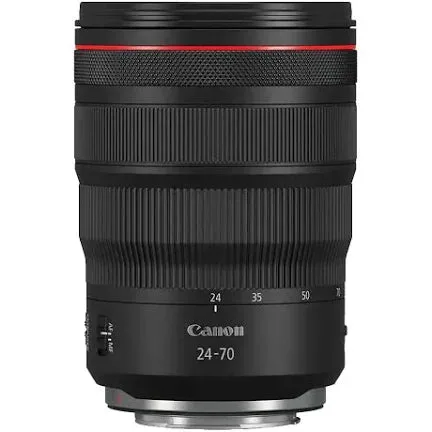
If budget is tight, a pre-owned Canon RF 24-70mm f/2.8L IS USM is another RF-mount route: it offers a constant f/2.8 aperture, three aspherical elements, and three ultra-low dispersion elements, but it does not have the 24-240mm's 10x reach. For Canon EF shooters moving to RF, the SNIPIZ EF-EOS R1 adaptor supports auto focus and lists compatibility with EOS R, R5, R6, RP, R8, R50, R10, R7, R100, R6 II, R6 III, and R5 II bodies. An adaptor adds a step and can affect balance, but it lets you keep using EF lenses you already own.
Decision rules
- If you shoot Sony E-mount: The Sony FE 24-70mm f/2.8 GM is the direct fit. Its constant f/2.8 aperture and 82mm filter thread suit low-light and event work. Buy the Sony only if your body is E-mount; there is no adaptor in this comparison that mounts it on RF.
- If you shoot Canon RF-mount and want one lens: The Canon RF 24-240mm f/4-6.3 IS USM gives you 10x reach and up to five stops of optical stabilisation in a single barrel. Choose it when convenience and reach matter more than a fast constant aperture.
- If you shoot Canon RF-mount and need f/2.8: Consider the pre-owned Canon RF 24-70mm f/2.8L IS USM. It keeps a constant f/2.8 but gives up the 24-240mm's reach. Inspect pre-owned glass for haze, fungus, and focus accuracy before buying.
- If you own Canon EF lenses: The SNIPIZ EF-EOS R1 adaptor adds auto focus and lists broad EOS R-series compatibility, so you can keep using EF glass on an RF body. Adapting is a bridge, not a substitute for a native RF lens when autofocus speed is critical.
Product facts
- Canon RF 24-240mm F4-6.3 IS USM Mirrorless Camera Lens: Canon RF 24-240mm f/4-6.3 IS USM: 10x zoom range, Optical Image Stabiliser compensating up to five stops, and Dynamic IS for video. One lens covers wide-angle to super-telephoto and helps handheld stills and walking video, which suits travel and all-day carry.
- Sony FE 24-70mm f/2.8 GM Lens (E Mount): Sony FE 24-70mm f/2.8 GM: E-mount full-frame, f/2.8 to f/22, one XA element, two aspherical elements, one ED element, one Super ED element, 82mm front filter. Constant f/2.8 and special elements support low-light work and consistent sharpness, while 82mm filters are a real accessory cost.
- Canon RF 24-70mm f/2.8L IS USM Lens pre- owned: Canon RF 24-70mm f/2.8L IS USM pre-owned: RF-mount full-frame, f/2.8 to f/22, three aspherical elements and three ultra-low dispersion elements. A constant f/2.8 RF-mount alternative if you want speed but not the 24-240mm's reach; pre-owned status means condition matters.
- SNIPIZ EF-EOS R1 Camera Lens Mount Adaptor: SNIPIZ EF-EOS R1 adaptor: Canon EF to RF, auto focus, compatible with EOS R, R5, R6, RP, R8, R50, R10, R7, R100, R6 II, R6 III, and R5 II. Lets Canon EF lenses work on RF bodies, so you can delay replacing existing glass when moving to mirrorless.
Who should buy which
Best for
- Sony E-mount shooters who need a fast f/2.8 standard zoom for low light and events
- Canon RF-mount shooters who want one 10x all-round lens with stabilisation for travel and family use
Not for
- Canon RF-mount shooters who need a constant f/2.8 aperture should look at the pre-owned Canon RF 24-70mm f/2.8L IS USM instead
- Sony E-mount shooters who need super-telephoto reach should not expect the 24-70mm to cover distant subjects