Quick answer
Choose a sound puzzle when you want cause-and-effect learning and auditory feedback to hold a toddler's attention. Choose a standard wooden puzzle when you want quiet, open-ended problem solving that travels easily and grows with your child. Many families use both: a sound puzzle for guided play and a standard puzzle for independent practice.
How sound changes the way a toddler solves a puzzle
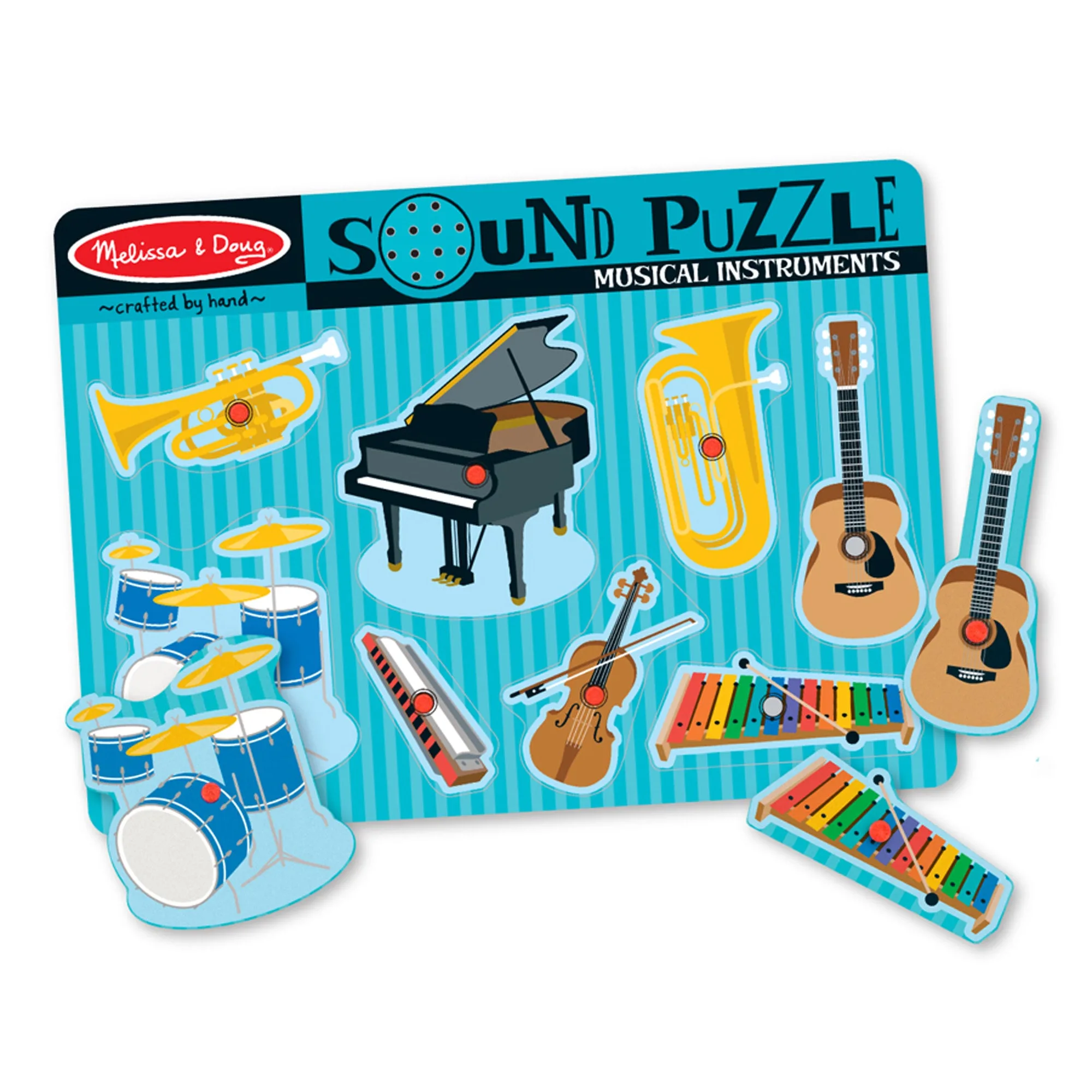
A standard wooden puzzle asks a child to match a shape to a space. The reward is visual and physical: the piece drops in, the picture completes. A sound puzzle adds a second layer. On the Musical Instruments Sound Puzzle, each correctly placed piece triggers the instrument's sound, so the child learns that a specific action produces a specific result. That cause-and-effect loop is a core early-learning skill, and it often keeps a toddler engaged longer than a silent puzzle.
The trade-off is that sound puzzles depend on a light-activated sensor. In a dim room, the sensor may not trigger reliably. Standard puzzles have no such requirement, which makes them the easier choice for bedtime, car rides, or any low-light setting.
What each type asks of your child
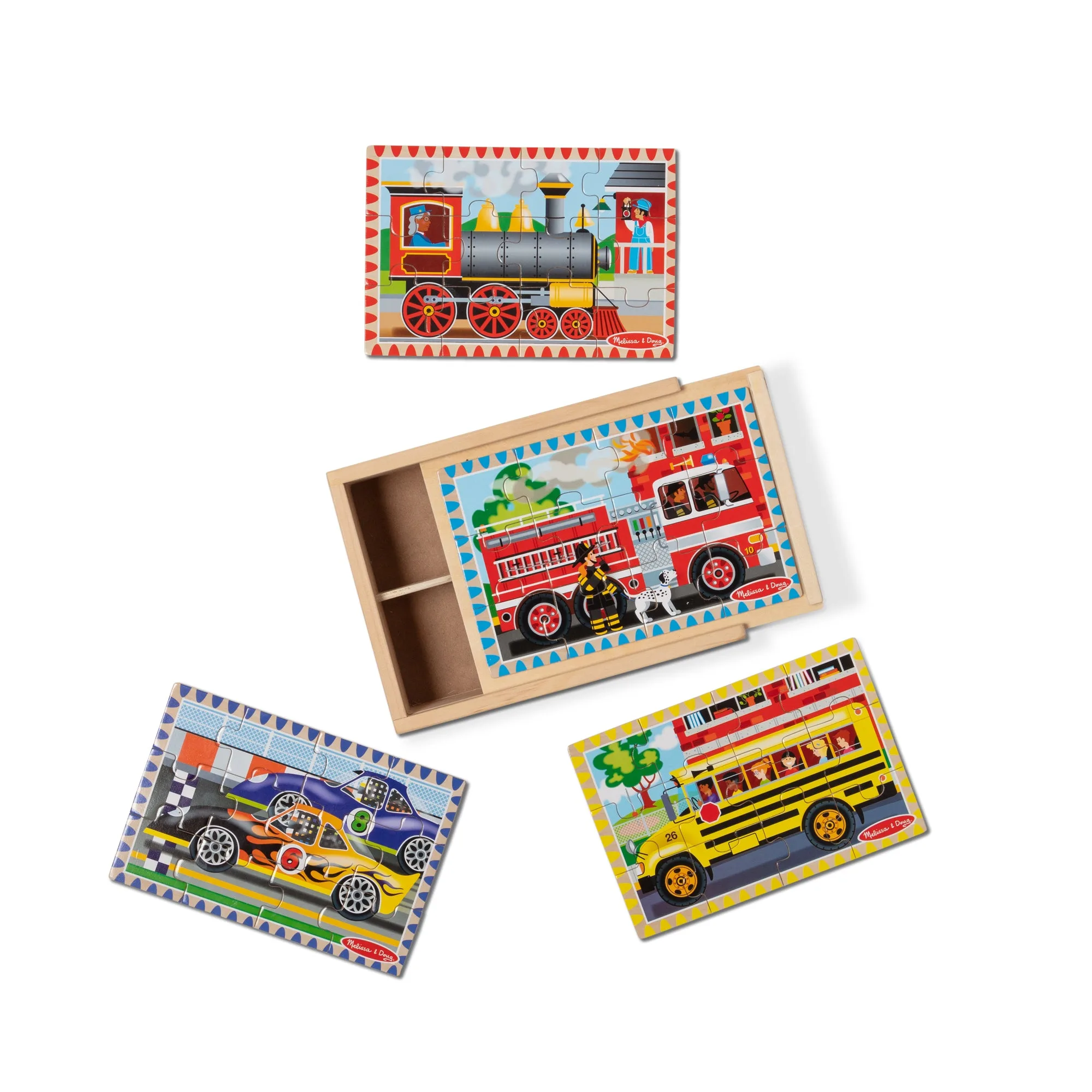
Standard puzzles build spatial reasoning and patience. A 12-piece jigsaw like the Wooden Jigsaw Puzzles in a Box - Vehicles asks a child to sort by shape, rotate pieces, and work through a sequence without external prompts. That is quiet, self-directed problem solving.
Sound puzzles build attention and auditory discrimination. Your child has to listen, connect a sound to an instrument, and repeat the action. For toddlers who need feedback to stay with a task, that immediate response can be the difference between two minutes and ten minutes of focused play.
Portability, cleanup, and storage
Standard wooden puzzles are generally the more travel-friendly option. The Wooden Jigsaw Puzzles in a Box - Vehicles stores each 12-piece puzzle in its own compartment, and the slide-on lid doubles as a puzzle board. Nothing needs batteries, and there is no sensor to protect.
Sound puzzles are usually board-style with chunky pieces, which makes them easy to set up at a table but less convenient to pack. They also need a reasonably bright space to work as intended. If you plan to puzzle on the go, standard wooden puzzles are the simpler pick.
How to choose based on your child's age and temperament
For a child around 18 months to 3 years who is still learning to attend to a task, a sound puzzle can be the better entry point because the audio feedback does the encouraging. For a child who already sits and works through a puzzle independently, a standard puzzle offers more challenge and less repetition.
If you are unsure, start with one of each. Use the sound puzzle during supervised play and keep the standard puzzle available for quiet time. That combination covers both auditory and spatial learning without overloading your toy shelf.
Trade-offs at a glance
- Feedback and attention: Sound puzzles give immediate audio feedback that can hold a toddler's attention longer, but the sensor needs a bright room to work reliably. Best for guided play in a well-lit space.
- Independent problem solving: Standard wooden puzzles ask for shape sorting, rotation, and sequencing without prompts, which builds patience and spatial reasoning. Best for quiet, self-directed play and travel.
- Setup and storage: Sound puzzles are usually table-bound and may need batteries; standard puzzles like the Vehicles set store in a self-contained wooden box with a lid that doubles as a board. Standard puzzles win on portability and low maintenance.
Product facts that matter for this comparison
- Musical Instruments Sound Puzzle - 8 Pieces: Place an instrument piece correctly in the puzzle board and listen to it play; light-activated sensors require a brightly lit room for best results. This is the clearest example of auditory feedback in a puzzle, but the light requirement means it is not a good fit for dim rooms or bedtime play.
- Wooden Jigsaw Puzzles in a Box - Vehicles: Set includes four wooden, 12-piece vehicle jigsaw puzzles, each stored in a separate compartment of a sturdy wooden box; the slide-on lid doubles as a puzzle board and pieces are shape-coded on the back. This is the standard-puzzle alternative: no batteries, no sensors, and the self-contained box makes it easy to store and travel with.
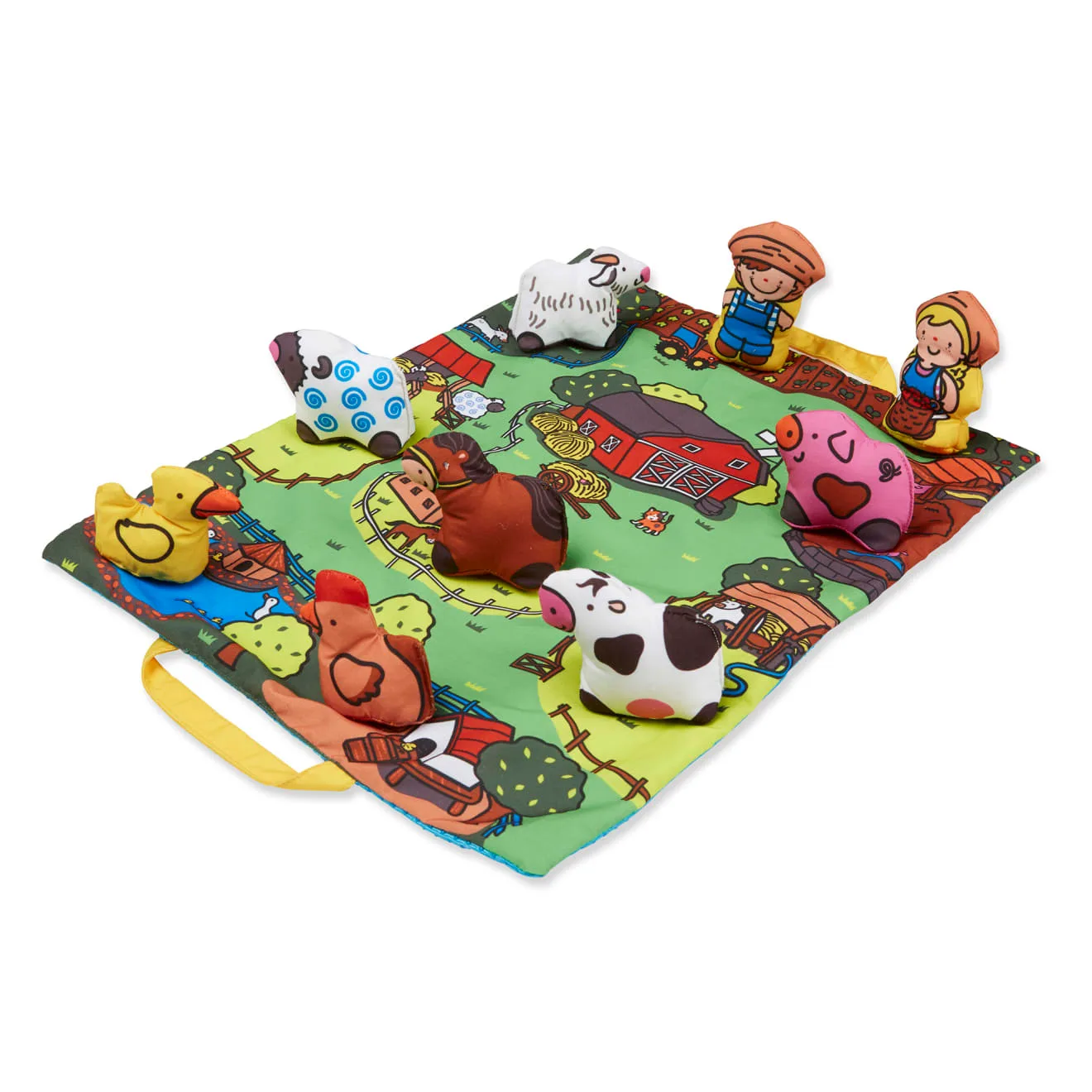
- K’s Kids Take-Along Farm Play Mat: The play mat features a non-skid backing, nine soft fabric animals and farmer figures that crinkle, rattle, or squeak, and it folds into a storage bag for travel. For families who want sound and texture without a puzzle board, this is a portable sensory option that supports auditory and tactile exploration.
Which puzzle fits your child?
Choose a sound puzzle if
- Your toddler needs immediate feedback to stay engaged with a task.
- You want to introduce cause-and-effect and auditory discrimination during supervised play.
- You usually puzzle in a bright, well-lit room.
Choose a standard wooden puzzle instead if
- You need a quiet, screen-free activity for bedtime, car rides, or dim spaces.
- Your child already works through puzzles independently and needs more challenge.
- You want a toy that travels easily and never needs batteries.