Quick answer
Sponge media is best for mechanical filtration and biological colonization, while carbon media targets chemical impurities like odors and discoloration. For most internal filters, a combination of both gives the most balanced water quality.
Mechanical vs chemical filtration: the core difference
Sponge media, like the coarse and fine synthetic sponges found in the BLUMODULAR SPONGE pack, physically trap particles such as uneaten food, fish waste, and plant debris. This mechanical cleaning keeps the water clear and prevents debris from breaking down into harmful compounds.
Carbon media, on the other hand, works through adsorption. The activated carbon in the BLUMODULAR SPONGE pack pulls dissolved organic compounds, tannins, medications, and odors from the water. It does not remove solid particles effectively on its own.
When carbon makes sense and when it doesn't
Activated carbon is excellent after treating a disease (to remove medication residues) or when you want crystal-clear, odor-free water. However, carbon becomes saturated relatively quickly—typically within 3 to 4 weeks—and stops working. It then needs replacement, not rinsing.
Carbon also removes some beneficial trace elements and plant fertilizers, so planted tank enthusiasts often prefer to run carbon only intermittently or skip it entirely.
Sponge's dual role in biological filtration
Coarse and fine sponge media provide a large surface area where beneficial bacteria can colonize. These bacteria convert toxic ammonia and nitrite into less harmful nitrate. Unlike carbon, sponge media can be rinsed in dechlorinated water and reused many times, making it more economical for long-term biological stability.
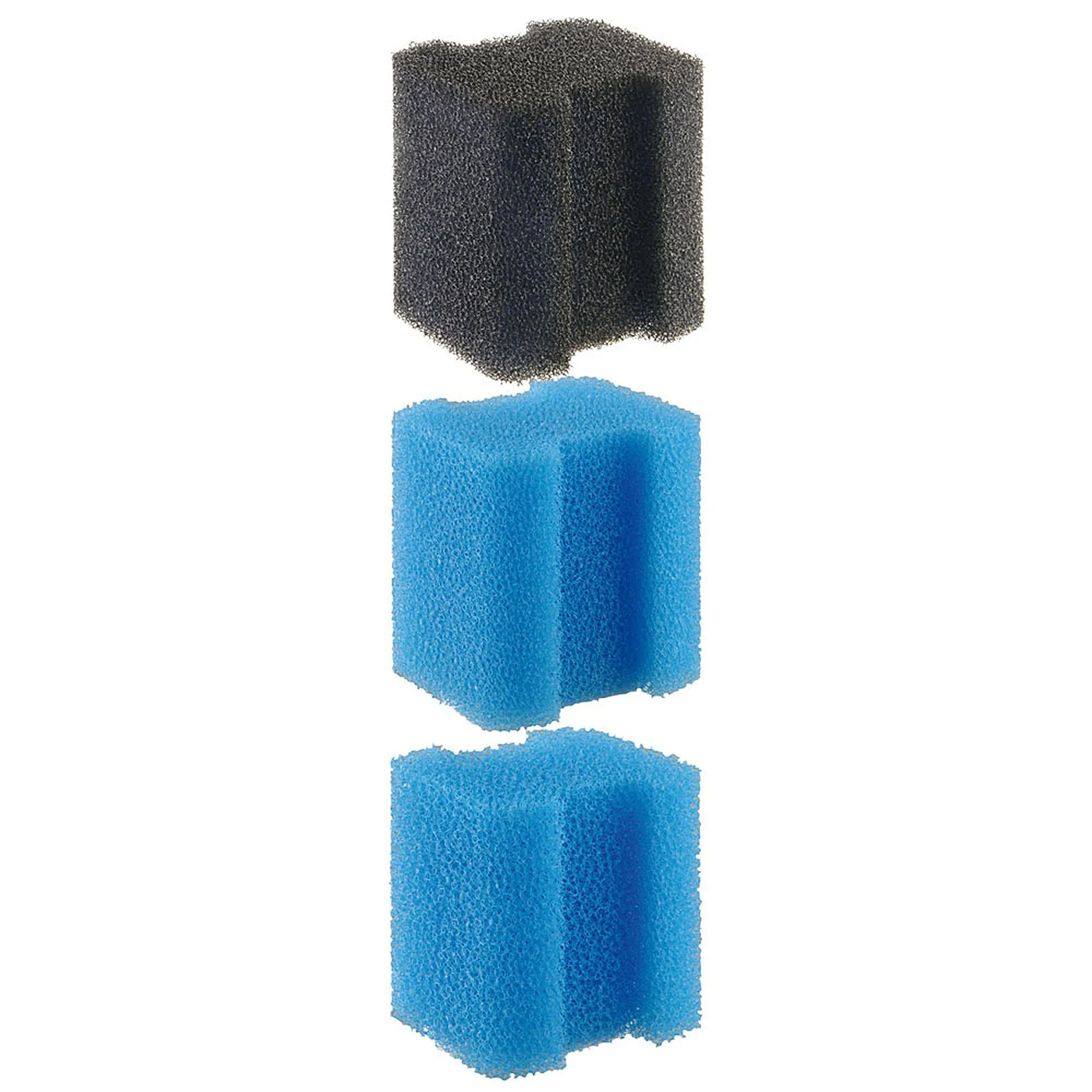
The BLUMODULAR SPONGE pack includes three different densities, allowing you to layer coarse, fine, and carbon sponges for progressive filtration.
Trade-offs at a glance
- Sponge (coarse & fine): Traps solid waste, provides surface for beneficial bacteria, reusable after rinsing. Does not remove dissolved chemicals or odors. Replace only when it starts to fall apart; rinse monthly in tank water.
- Activated carbon sponge: Adsorbs dissolved organics, medications, and odors. Becomes saturated in 3–4 weeks and must be replaced, not rinsed. Use carbon after medication or for short-term clarity; skip it for planted tanks.
- Combined approach: Layer coarse sponge first, then fine sponge, then carbon (if needed). This catches debris early and polishes the water chemically. Replace carbon monthly; rinse sponges as needed.
Product facts
-
BLUMODULAR SPONGE: The BLUMODULAR SPONGE pack contains one active carbon sponge, one synthetic fine sponge, and one synthetic coarse sponge. You get both mechanical and chemical media in one set, making it easy to set up a multi-stage internal filter without buying separate products.
BLUMODULAR SPONGE
Which media should you choose?
Best for
- General freshwater community tanks that need clear water and stable biological filtration
- Aquarists who want a low-maintenance, reusable mechanical media
Not ideal for
- Planted aquariums where carbon may strip fertilizers and trace elements
- Short-term medication removal where dedicated carbon-only media is more efficient