Why dogs eat poop, and what a soft chew can and cannot do
If your dog eats stool, the first useful step is not buying a chew. It is separating the habit from the cause. The supplied information for VetClassics Stop Stool Eating Soft Chews describes the product as helping deter dogs from consuming their own stool or other dogs' stool, and it is veterinarian formulated and recommended for dogs over 12 weeks of age. That is a behavior-deterrent role, not a diagnosis.
The label does not explain why any individual dog eats feces, and it does not provide a corrective procedure. Those questions belong to your veterinarian, especially if the habit is new, sudden, or accompanied by any change in your dog's condition. A soft chew can fit a plan; it cannot replace the check that tells you what the plan should be.
What the VetClassics label actually confirms
-
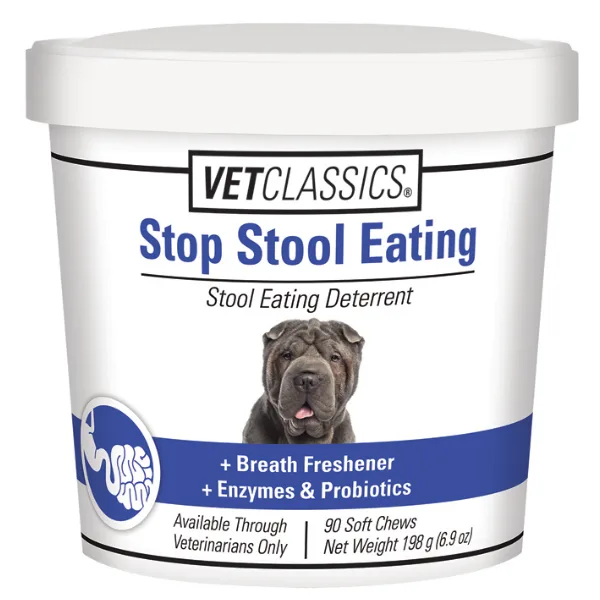
VetClassics Stop Stool Eating Soft Chews for Dogs: Veterinarian formulated and recommended for use in dogs over the age of 12 weeks. Age is the first compatibility check before you consider this product for a puppy or adult dog.
VetClassics Stop Stool Eating Soft Chews for Dogs
-
VetClassics Stop Stool Eating Soft Chews for Dogs: Helps deter dogs from consuming their own stool or other dogs' stool if they are also given VET CLASSICS Stop Stool Eating Soft Chews. The label frames this as a deterrent for stool eating, not a treatment for an underlying cause.
-
VetClassics Stop Stool Eating Soft Chews for Dogs: Available in a 90-count size. The count, combined with the weight-based daily amount, determines how long one container lasts.
Dose by weight, not by habit severity
The label gives a simple weight table, and it is the only dosing guidance supplied: up to 40 lbs. gets 1 soft chew daily, 41 to 80 lbs. gets 2 soft chews daily, and dogs over 80 lbs. get 4 soft chews daily. There is no supplied instruction to increase the amount because your dog eats more stool, and no supplied schedule for tapering off. Follow the table as written and let your veterinarian decide anything beyond it.
The label also says the deterrent effect applies when dogs are given the chews, so consistency matters more than a single dose. If you are deciding whether the 90-count container fits your routine, do the arithmetic from your dog's weight band rather than from the size of the tub.
Where the product fits, and where your vet comes in
- What the chews address: The label positions them as a deterrent to eating own or other dogs' stool, with breath freshener, enzymes, and probiotics in the formula.
- What the chews do not address: The supplied information does not identify causes of stool eating or provide a behavior-modification procedure. Those are veterinary and training questions.
- When to stop and call your vet: The label states that if the animal's condition worsens or does not improve, stop product administration and consult your veterinarian.
- Household safety: The label warns that safe use in pregnant animals or animals intended for breeding has not been proven, that the product is not for human consumption, and that the package should not be left unattended around pets because of its tasty nature.
The questions a chew cannot answer
Why dogs eat feces is a question with many possible answers, and the supplied product information does not rank or rule out any of them. It also does not supply a cleaning protocol for yards or a training sequence for preventing access to stool. If those are the parts of the problem you need to solve, treat the chew as one supporting piece and get the rest of the plan from your veterinarian.
The honest tradeoff is this: a deterrent chew is easy to add to a daily routine, but it works alongside management and veterinary advice rather than instead of them. If the habit continues despite consistent use, the label's own instruction is to stop and consult your veterinarian rather than to keep escalating the dose.