Quick answer
Choose a stroller toy that attaches securely without long straps, matches your baby's current sensory stage, and stays interesting for more than one outing. For most families, a soft, multi-texture toy like the Taggy Ball with Rattle works well from early infancy, while a quilted playmat is better for stationary play at home. Always test the attachment point before you leave the house.
Why stroller toys are different from other baby toys
A stroller toy has one job that a floor toy does not: it must stay put while the stroller moves, turns, and bumps over sidewalks. That means the attachment method matters as much as the toy itself. A toy that clips on with a short loop or a built-in tag is far less likely to end up on the pavement than one balanced on the canopy.
Stroller toys also need to work in short bursts. Your baby may engage for five minutes, then want to look at the world. The best options offer a quick sensory hit, such as a rattle sound or a high-contrast pattern, without requiring a full play session. This is why small, multi-sensory toys tend to outperform large, single-purpose ones on the go.
How to evaluate stroller toy attachment
Start by checking what your stroller actually offers. Some have dedicated toy loops, some have a bar across the canopy, and some have nothing at all. If your stroller lacks a loop, you will need a toy with a long enough tag or a separate clip, but be cautious: any strap longer than about seven inches can become a strangulation risk. The safest attachment is a short, fixed loop that cannot be undone by a baby's hands.
Next, test the attachment with a gentle tug before every outing. A toy that rotates freely is fine, but it should not slide along the bar or detach with light pressure. If the toy uses a plastic ring, check that the ring is not cracked and that the fabric loop is securely stitched. For toys with multiple tags, like the Taggy Ball, you can loop one tag through a stroller loop and let the others hang free for grabbing.
Matching the toy to your baby's stage
Newborns and young infants (0–4 months) are still developing their visual system. High-contrast black-and-white or bold patterns are easier for them to see than pastel colors. At this stage, a toy that is mostly about looking and listening is ideal. A soft ball with a gentle rattle, such as the Taggy Ball with Rattle - Woodland, gives them something to track with their eyes and a soft sound to turn toward.
Babies around 4–7 months start reaching and grasping. They need toys they can hold, tug, and bring to their mouth. Tags and fabric loops become especially interesting because they offer different textures and resistance. The Taggy Ball with Rattle - Wild has a patchwork of organic fabrics and multiple tags, which supports this grasping phase without being too heavy for small hands.
Once babies can sit up and actively play (7 months+), they may want more than a stroller toy can offer. That is when a playmat or a floor-based activity becomes more useful. A stroller toy still helps during transitions, but do not expect it to replace dedicated floor play.
Materials, cleaning, and safety checks
Stroller toys get dropped, chewed, and dragged. Look for materials that are safe for mouthing and easy to spot-clean. Organic cotton is a common choice because it is soft and gentle on a baby's skin, but it still needs care. Most fabric stroller toys are spot clean only, so keep a damp cloth and mild soap handy rather than tossing them in the washing machine.
Before each use, do a quick safety scan: check seams for loose threads, make sure any rattle insert is fully enclosed, and confirm that no small parts have become detached. If a toy has a wooden dowel or hard element, like the Jungle Alphabet Tapestry, it is not a stroller toy and should be hung out of reach. Stroller toys should be soft and flexible, with no rigid parts that could bump your baby's face.
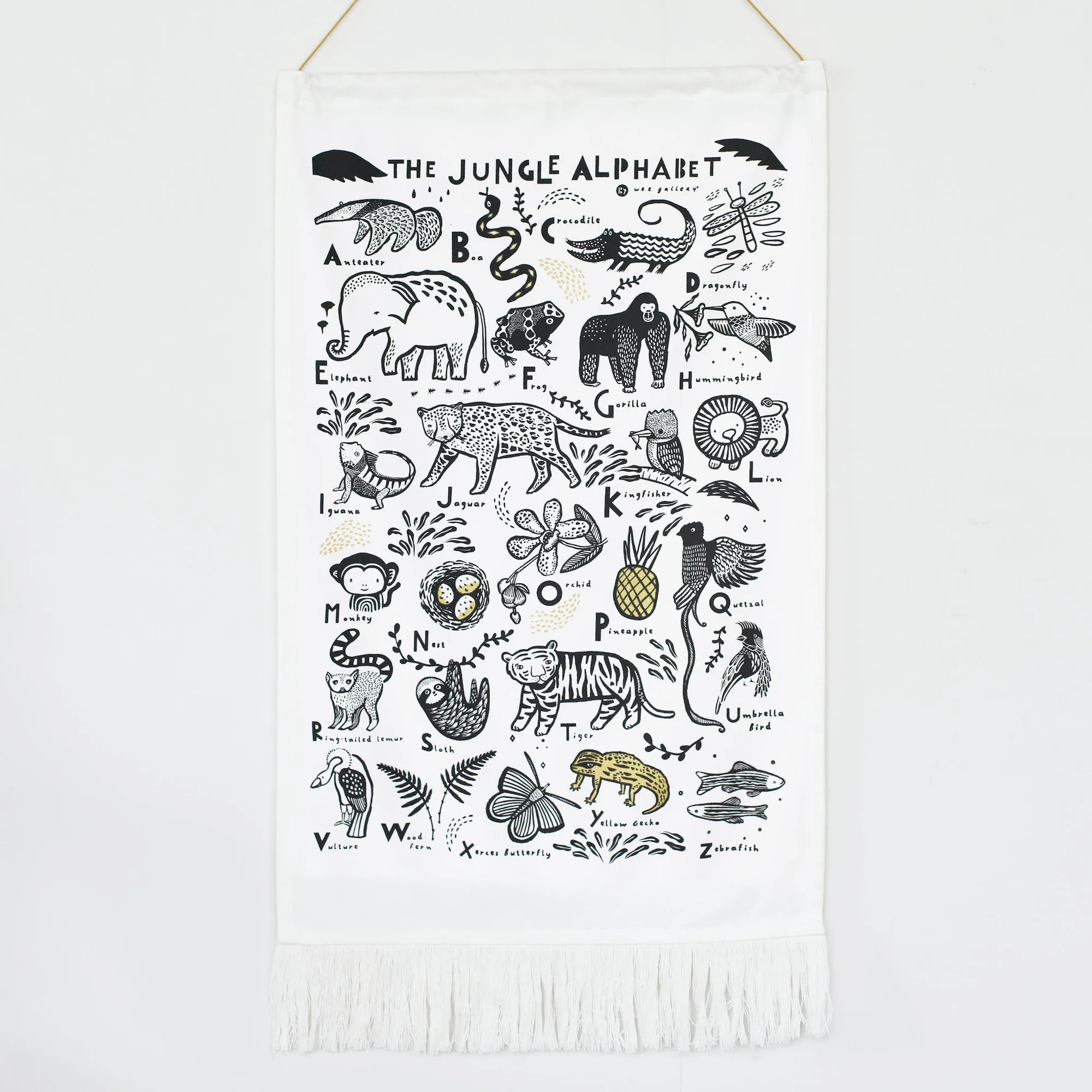
Jungle Alphabet Tapestry
When to rotate and when to retire a stroller toy
Babies habituate quickly. A toy that was fascinating last week may be ignored today. Rotate two or three stroller toys every few days, keeping one familiar favorite and introducing one new option. This keeps novelty high without overwhelming your baby.
Retire a stroller toy when it shows signs of wear: fraying tags, a cracked ring, a muffled rattle, or fabric that has become stiff or pilled. Also retire it when your baby outgrows it. A toy designed for a 3-month-old's visual tracking may not hold a 9-month-old's attention. Passing it down to a younger sibling or storing it for a future baby is fine, as long as it is still in safe condition.
Decision rules for buying stroller toys
- If your stroller has a toy loop: Choose a toy with a short, fixed fabric tag or loop that you can thread through the stroller loop. Avoid long strings or detachable clips that can slide. A Taggy Ball's tags work well here because you can loop one through and leave the rest for grabbing. Test the attachment with a firm tug before every trip.
- If your baby is under 4 months: Prioritize high-contrast patterns and gentle sounds over complex textures. A soft rattle ball with black-and-white or bold graphics supports visual tracking and auditory development without overstimulating. Look for toys labeled for newborns or 0+ months.
- If your baby is mouthing everything: Choose a toy made from organic cotton or other safe, soft fabrics with no loose parts. Check that any rattle is fully enclosed and that tags are securely stitched. Spot clean regularly. Avoid toys with painted details or small detachable pieces.
- If your baby loses interest quickly: Rotate two or three stroller toys every few days. Keep one familiar toy and swap in one new one. This maintains novelty without overwhelming your baby. Store rotated toys out of sight so they feel new again.
- If you need a toy for home, not the stroller: A quilted playmat with a crinkle toy offers more space for rolling and tummy time than a stroller toy. Use the stroller toy for travel and the playmat for floor play. Match the toy to the environment, not just the age.
Stroller-friendly picks from Wee Gallery
- Taggy Ball with Rattle - Woodland: Taggy Ball with Rattle - Woodland is a soft ball made from a patchwork of organic fabrics with an array of little tags and high-contrast woodland animal graphics. The multiple tags give you several attachment points for a stroller loop, and the organic cotton shell is gentle for mouthing babies. The rattle adds sound without being loud enough to startle.
- Taggy Ball with Rattle - Wild: Taggy Ball with Rattle - Wild is a Montessori-inspired soft ball with organic cotton fabric, multiple tags, and high-contrast wild animal graphics. A good alternative if your baby prefers different patterns or you want a second ball for rotation. The tag array supports grasping and tugging, which builds fine motor skills.
- Quilted Playmat - Acorn: Quilted Playmat - Acorn is a generously sized, quilted playmat with high-contrast acorn details and an attached crinkle toy leaf. This is not a stroller toy, but it is a strong choice for tummy time and floor play at home. The crinkle leaf adds tactile and auditory feedback that babies enjoy during stationary play.
Is a stroller toy right for you?
Best for
- Parents who take frequent walks or commute with a baby in a stroller
- Babies who need a safe, engaging distraction during errands or travel
- Caregivers who want a compact, portable sensory toy that attaches securely
Not for
- Babies who are already crawling or walking and need active floor play
- Parents looking for a toy to leave in the crib or bed (stroller toys are not sleep-safe)
- Strollers without any attachment point, unless you add a safe, short tether