Quick answer
To play Subatomic 2nd Edition, you'll build atoms by acquiring protons, neutrons, and electrons through deck-building, then use them to score points and activate special abilities. This guide walks you through the full game flow, from setup to final scoring.
Why Subatomic 2nd Edition stands out
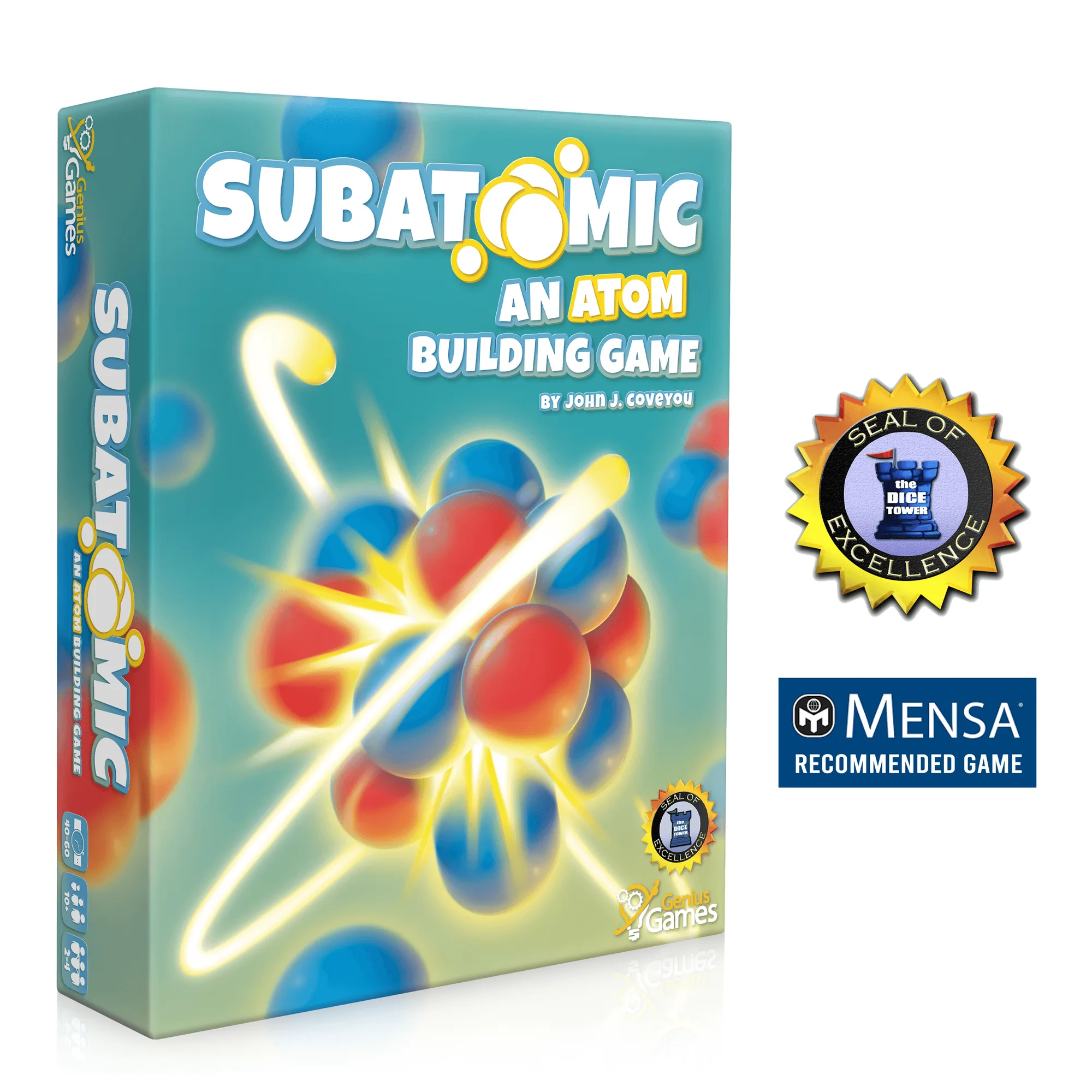
Subatomic 2nd Edition is a chemistry board game that turns subatomic particles into a deck-building and area-control challenge. It's a MENSA Recommended Game and has earned The Dice Tower Seal of Excellence, which signals strong design and educational value.
Unlike many science games that feel like quizzes, Subatomic makes particle physics the core mechanic. You're not just memorizing facts; you're making strategic decisions about which particles to collect and how to use them.
What to know before your first game
Subatomic 2nd Edition is designed for 2 to 4 players aged 14 and up, and a typical game lasts 40 to 60 minutes. The game emphasizes deck building and hand management, so expect to think carefully about every card you add to your deck.
The area-control element comes into play on the game board, where you compete for influence over different particle zones. This adds a spatial layer that keeps each game different.
How to play Subatomic 2nd Edition step by step
- Set up the game board and decks: Place the main board in the center. Shuffle the particle decks (protons, neutrons, electrons) and place them in their designated spaces. Each player chooses a color and takes their starting deck and player board. Make sure all players have the same starting deck to keep the game fair.
- Understand the turn structure: On your turn, you play cards from your hand to gain energy or acquire new particles. You can also use cards to move your influence tokens on the board. After playing, discard your hand and draw back up to your hand limit. Don't overspend energy early; you'll need it to buy high-value particles later.
- Build atoms to score points: When you have the right combination of protons, neutrons, and electrons, you can build an atom. This scores you points and often gives you a one-time bonus, such as extra energy or a special action. Check the atom cards available each game—some are worth more points but require rarer particles.
- Use area control to your advantage: Move your influence tokens on the board to claim control over particle zones. Controlling a zone gives you a discount when buying those particles, so it's a key strategy. Don't ignore area control; it can be the difference between winning and losing.
- End the game and count final scores: The game ends when a certain number of atoms have been built or the particle decks run out. Players then count points from atoms built and any end-game scoring cards. Keep track of your opponent's progress—if they're close to ending the game, you may need to shift your strategy.
Product facts
-
Subatomic: 2nd edition an Atom Building Game | 2019 MENSA Recommended Game | Dice Tower Seal of Excellence |Chemistry Game: Subatomic: 2nd edition Atom Building Game is a 2021 MENSA Recommended Game and a recipient of The Dice Tower Seal of Excellence. These awards indicate that the game has been vetted for both educational value and engaging gameplay, making it a solid choice for families and classrooms.
Subatomic: 2nd edition an Atom Building Game | 2019 MENSA Recommended Game | Dice Tower Seal of Excellence |Chemistry Game