Quick answer
Most pediatric organizations, including the American Academy of Pediatrics, recommend waiting until your baby is at least 6 months old before applying sunscreen. For younger infants, keep them out of direct sun, dress them in lightweight long sleeves and a brimmed hat, and use shade. If sun exposure is unavoidable and your pediatrician agrees, a small amount of mineral sunscreen on exposed skin is better than a sunburn.
Why the 6-month mark matters
A baby's skin is thinner and less developed than an adult's, and their ability to metabolize and clear ingredients is still maturing. That's why the standard advice is to avoid sunscreen on infants under 6 months unless your pediatrician specifically says otherwise. Sunscreen isn't poison, but the precaution reflects real differences in how infant skin handles topical products. The bigger risk for this age group is direct sun exposure itself, so the first line of defense is physical: shade, clothing, and timing.
What to do instead of sunscreen for a newborn
Use a stroller canopy, a sunshade, or a lightweight muslin blanket draped for shade—never over the face or car seat opening in a way that traps heat. Dress your baby in breathable long sleeves and pants, and choose a wide-brimmed hat that stays on. Plan walks before 10 a.m. or after 4 p.m., when UV rays are less intense. If you're nursing or bottle-feeding, offer extra fluids in hot weather. These steps protect without putting anything on the skin.
When can babies wear sunscreen?
Once your baby passes 6 months, sunscreen becomes part of the routine. Start with a patch test on a small area of skin to check for irritation, then apply broadly. Mineral formulas with zinc oxide or titanium dioxide are often the first choice for infants because they sit on top of the skin rather than being absorbed. Reapply every two hours, and more often after swimming or sweating. Don't forget the tops of feet, ears, and the back of the neck.
Is sunscreen safe for infants with eczema or sensitive skin?
If your baby has eczema or very reactive skin, talk to your pediatrician before introducing any sunscreen. Fragrance-free, dye-free mineral formulas are generally the least likely to sting or trigger flare-ups. Avoid sprays for the face—spraying near the nose and mouth can cause inhalation—and instead spray into your hands first, then pat onto the skin. If a rash develops, stop using that product and check with your doctor.
How to apply sunscreen to a wriggly baby
Apply before you leave the house so the product has a few minutes to settle. Use about a shot-glass amount for the body, adjusting for your baby's size. Distract with a toy or song while you cover exposed areas. For the face, dot sunscreen on your fingertips and gently smooth it on, avoiding the eyelids. If your baby is in a carrier, remember that thin fabric may not block all UV—sunscreen on arms and legs still helps.
What to look for in a baby sunscreen
Choose broad-spectrum protection (UVA and UVB), SPF 30 or higher, and water resistance if you'll be near water. Mineral actives like non-nano zinc oxide are a common pick for delicate skin. Skip formulas with added fragrance, which can irritate. The texture matters too: a spray can be quicker for toddlers, while a lotion gives more control for the face. The best sunscreen is the one you'll actually reapply consistently.
Infant sun protection FAQ
Can I use sunscreen on my 2-month-old at the beach?
The AAP recommends avoiding sunscreen under 6 months. If you can't keep your baby fully shaded, use a minimal amount of mineral sunscreen on small exposed areas like the face and hands, and ask your pediatrician first. Shade and clothing are the priority; sunscreen is a last resort for this age.
What SPF is safe for a baby over 6 months?
SPF 30 to 50 is generally recommended. Higher SPF doesn't mean you can skip reapplication—it just filters slightly more UVB. Reapply every two hours. SPF 30 is sufficient; consistency matters more than the number.
Are spray sunscreens okay for babies?
Sprays are convenient but pose an inhalation risk. Spray into your hands first, then apply to your baby's skin. Never spray directly onto the face. Use sprays for body only, and always into your hands first.
Do I need to reapply sunscreen if my baby is in the shade?
Yes, if they're getting indirect UV exposure from sand, water, or concrete. Shade reduces but doesn't eliminate UV. Reapply every two hours if they're outside. Shade helps, but sunscreen still needs reapplication.
Product facts
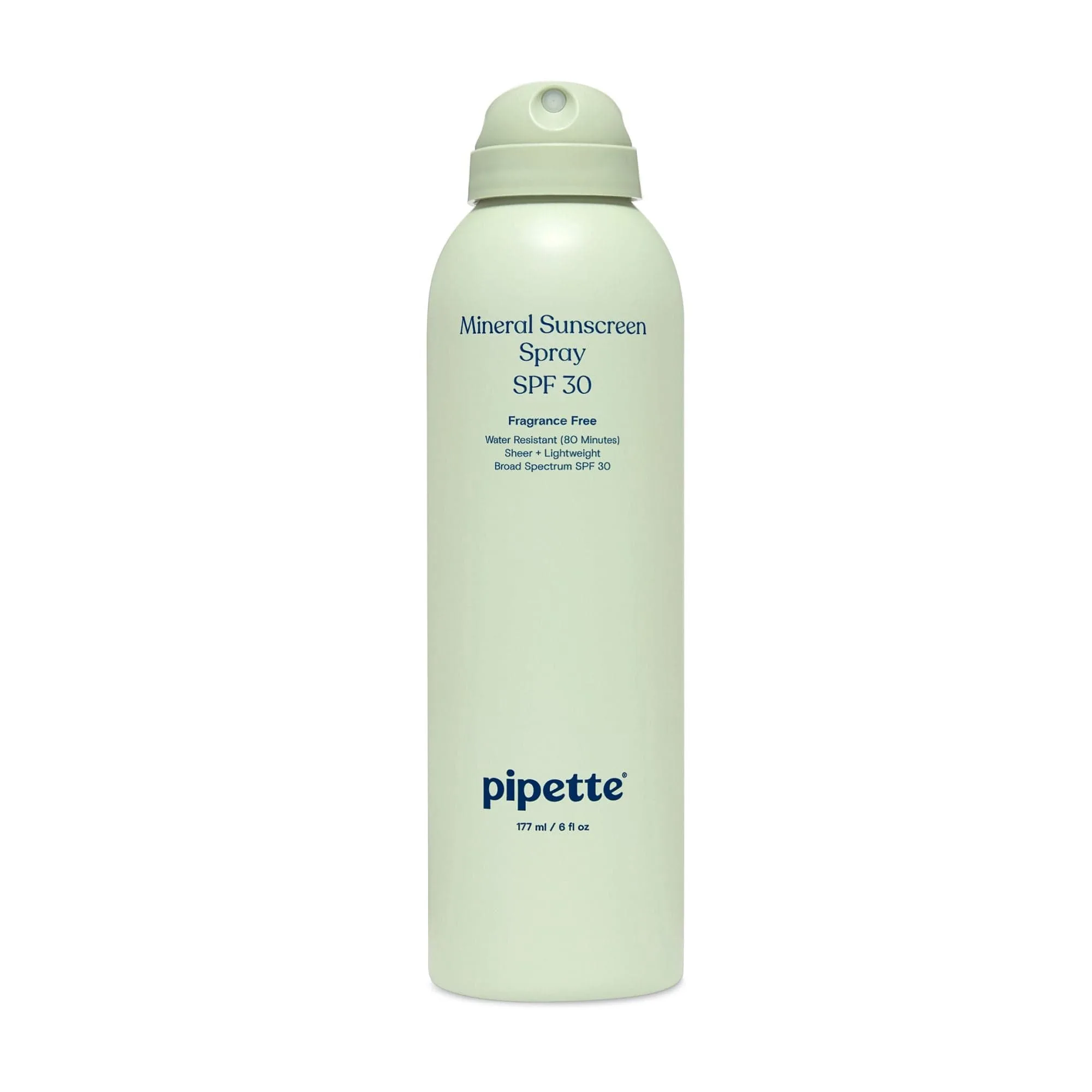
- Mineral Sunscreen Spray SPF 30: This water-resistant mineral sunscreen spray is made with 100% mineral non-nano zinc oxide and moisturizing sugarcane-derived squalane, and is hypoallergenic with SPF 30. Once your baby is over 6 months, a mineral spray can be a fast option for arms and legs, and the squalane helps offset the dryness some zinc formulas cause.
- Skin Rescue Spray: Skin Rescue Spray is a no-sting, non-toxic first aid spray powered by hypochlorous acid (HOCl) that helps disinfect, calm irritation, and support skin repair without alcohol or steroids. If your baby's skin gets irritated from heat, drool, or a mild scrape, this can soothe without the sting of traditional antiseptics.