Quick answer
For most beginners, a lightweight alt-az or strain wave mount without counterweights is the easiest to learn and use, while an equatorial mount is better if you plan to do long-exposure astrophotography.
Why mount choice matters more than you think
The mount is the foundation of your telescope setup. A shaky or hard-to-use mount can turn a great telescope into a frustrating experience. Your mount determines how smoothly you can track objects, how easy it is to set up, and how much weight it can carry.
Alt-az vs equatorial: key trade-offs
Alt-az mounts move up-down and left-right, making them intuitive for visual observation. Equatorial mounts tilt to match Earth's rotation, which helps for astrophotography but adds setup complexity. For visual use, alt-az is simpler; for long-exposure photos, equatorial is usually required. Some mounts offer both modes, giving you flexibility to start one way and switch later.
Strain wave mounts: a modern option
Strain wave mounts use a gear system that is compact and lightweight while still carrying a decent payload. They often don't need counterweights, which cuts down setup time and travel weight. This makes them a strong option for portable setups or if you have limited storage space.
Beginner mount FAQ
What is the most important spec for a beginner?
Payload capacity and mount weight. Make sure the mount can support your telescope's weight, and consider how often you'll carry it outside. A lighter mount is easier to set up, but it must still be stable enough for your scope. Check the payload capacity against your telescope's actual weight, including accessories.
Do I need an equatorial mount for astrophotography?
For long-exposure deep-sky photos, yes. Alt-az mounts can't rotate the camera to match the sky, causing field rotation. If you plan to do planetary or short-exposure imaging, alt-az can work. A dual AZ/EQ mount gives you both options in one. If astrophotography is a future goal, choose a mount that can do equatorial tracking.
Why do strain wave mounts skip counterweights?
Their gear design provides enough torque to balance the load without heavy counterweights. This reduces setup time and makes the mount more portable. Just be sure to follow the manufacturer's balance instructions to avoid strain on the gears. Less counterweight means less to carry, but proper balance is still essential.
Mounts to consider
-
HAZ31 Alt-Az Strain Wave Mount: The HAZ31 Alt-Az Strain Wave Mount has a mount head that weighs 8.2 lbs and a payload capability of 31 lbs, without needing a counterweight or shaft. This is a good fit if you want a lightweight, compact mount that can still carry a medium-sized telescope without extra balancing hardware.
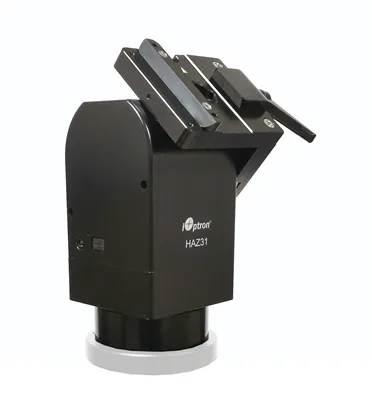
HAZ31 Alt-Az Strain Wave Mount
-
Strain Wave AZ/EQ Mount HAE43: The Strain Wave AZ/EQ Mount HAE43 is an AZ/EQ dual mount with a mount head under 13 lbs and a payload capability of 44 lbs, also without a counterweight or shaft. This offers the flexibility to start with alt-az and later switch to equatorial mode for astrophotography, all in one portable package.
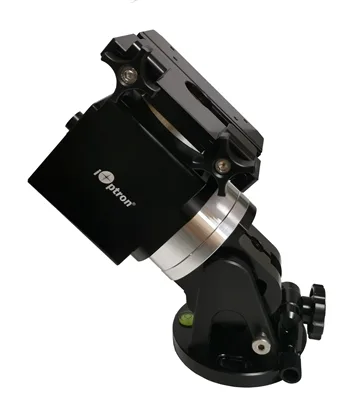
Strain Wave AZ/EQ Mount HAE43