Quick answer
A two-person camping mattress is worth it when you and your partner sleep on the same schedule and want one shared, uninterrupted surface instead of two pads that slide apart. If your sleep schedules, temperatures, or vehicle space differ, two single pads usually work better. Judge any double camping pad by three things: usable width per person, how the foam behaves in cold, and how fast it deploys and packs.
Two single pads pushed together look like a double bed until someone rolls toward the middle and drops into the gap. That gap, plus the nightly ritual of re-aligning two pads, is the real reason couples start looking at a two-person camping mattress. The question is whether a shared surface actually fits your vehicle, your sleep habits, and your tolerance for cold foam.
This guide walks through the decisions that matter before you buy: width per sleeper, foam behavior, setup and pack-down, and the small hardware details that keep a mattress from shifting. Where a specification is not published for a given model, treat that as an open question to confirm with the maker rather than assuming a number.
Width per person is the number that decides everything
A double camping pad is only comfortable if each sleeper gets enough usable width. Measure your current bed at home, then subtract the space you actually use. Most couples discover that a shared camping surface feels tight not because the total width is small, but because the middle is dead space where neither person can sleep. A pad with a defined center seam or contoured edges can waste more room than the listed dimensions suggest.
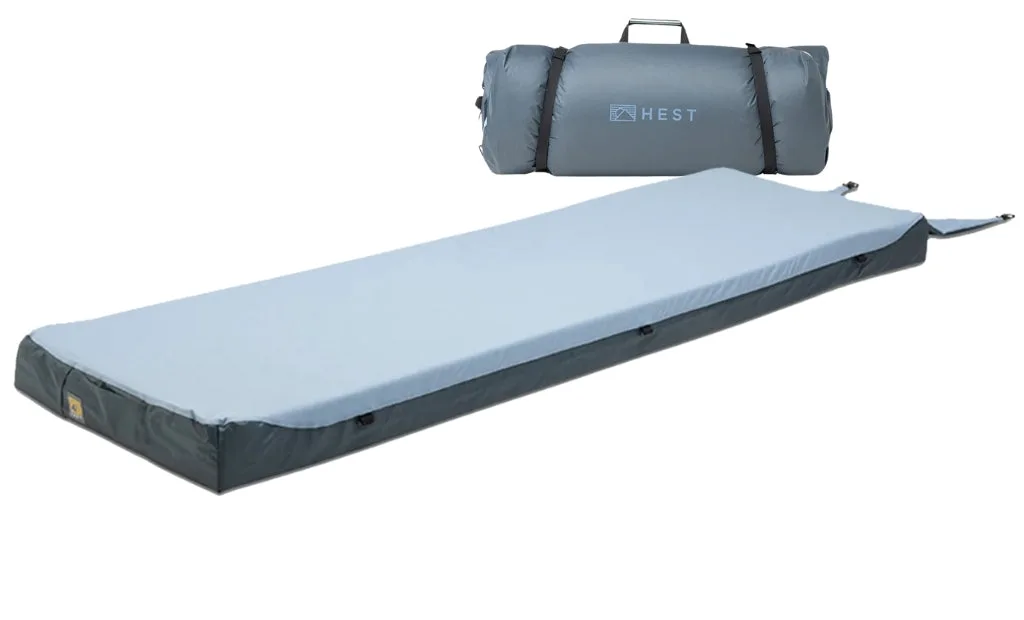
Before buying, check whether the mattress is sold as a full sleeping area or as a single unit meant for one side. The foamy-for-r2-478dbb14600a33c419f17eb2-1913178">Foamy For R2 by HEST is sold as a single mattress for the driver and/or passenger sides, and covering the full sleeping area of the vehicle requires more than one. That is a design decision, not a flaw, but it changes your math: two units may cost more and pack into two rolls rather than one.
- Measure your vehicle's flat cargo length and width before comparing mattress dimensions.
- Ask whether the listed width is the full sleep surface or one side of a two-piece system.
How memory foam behaves when the temperature drops
Memory foam softens with body heat and firms up in the cold. A pad that feels plush in a warm showroom can feel noticeably firmer on a 35-degree night. Temperature-resilient foam is formulated to reduce that swing, which matters most for cold-weather campers and for anyone who sleeps on a vehicle platform where the mattress sits directly over cold metal or a cold floor.
If a product page does not state a temperature rating or foam density, do not assume one. Instead, look for language about temperature resilience and ask the maker directly. The practical test is simple: if you routinely camp below freezing, prioritize foam described as temperature-resilient over foam chosen purely on thickness.
- Cold makes most memory foam firmer; plan for a firmer feel on winter trips.
- A waterproof base layer protects the foam from ground moisture and adds a little insulation.
Setup, pack-down, and where the mattress lives in your vehicle
A shared mattress is only convenient if it deploys and packs quickly. Look for how the pad rolls or folds, whether it has a stuff sack or compression strap, and whether it fits in the space you actually have. The Foamy For R2 by HEST rolls compact for storage in the frunk and deploys quickly, which is the kind of detail that determines whether you use the mattress every trip or leave it at home.
Pack size also affects what else you can bring. A double pad that rolls into one large bundle can be harder to stow than two smaller singles that tuck into separate corners. If your storage is tight and irregular, two singles may pack better even though one shared surface sleeps better.
- Test pack size against your real storage space, not the mattress's listed dimensions alone.
- A waterproof base makes the pad usable on damp ground or a truck bed without a separate tarp.
Small hardware details that keep a shared mattress stable
A shared mattress shifts when one person moves unless something holds it in place. Carabiner loops, strap points, or a grippy base are the quiet features that make a double pad feel like furniture instead of a pool toy. If a product page mentions carabiner use, that usually means the pad can be clipped to itself, to a vehicle tie-down, or to a partner's pad to stop sliding.
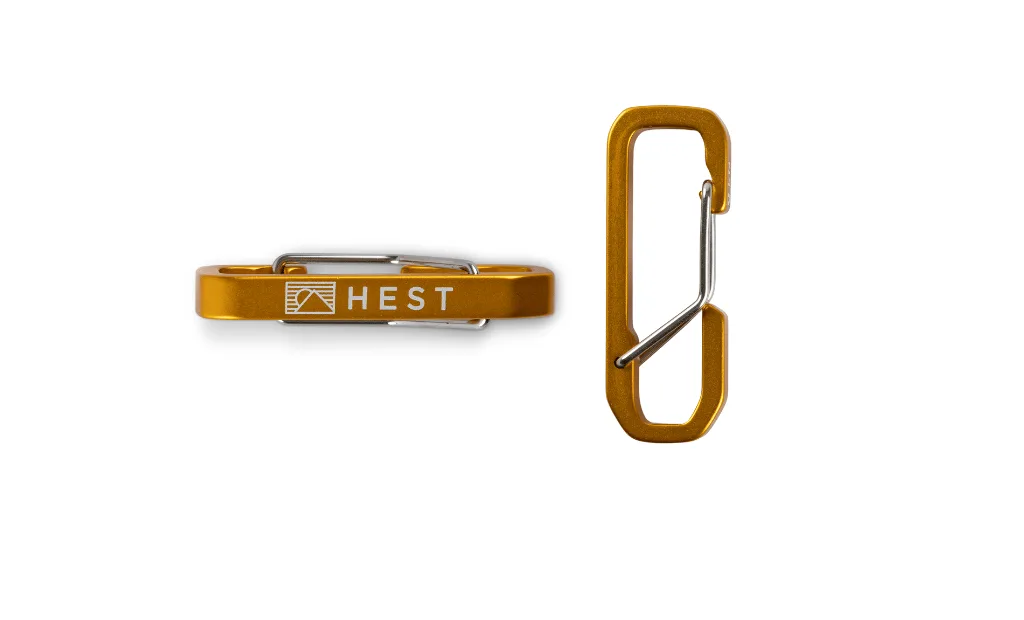
Carabiner
Check where the attachment points sit and whether they are reinforced. A single loop at one end is fine for hanging the pad to dry but will not stop lateral movement during the night. Two or more points along the sides give you real options for anchoring.
- Look for reinforced attachment points rather than a single hanging loop.
- Clipping the pad to a vehicle tie-down is often more effective than clipping two pads together.
Decision rules for choosing a shared sleep surface
- Rule 1: Same schedule, one surface: If you and your partner go to bed and wake at roughly the same time, a two-person camping mattress removes the gap and the nightly re-alignment. If your schedules differ, two singles let one person get up without disturbing the other. Shared surface for matched schedules; separate pads for mismatched ones.
- Rule 2: Cold sleepers get priority on foam: Choose temperature-resilient foam if you camp in shoulder seasons or winter. If the product page does not describe the foam's cold behavior, ask before buying rather than assuming it stays soft. Cold-weather campers should confirm foam behavior in writing.
- Rule 3: Match the mattress to the vehicle, not the other way around: A custom-fit pad like the Foamy For R2 is the right call only if you actually drive that vehicle. For everything else, measure your flat cargo area and compare it to the pad's real footprint, including any gap between two single units. Vehicle-specific fit is a benefit only when the vehicle matches.
- Rule 4: Count the total cost of covering the full area: Some mattresses are sold per side. Two units, two stuff sacks, and two rolls may cost and pack differently than one double pad. Add that up before comparing sticker prices. A per-side mattress means buying more than one to sleep two.
- Rule 5: Anchor points are not optional for couples: Look for reinforced attachment points or carabiner loops. A pad that slides during the night undoes the comfort advantage of a shared surface. No anchor points means you will be re-aligning the pad at 2 a.m.
HEST products that solve adjacent problems
- Foamy For R2: Designed specifically for the Rivian R2, built with temperature-resilient memory foam and a durable waterproof base, and rolls compact for storage in the frunk. Sold as a single mattress for the driver and/or passenger sides. If you drive an R2, this is a custom-fit option rather than a universal pad, but you need to plan for more than one unit to cover the full sleeping area.
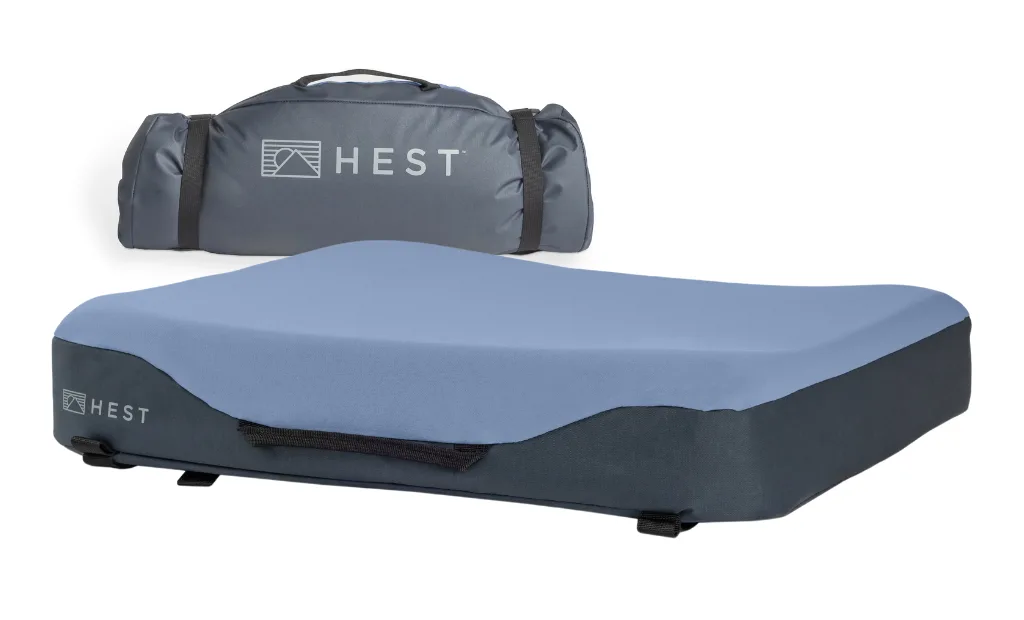
- Foamy Seat Cushion: Designed to add comfort and support in airplane seats, cars, camp chairs, bleachers, cooler tops, and other surfaces. A useful companion piece when the mattress is only part of your comfort setup, or when a passenger wants support during the drive to camp.
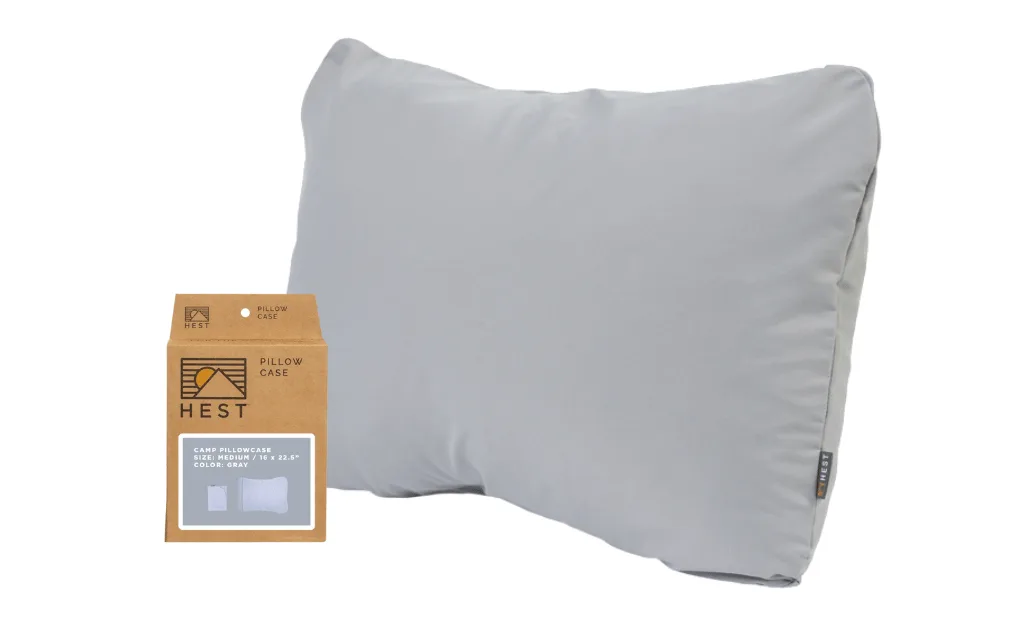
- Pillowcase: Designed for best use with a HEST Pillow, made from performance stretch nylon that contours and moves with a memory foam pillow. If you already carry a HEST pillow, a matched pillowcase keeps the pillow from sliding and is easier to wash than the foam itself.
Who should buy a two-person camping mattress
Best for
- Couples with similar sleep schedules who want one uninterrupted surface
- Campers sleeping on a flat vehicle platform where a shared pad will not bend or gap
- Rivian R2 owners who want a custom-fit, temperature-resilient pad and will buy the number of units needed to cover the full area
Not for
- Couples with very different bedtimes or wake times, who are better served by two single pads
- Campers with irregular or very tight storage, where two smaller rolls pack more easily than one large one
- Anyone who needs a published temperature rating or density spec before buying and cannot get one confirmed
A two-person camping mattress earns its place when the shared surface matches your sleep schedule, your vehicle, and the temperatures you actually camp in. Get the width per person and the foam behavior right first, then let setup and anchor points decide between models. If any of those three is a mismatch, two single pads remain the smarter buy.