Quick answer
Use a hydrogen-alpha (H-alpha) filter to capture emission nebulae by isolating the 656nm wavelength. This narrowband filter blocks light pollution and moonlight, letting you shoot deep-sky targets even from suburban skies.
Why choose an H-alpha filter over other narrowband filters
H-alpha filters are the go-to choice for capturing ionized hydrogen in emission nebulae. They transmit only a narrow band around 656nm, which is the strongest emission line from most bright nebulae. This makes them ideal for monochrome cameras or as part of an LRGB-Ha composite.
A common trade-off: H-alpha filters are not for visual use or solar observation. They are designed exclusively for black-and-white deep-sky photography. The Lumicon 82 mm Night Sky Hydrogen-Alpha Filter, for example, has zero transmission below its cutoff and warns against solar use to prevent eye damage.
H-alpha vs. H-beta – what the Tele Vue H-Beta filter does
While H-alpha targets the 656nm line, an H-beta filter isolates the 486nm hydrogen-beta line. The Tele Vue Bandmate H-Beta Filter is designed for visual observation of faint nebulae like the California Nebula or Horsehead Nebula, not for imaging. It provides contrast gain in dark skies, but it is not a substitute for an H-alpha imaging filter.
For deep-sky imaging, stick with an H-alpha filter. The H-beta filter is a visual tool for advanced observers under pristine skies.
Step-by-step: How to use an H-alpha filter for deep-sky imaging
- 1. Attach the filter to your imaging train: Screw the H-alpha filter into the nosepiece of your camera or into a filter wheel. For a 2-inch filter like the Lumicon 82 mm, use a 2-inch nosepiece or a filter drawer. Ensure the filter is clean and free of dust before mounting. Common mistake: using the filter on the wrong side of the optical train – always place it as close to the sensor as possible to avoid vignetting.
- 2. Focus using a bright star or a Bahtinov mask: H-alpha filters shift focus slightly compared to unfiltered imaging. Use a bright star and a Bahtinov mask to achieve critical focus. Start with your normal focus point and adjust in small increments until the diffraction spikes are symmetrical. Checkpoint: autofocus routines may fail with narrowband filters – manual focusing is more reliable.
- 3. Set your exposure parameters: Because H-alpha filters transmit only a narrow band, you will need longer exposures – typically 5 to 10 minutes per sub at a high gain (e.g., gain 200 on a CMOS camera). Use a dark frame library to calibrate out thermal noise. Common mistake: underexposing subs – aim for a histogram peak at about one-third from the left to capture faint nebula details.
- 4. Capture a sequence of calibrated frames: Take at least 20 to 30 light frames, plus matching dark, flat, and bias frames. Use a dithering routine between subs to reduce walking noise. Stack the frames in software like DeepSkyStacker or PixInsight. Checkpoint: without dithering, fixed pattern noise from the filter may not average out.
- 5. Process the stacked image: Stretch the stacked Ha image using a non-linear stretch (e.g., histogram transformation). Remove gradients caused by light pollution with a tool like GradientExterminator. Sharpen with a mild deconvolution or unsharp mask. Common mistake: over-sharpening an Ha-only image can create artifacts – keep sharpening subtle.
Product facts
-
Lumicon 82 mm Night Sky Hydrogen - Alpha (Ha) Filter - LF3115: The Lumicon 82 mm Night Sky Hydrogen-Alpha Filter is a sharp-cut-off filter with zero transmission below its cutoff, designed for black-and-white deep-sky photography only. It is not for solar or visual work. Its deep cutoff blocks nearly all light pollution, letting you capture faint hydrogen emission nebulae even from light-polluted locations.
Lumicon 82 mm Night Sky Hydrogen - Alpha (Ha) Filter - LF3115
-
Tele Vue Bandmate H-Beta Filter - 2" - B2H-0200: The Tele Vue Bandmate H-Beta Filter is a 2-inch narrowband filter that highlights the aqua-colored hydrogen-beta emission line for visual use on nebulae like the California Nebula. This filter is for visual observers seeking contrast on extremely faint nebulae, not for imaging – a key distinction when choosing gear.
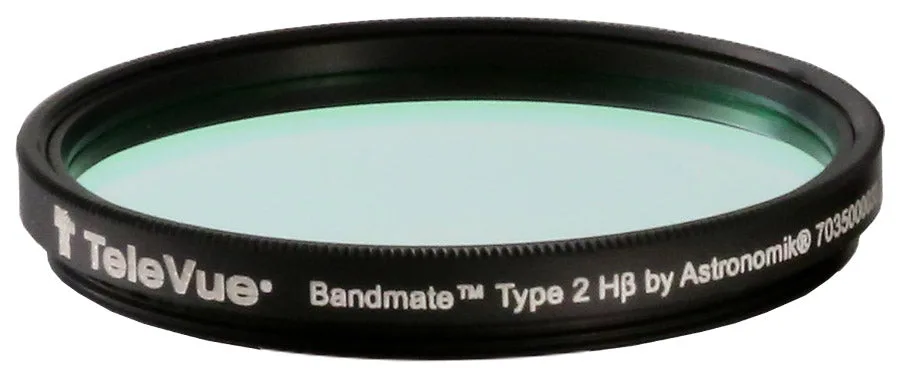
Tele Vue Bandmate H-Beta Filter - 2" - B2H-0200