What the KASA500 Amplifier Does for Your System
The KEF KASA500 Amplifier is part of KEF's Architectural Speaker Accessories line, designed specifically to support in-wall and in-ceiling speaker installations. If you are building a distributed audio system or adding power to a multi-room setup, this amplifier bridges your source components and passive KEF architectural speakers.
Available in a Black finish, the KASA500 is a dedicated power solution that avoids the bulk of a full-sized receiver while still delivering the amplification needed for architectural speakers. It is not a standalone streaming device or preamp; its role is to provide clean, reliable power where you need it most.
KASA500 Amplifier at a Glance
-
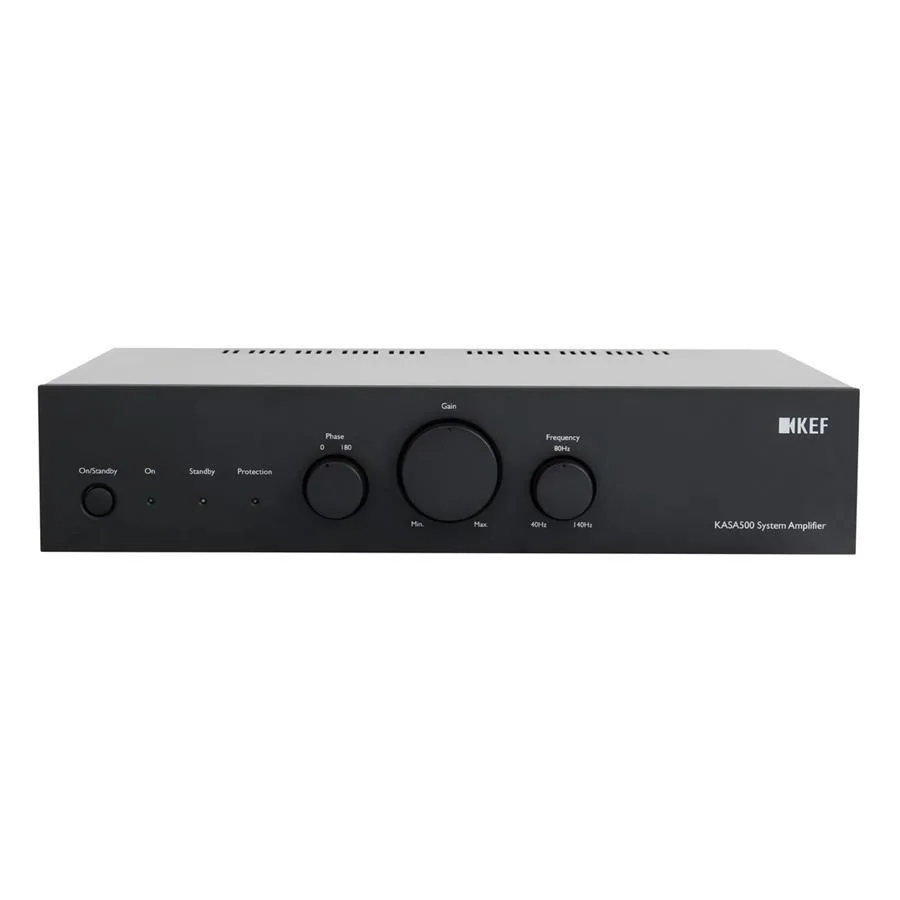
KASA500 Amplifier: The KEF KASA500 Amplifier is part of KEF's Architectural Speaker Accessories line, designed to support architectural speaker installations. This confirms the amplifier is purpose-built for in-wall and in-ceiling speakers, not for traditional bookshelf or floor-standing models.
KASA500 Amplifier
-
KASA500 Amplifier: It is offered in a Black finish and carries the KEF brand name. The single color option means it will blend with most equipment racks or be mounted out of sight near the speakers.
System Compatibility and Connections
The KASA500 is intended for use with passive KEF architectural speakers. Because it is a standalone amplifier, you will need a separate source component—such as a preamp, AV receiver pre-out, or streaming device with analog outputs—to feed it an audio signal. The amplifier then powers the speakers directly.
For multi-room or distributed audio setups, you can use multiple KASA500 units to power different zones, each connected to its own source or a multi-zone preamp. This approach gives you independent volume control per room without the complexity of a single large receiver.
Keep in mind that the supplied information does not specify the amplifier's power output, number of channels, or input types. For detailed connection diagrams and exact specifications, refer to the product documentation included with your unit.
Placement and Installation Considerations
Since the KASA500 is designed for architectural speaker installations, it is often placed near the speakers themselves—inside a closet, equipment rack, or even mounted on a wall in a utility area. Its compact form factor (though exact dimensions are not supplied) suggests it can fit in tighter spaces than a full-sized AV receiver.
Ensure the amplifier has adequate ventilation. Even without supplied thermal specifications, any power amplifier generates heat, so avoid enclosing it in a sealed cabinet without airflow. If you are installing multiple units, leave space between them for cooling.
The Black finish helps it disappear in darker equipment racks or behind grilles, maintaining the clean aesthetic of your architectural speaker installation.
Integrating into a Distributed Audio System
To use the KASA500 in a multi-room audio setup, you will need a source selector or multi-zone preamplifier that can send independent signals to each amplifier. Connect the source outputs to the KASA500 inputs, then run speaker wire from the amplifier to your KEF architectural speakers in that zone.
Because the KASA500 is a dedicated amplifier, it does not include built-in streaming, room correction, or network capabilities. Those functions must be handled by upstream components. This separation can be an advantage: you can upgrade your source or streaming device without replacing the amplifier, and vice versa.
If you are wiring multiple rooms, label each amplifier and its corresponding speaker pair clearly. This simplifies troubleshooting and future system changes.
What the Supplied Information Does Not Cover
The catalog confirms the KASA500's category, brand, color, and purpose, but it does not include specifications such as power output per channel, impedance compatibility, input types (RCA, balanced, etc.), or dimensions. Without these details, it is not possible to recommend specific speaker pairings or calculate amplifier headroom.
For installation, refer to the manual that ships with your KASA500. If you are planning a whole-home system, consult with a professional integrator who can verify that the amplifier meets your power and connectivity requirements.