Quick answer
Use the Know and Follow Rules Book as a structured read-aloud and discussion tool to teach children aged 4-8 why rules matter and how to follow them, reinforcing each rule with role-play and positive reinforcement.
Why this book works for therapy
The Know and Follow Rules Book by Cheri J. Meiners is designed for children aged 4-8, a critical window for developing social skills and understanding behavioral expectations. Its simple language and clear examples make it accessible for children who struggle with abstract concepts like fairness or safety.
The book presents just four basic rules—Listen, Best Work, Hands and Body to Myself, and Please and Thank You—which are easy for children to remember and practice. This simplicity is a strength in therapy, where too many instructions can overwhelm a child. By focusing on a few concrete rules, you can help a child build a foundation for more complex social interactions.
Trade-offs to consider
While the book is excellent for introducing rules, it does not provide specific strategies for children with severe behavioral challenges or neurodevelopmental disorders like ADHD or autism. In those cases, you may need to supplement with more individualized behavior plans or visual supports.
The book's focus is on positive reinforcement and pride in following rules, which is effective for many children but may require adaptation for those who need more explicit consequences or rewards. Be prepared to pair the book with a token system or other motivational tools if needed.
How to use the book in therapy
- Introduce the book: Start by reading the book aloud with the child, pausing to ask questions like 'Why do we have rules?' and 'What does 'Listen' mean to you?' This builds engagement and connects the content to the child's own experiences. Checkpoint: Ensure the child can name at least one reason for rules before moving on.
- Focus on one rule at a time: Pick one of the four rules (e.g., 'Hands and Body to Myself') and discuss it in depth. Use examples from the book and ask the child to give their own examples. This prevents overwhelm and allows for deeper learning. Checkpoint: Confirm the child can give a correct example of the rule in their own words.
- Role-play scenarios: Act out situations where the rule applies, such as sharing a toy or waiting in line. Let the child practice the rule in a safe, playful setting. This helps generalize the skill beyond the book. Checkpoint: Observe if the child can apply the rule in a new role-play scenario without prompting.
- Reinforce with positive feedback: Praise the child specifically when they follow a rule during the session or in real-life situations. For example, say 'Great job keeping your hands to yourself during that game!' This builds the positive association the book emphasizes. Checkpoint: Keep a simple chart of praised behaviors to track progress over sessions.
- Send home a practice activity: Give the child a simple homework task, like drawing a picture of themselves following one rule at home. Involve caregivers by sharing the rule and asking them to reinforce it. This extends learning beyond therapy. Checkpoint: Ask caregivers to report one instance of the child following the rule at home.
Product facts
-
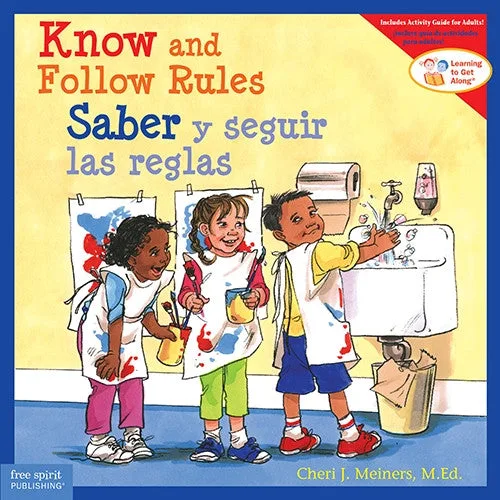
Know and Follow Rules Book: By Cheri J. Meiners M.Ed., ages 4-8. The book explains simple reasons for rules and presents four basic rules: Listen, Best Work, Hands and Body to Myself, and Please and Thank You. The four-rule framework gives therapists a clear, memorable structure to teach and reinforce in sessions, making it easier for children to internalize expectations.
Know and Follow Rules Book