Quick answer
Spectrum Noir Aquablend Pencils let you create soft, blended landscape scenes by layering dry pencil, then activating with water for watercolor effects.
Why Aquablend Pencils work for landscapes
Landscape art often requires smooth transitions between sky, foliage, and ground. Water-soluble pencils like the Spectrum Noir Aquablend range let you draw precise lines dry and then dissolve them into washes, giving you control over both detail and atmosphere.
The thick, richly pigmented cores deliver bold color that stays vibrant even after water activation. This makes them especially useful for capturing the depth of a sunset sky or the varied greens of a forest.
Step-by-step landscape drawing with Aquablend Pencils
- 1. Sketch the composition lightly: Use a light hand to outline the main landscape elements—horizon, hills, trees, water. Stick to a single neutral pencil (like a light blue or warm gray) so the lines dissolve when water is added. Common mistake: pressing too hard. Heavy lines won't wash away cleanly and can leave dark outlines in your finished piece.
- 2. Layer dry pencil for base colors: Fill in broad areas with horizontal or circular strokes. For a sky, apply light blue at the top and pale yellow near the horizon. Overlap colors slightly where you want a gradient. Checkpoint: Keep the paper dry at this stage. Wetting too early will prevent you from building up enough pigment for vivid results.
- 3. Activate with water using a brush: Dip a clean brush in water, shake off excess, and gently stroke over the pencil marks. Work from light to dark to avoid dragging dark pigment into light areas. Let each section dry before moving on. Common mistake: using too much water. A damp brush gives you control; a soaking wet brush will lift the pigment and create puddles that dry unevenly.
- 4. Add details and texture after drying: Once the base wash is dry, use the pencils dry again to draw grass blades, tree trunks, clouds, or rocks. These dry details will stay crisp and sharp against the soft washed background. Checkpoint: Test the paper's dryness with the back of your hand. If it feels cool, it's still damp and will cause your pencil to drag or smudge.
- 5. Refine with multiple layers: Repeat the layering-and-wash process to deepen shadows or add highlights. For example, layer a darker green over a dry hill wash, then activate again with a nearly dry brush to soften edges. Common mistake: overworking an area. Two to three layers are usually enough; more can lift the paper surface and muddy the colors.
Product used in this tutorial
-
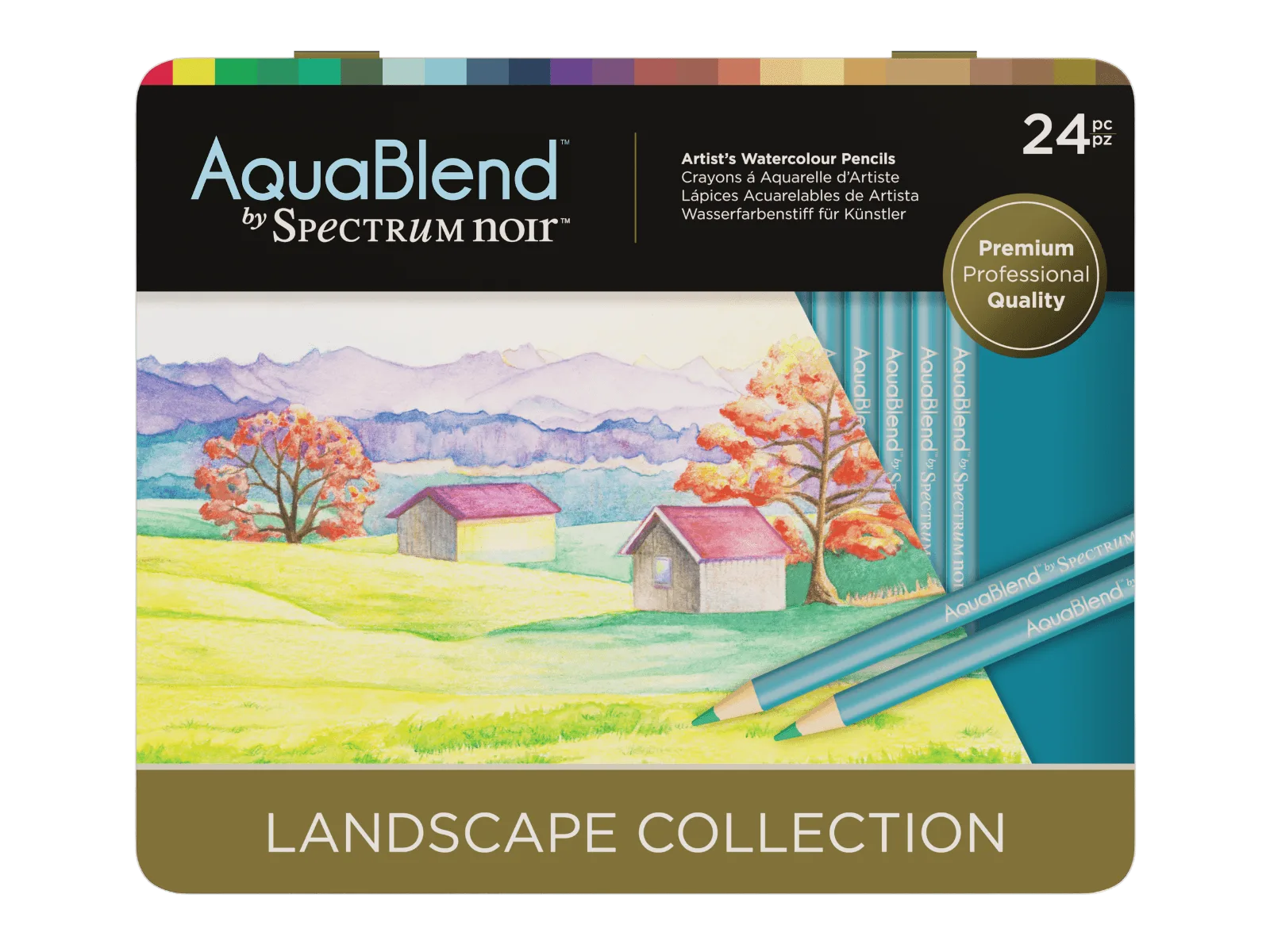
Spectrum Noir Aquablend Pencils (24PC) - Landscape: Fully water-soluble with a thick, richly pigment core, they offer bold, vivid colour that will blend away effortlessly and cleanly. The high pigment load means you get strong color from light layers, and the water-soluble binder lets you create smooth gradients without muddying your landscape.
Spectrum Noir Aquablend Pencils (24PC) - Landscape