Quick answer
For landscape photography, a fixed ND filter gives you predictable, streak-free long exposures, while a variable ND filter offers quick exposure adjustments for changing light. Choose fixed for precision, variable for speed.
When precision matters: fixed ND filters
Fixed ND filters provide a single, exact density—like ND8 (3 stops) or ND64 (6 stops)—so you can calculate shutter speed with confidence. They eliminate the risk of X-pattern cross-polarization that can appear on variable filters at higher densities, especially with wide-angle lenses. For landscape scenes where you want a 30-second silky waterfall or a 2-minute cloud streak, a fixed ND is the reliable choice.
When speed matters: variable ND filters
Variable ND filters use two polarizing layers to adjust from 1 to 5+ stops by rotating the front ring. This lets you adapt exposure without swapping glass—handy when clouds roll in or the sun dips behind a ridge. The trade-off is that at the maximum stop setting, you may see uneven darkening or a cross pattern, especially on ultra-wide lenses. For run-and-gun landscape shooting or video, the convenience often outweighs the optical compromise.
Trade-offs at a glance
- Fixed ND filter: Delivers a single, exact density (e.g., 3, 6, or 10 stops) with no risk of X-pattern or uneven darkening. Best for precise long exposures where you can plan ahead. Carry a set of 2–3 fixed densities (e.g., ND8, ND64, ND1000) to cover most landscape scenarios.
- Variable ND filter: Adjusts exposure from 1 to 5+ stops by rotating the ring. Ideal for fast-changing conditions but may show cross-polarization artifacts at maximum density, especially on wide lenses. Use a variable ND for handheld or video work; avoid pushing it past 5 stops to maintain image quality.
- Which one for landscapes?: If your landscape work is tripod-based and you shoot long exposures (over 1 second), choose fixed ND filters. If you shoot handheld, video, or quickly changing scenes, a variable ND like the ND2–32 Plus offers more flexibility. Many landscape photographers carry both: a variable ND for mobility and a fixed ND for critical long exposures.
Product spotlight
-
Variable ND2–32 Filter Plus: The Variable ND2–32 Filter Plus offers seamless 1–5 stop adjustment with German SCHOTT B270 glass and CoraNano™ 20-layer coating. This means you get smooth exposure control for daylight landscapes without carrying multiple fixed filters, while the coatings minimize reflections and color shifts.
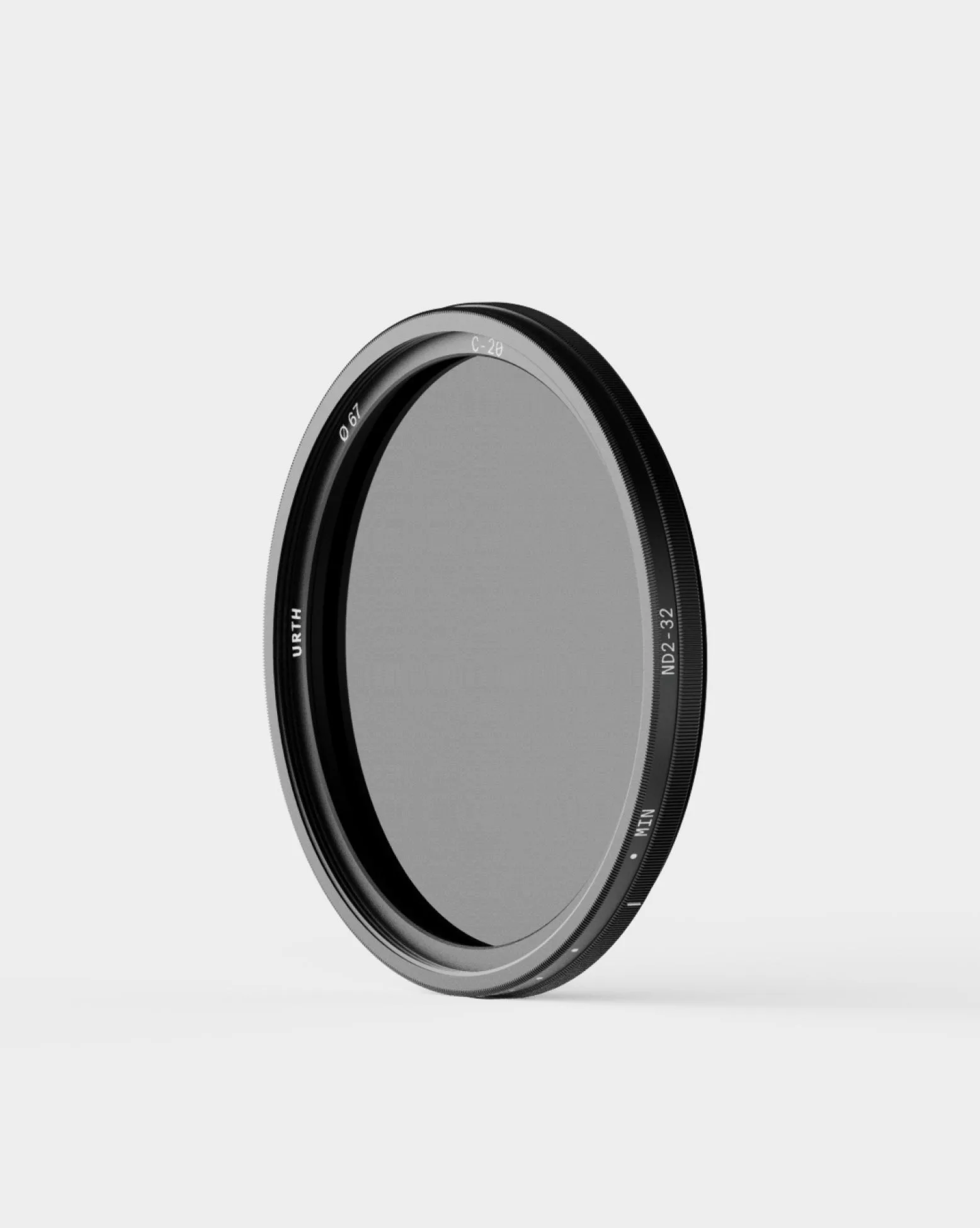
Variable ND2–32 Filter Plus
Which filter fits your style?
Best for
- Tripod-based landscape photographers who need predictable, streak-free long exposures
- Photographers shooting waterfalls, seascapes, or cloud motion with precise shutter speeds
Not for
- Run-and-gun shooters who need to adapt exposure quickly without changing filters
- Hybrid shooters who want one filter for both photo and video in variable light