Myth: 5000IU is automatically too much for everyone
The number on the label is a dose, not a verdict. Whether 5000IU is appropriate depends on your own vitamin D status, health history, medications, and what a qualified professional recommends. The supplied product information does not include a universal safety statement or a suggested daily serving for this softgel, so it cannot tell you whether 5000IU fits you.
What the record does show is context: the label notes that studies show over 40% of U.S. adults are deficient in vitamin D. That statistic describes a population, not your personal level. It is a reason to test and ask, not a reason to assume a high-dose softgel is right for you.
If you are considering a 5000IU product, treat the dose as a conversation starter with your clinician rather than a self-prescribed default. People who take other vitamin D products, certain medications, or who have kidney or other health conditions should ask before adding a dose.
What the label actually says about this softgel
-
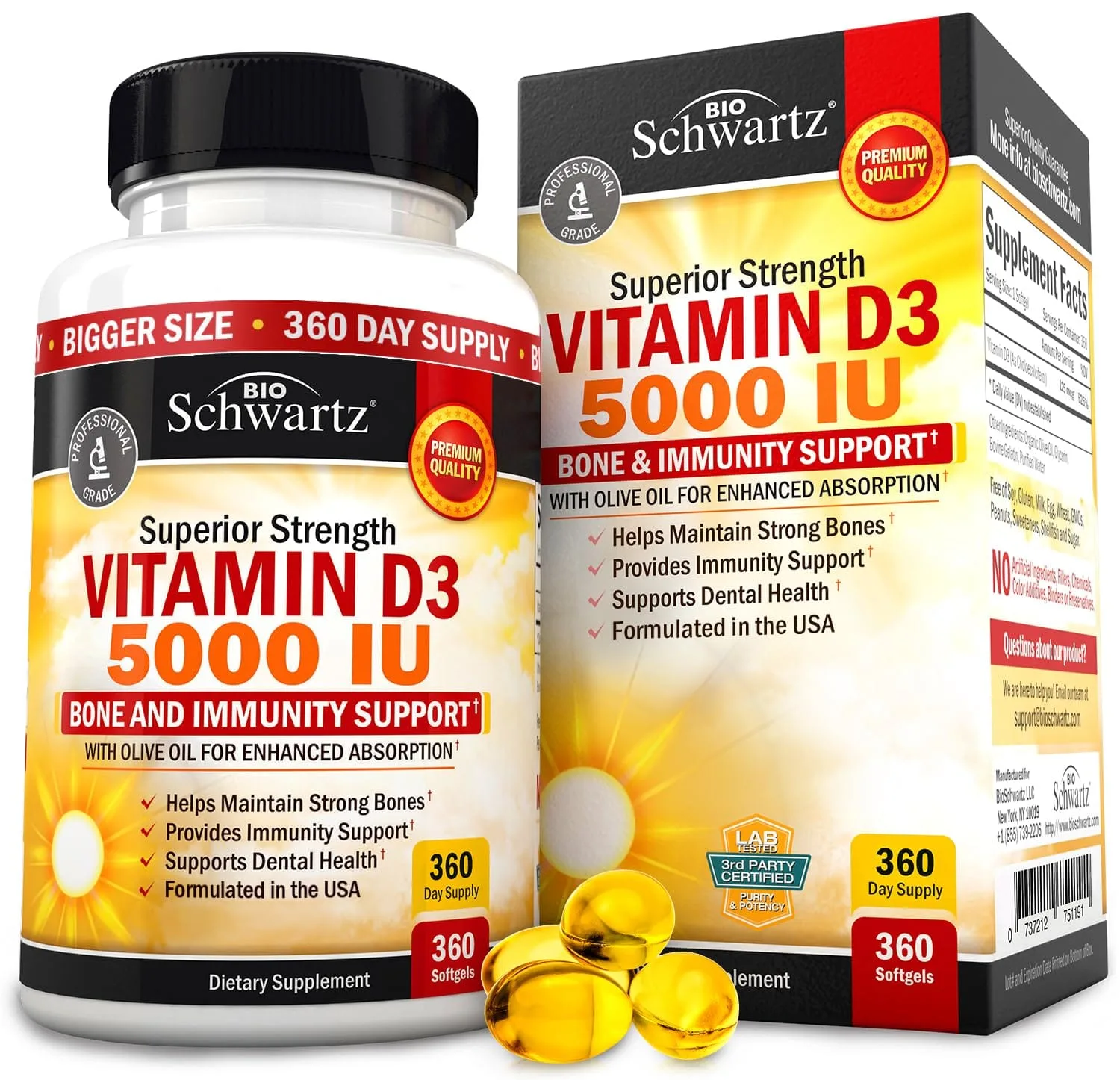
Vitamin D3 5000IU Softgels, 360ct: BioSchwartz Vitamin D3 5000IU Softgels are described as providing 5000 IU of vitamin D3 per softgel, with organic olive oil included to help enhance absorption. This clarifies the dose per softgel and the absorption rationale supplied for the product, without implying a serving schedule the record does not state.
Vitamin D3 5000IU Softgels, 360ct
-
Vitamin D3 5000IU Softgels, 360ct: The product is third-party tested for purity, potency, and quality, and the formula is described as reviewed and approved by a licensed physician. These are quality-control claims from the supplied record, not proof of clinical benefit or a substitute for personal medical advice.
Myth: You can get enough vitamin D from sunlight alone
Sunlight helps your body make vitamin D, but it is not a reliable daily plan for everyone. Season, latitude, time spent outdoors, skin tone, sunscreen use, and clothing all affect how much vitamin D you make. The supplied record does not quantify any of these factors, so it would be misleading to promise a specific amount of sun exposure as a substitute for a supplement or a test.
The more useful takeaway is that "the sunshine vitamin" nickname is not a dosing instruction. If you rely on sun exposure, consider whether your routine realistically supports it year-round, and discuss any gaps with a professional rather than guessing.
Myth: Every D3 softgel must include K2 to be worthwhile
Vitamin D3 with K2 is a popular pairing, but the supplied record for this product does not list vitamin K2 as an ingredient. That is a formulation fact, not a flaw. Whether you want a D3-only softgel or a combined D3/K2 product depends on your goals and what your clinician advises.
If K2 is important to you, check the supplement facts panel of any product before buying. Do not assume a D3 softgel includes K2 just because the two are often discussed together.
Myth: Softgel storage is a minor detail
Storage matters because heat, light, and moisture can degrade softgels over time. The supplied record does not include specific storage temperatures or shelf-life instructions for this product, so the honest guidance is to follow the label on your bottle and keep the softgels in a cool, dry place away from direct sunlight.
Do not transfer softgels into an unlabeled container or store them in a hot bathroom cabinet. If the label gives a temperature range or an expiration date, use it as your reference rather than a general rule from another product.
Practical checks before you take a 5000IU softgel
These are decision steps, not a dosing protocol. The supplied record does not provide a serving schedule, so confirm timing and frequency with the product label or a qualified professional.
- Check the dose per softgel: This product is labeled 5000IU per softgel. If you take other vitamin D products, add up the total before assuming one softgel is your only source.
- Review your current medications and supplements: Some medications and health conditions affect vitamin D needs or absorption. A pharmacist or clinician can review your full list.
- Ask whether testing makes sense for you: A blood test is the standard way to assess vitamin D status. The supplied record does not include testing guidance, so this is a conversation for your healthcare provider.
- Keep the bottle labeled and stored properly: Follow the storage directions on your bottle. The supplied record does not specify a temperature range, so do not invent one.
Product facts relevant to daily use
- Vitamin D3 5000IU Softgels, 360ct: BioSchwartz Vitamin D3 5000IU Softgels are manufactured without GMOs, soy, gluten, wheat, peanuts, milk, dairy, egg, or shellfish, and without preservatives or artificial colorants. These formulation details help readers with dietary restrictions evaluate fit, though they do not establish that the product is appropriate for every person.
- Vitamin D3 5000IU Softgels, 360ct: The product is described as supporting immune, heart, and bone health, as well as healthy bones, teeth, mood, and daily wellness. These are the manufacturer's stated benefit areas. They are not guarantees of results and do not replace medical treatment.