Quick answer
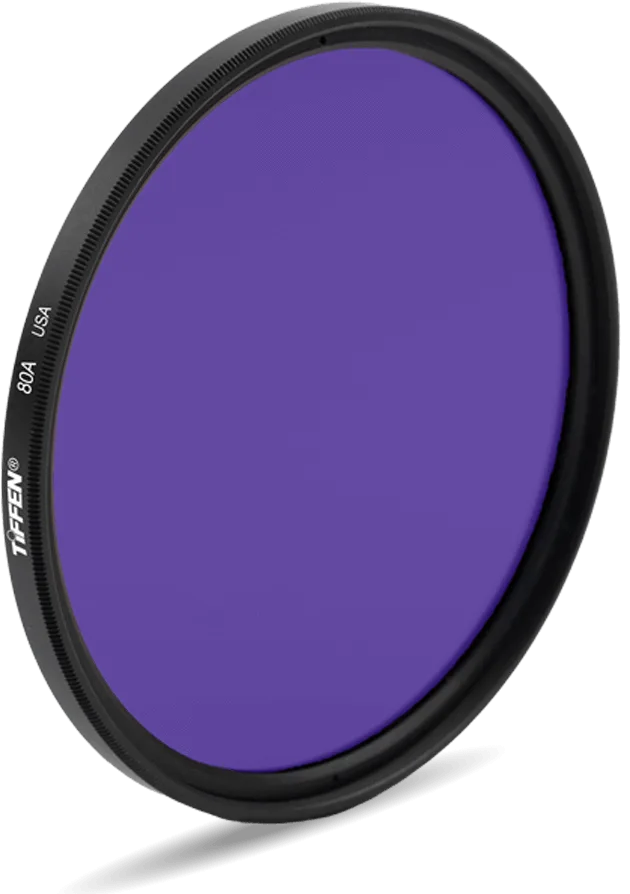
The Tiffen 80A Color Conversion Filter corrects the warm orange cast from tungsten lighting so you can use daylight-balanced film indoors without color shifts.
Why you need a color conversion filter
Daylight film is balanced for 5500K light, but household tungsten bulbs emit around 3200K. Without correction, your photos turn yellow-orange. The 80A filter absorbs the excess red and yellow, bringing the color temperature back to daylight balance.
This is different from white balance adjustments in digital cameras—with film, the correction has to happen at the lens. You can't fix it later in post without losing quality.
Trade-offs to consider
The 80A filter is dense blue, so it cuts light transmission significantly. You'll need to increase exposure by about 2 stops. That means slower shutter speeds or wider apertures, which may not work in dim interiors.
It's designed specifically for tungsten (3200K) sources. Mixed lighting or fluorescent bulbs will give unpredictable results. For those situations, a variable color correction filter or gels might work better.
Frequently asked questions
When should I use a Tiffen 80A filter?
Use it when shooting daylight-balanced film under tungsten (3200K) light sources—common in home interiors, restaurants, or stage lighting. It removes the orange cast.
How much light does the 80A filter block?
The filter requires about 2 stops of additional exposure (filter factor 4). For example, if your meter says 1/60 at f/8, you'd need 1/15 at f/8 or 1/60 at f/4. Check your camera's meter through the filter if possible, or use a handheld meter and compensate manually.
Can I use an 80A filter with digital cameras?
Yes, but it's usually unnecessary because digital cameras have adjustable white balance. The filter is most useful for film shooters who cannot correct color temperature in-camera.
What's the difference between 80A and 80B or 80C?
80A is for 3200K tungsten. 80B corrects 3400K photoflood bulbs, and 80C corrects 3800K clear flashbulbs. Using the wrong one leaves a color cast. Match the filter to your exact light source. For household bulbs, stick with 80A.
Does the 80A filter affect image sharpness?
A high-quality optical glass filter like the Tiffen 80A has minimal effect on sharpness. However, any filter adds another glass surface, so use a lens hood to reduce flare.
Product details
-
Tiffen 80A Colour Conversion Filter: Converts 3200K tungsten lighting to 5500K daylight balance, using Tiffen's ColorCore technology. This means your whites stay white and colors look natural when shooting daylight film under tungsten bulbs, without needing to swap film stocks.
Tiffen 80A Colour Conversion Filter