Quick answer
A pruning saw is used for cutting thicker branches (typically over 2 cm in diameter) that bypass pruners or secateurs cannot cleanly sever, especially on sap-laden trees and shrubs.
When a pruning saw beats secateurs
Secateurs (hand pruners) are ideal for stems up to about 2 cm thick. Beyond that, they crush the wood rather than slice it, leaving a ragged wound that invites disease. A pruning saw’s longer blade and coarser teeth cut through thicker wood with less effort, and the kerf (the groove cut by the teeth) clears sawdust so the blade doesn't bind.
The sap problem
Many garden trees and shrubs – pines, citrus, figs, and eucalyptus – ooze sticky sap when cut. Ordinary saws gum up after a few strokes, forcing you to stop and clean the blade. A saw with low-stick teeth, like Hoselink’s Pruning Saw, keeps cutting even when coated in sap, saving time and frustration.
Frequently asked questions about pruning saws
What size branches can a pruning saw cut?
Most pruning saws handle branches up to 10–15 cm in diameter. For anything larger, a chainsaw or bow saw is safer and faster.
Can I use a pruning saw on green (live) wood?
Yes. Pruning saws are designed for both green and dead wood. The teeth cut on the pull stroke, giving you more control on live, flexible branches. Pull the saw toward you on each stroke rather than pushing – this prevents the blade from binding.
How is a pruning saw different from a carpenter's saw?
Pruning saws have wider-set teeth (a larger kerf) to prevent clogging with wet wood and sap. Carpenter saws have finer teeth meant for dry, indoor lumber and will gum up quickly outdoors. Never substitute a carpentry saw for garden pruning – it will jam and leave a rough cut.
Do I need a curved or straight blade?
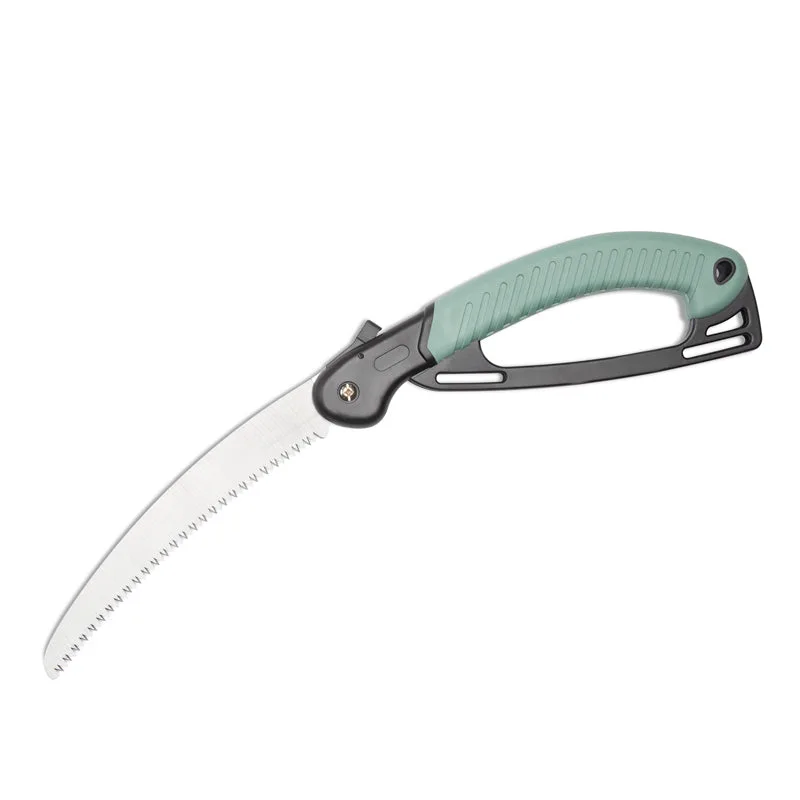
Curved blades (like Hoselink’s) help you reach around other branches and cut in tight spaces. Straight blades are better for flush cuts against a trunk or fence. Choose a curved saw if you prune dense shrubs or trees with overlapping limbs.
How do I clean a pruning saw after use?
Wipe the blade with a rag and a little mineral oil or WD-40 to remove sap and prevent rust. For heavy sap buildup, scrub with a stiff brush and warm soapy water, then dry and oil. A clean, oiled blade cuts easier and lasts years longer than a neglected one.
Product spotlight
-
Pruning Saw: Hoselink's Pruning Saw features low-stick teeth that continue to cut even when covered by sap. You won't have to stop mid-cut to scrape off sticky residue, making it ideal for resinous trees like pine or citrus.
Pruning Saw