Quick answer
If your child's anger is frequent, intense, and slow to cool, start by treating it as a skill gap rather than defiance. A structured child anger management book such as What to Do When Your Temper Flares gives you shared language and ready-made activities to practice between blow-ups.
When a bad day becomes a pattern worth addressing
Every child melts down sometimes. The difference between a hard week and a pattern that needs a plan is usually frequency, intensity, and recovery time. If your child is having big reactions most days, if small frustrations turn into hitting, screaming, or throwing, or if it takes more than 20 to 30 minutes to return to baseline, that is a signal to stop improvising and start practicing anger control for children deliberately.
One useful checkpoint: how often does the anger cost your child something they care about, like a friendship, a spot on a team, or a calm bedtime? When the answer is regularly, the goal shifts from managing today's flare-up to building a skill your child can carry forward.
What is usually fueling the flare
Big anger in children rarely comes out of nowhere. It is more often the visible tip of something underneath: lagging language for naming feelings, an unmet need for control, sensory overload, hunger or poor sleep, or a nervous system that goes from zero to sixty faster than peers. That is why consequences alone often backfire. Punishing the explosion teaches a child that anger is bad, but it does not teach them what to do with it.
This is also why a book works well as one part of a parenting anger guide. A story or workbook format lets a child see anger described without shame, which lowers defensiveness. It gives you a neutral third voice, so the lesson is not coming only from a parent in the middle of a tense moment.
Where a book fits and where it does not
A children's book for anger is a teaching tool, not a crisis plan. It works best when your child is calm enough to read together, reflect, and practice a strategy. It is a poor fit if your child is currently in a violent episode, if reading together reliably triggers a power struggle, or if the anger is paired with self-harm, threats, or destruction that puts anyone in danger. In those situations, talk to a pediatrician or a child therapist first.
For everyday hot tempers, though, a book can do something a lecture cannot: it gives your child a character to identify with and a set of steps to rehearse before the next flare. That rehearsal is what turns information into a skill.
Diagnosis: symptom, likely cause, action, and stop point
- Symptom: daily blow-ups over small frustrations: Your child's anger is frequent, intense, and slow to cool, and it is interfering with daily routines or relationships. This is a pattern, not a one-off bad day. Track frequency, intensity, and recovery time for one week before deciding on any tool.
- Likely cause: a skill gap, not a character flaw: Your child has not yet learned to notice anger early, name it, and choose a coping step. Underneath the flare is often lagging emotional vocabulary, a need for control, or a nervous system that escalates quickly. Respond to the skill gap with teaching and practice, not only consequences.
- Corrective action: practice during calm moments: Read What to Do When Your Temper Flares together when everyone is calm, not mid-meltdown. Use the fire metaphor to help your child describe what their anger feels like, then rehearse one or two coping steps they can try next time. Keep sessions short and low-pressure; the goal is repetition, not a perfect conversation.
- Stop point: when to choose a different option: If your child's anger includes self-harm, threats, destruction, or danger to others, or if reading together consistently triggers a power struggle, stop using the book as your main strategy and consult a pediatrician or child therapist. A book supports skill-building; it does not replace professional care for unsafe behavior.
Product facts
-
What to do When Your Temper Flares: What to Do When Your Temper Flares is written by Dawn Huebner, Ph.D, and illustrated by Bonnie Mathews, and it frames anger as fire: it starts with a spark, ignites energy and purpose, but can blaze out of control. The fire metaphor gives kids a concrete, non-shaming way to talk about their anger, which makes it easier to introduce coping steps without a lecture.
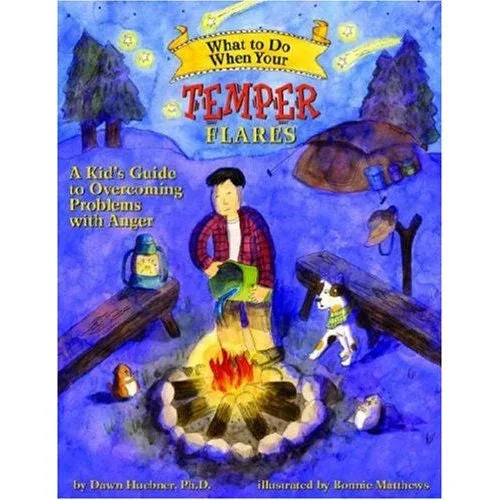
What to do When Your Temper Flares
-
What to do When Your Temper Flares: The book is designed for kids whose anger gets too big, too hot, or too fast, and it guides children and their parents through the process together. Because it is built for parent and child to use as a pair, it works as a shared practice tool rather than something you hand over and hope for the best.