Quick answer
A 70W 4-port charger with PD 3.0 is ideal for home use when you need to charge a laptop, tablet, and phone simultaneously without swapping cables. Look for models with at least one USB-C port that can deliver 45W or more to handle a laptop, and check that the total power is split intelligently across all ports.
Why 70W matters for home charging
70 watts is a sweet spot for a home desk or nightstand. It can fast-charge a modern ultrabook (which typically needs 45–60W) while still having enough leftover power for a phone and a pair of earbuds. A lower-wattage charger would struggle to keep a laptop running under load, while a 100W+ charger is often overkill and bulkier for a fixed location.
Port count vs. port type trade-off
Four ports give you flexibility, but not all ports are equal. A good 4-port charger will have at least two USB-C ports, with one capable of 45W or higher for a laptop. The remaining ports may share the remaining wattage, so charging three devices at once might slow down the laptop charge. If you regularly charge multiple high-power devices, look for a charger that lists its power distribution table.
PD 3.0 and device compatibility
Power Delivery 3.0 is the universal fast-charging standard for USB-C devices. It ensures your charger can communicate with your phone, tablet, or laptop to deliver the fastest safe speed. A PD 3.0 charger will also work with older PD 2.0 devices, but may not support newer features like PPS (Programmable Power Supply) for Samsung phones. Check your devices' charging requirements before buying.
Decision rules for choosing a 70W 4-port charger
- Power distribution: Check the wattage per port. At least one USB-C port should deliver 45W or more to charge a laptop. The other ports should collectively offer enough for phones and accessories. If you need to charge two laptops, look for a 100W+ charger instead.
- Port types: Prefer a charger with 2+ USB-C ports. USB-A ports are fine for older devices, but USB-C is the future. Make sure the charger supports PD 3.0 on all USB-C ports. If all your devices use USB-A, a 4-port USB-A charger will be cheaper.
- Form factor: For home use, a compact desktop block with a fixed plug is fine. Avoid foldable plugs if you plan to leave it plugged in—they can be less durable over time. If you travel often, look for a charger with interchangeable plugs.
- Safety features: Look for overcurrent, overvoltage, and short-circuit protection. These prevent damage to your devices and the charger itself. Brands like Anker include these protections as standard.
Product spotlight
-
Anker Zolo Charger (70W, 4-Port, PD 3.0): 70W total power output and four ports, including PD 3.0 support. You can charge a laptop, phone, and tablet from one outlet without needing separate adapters, and PD 3.0 ensures each device gets the fastest compatible speed.
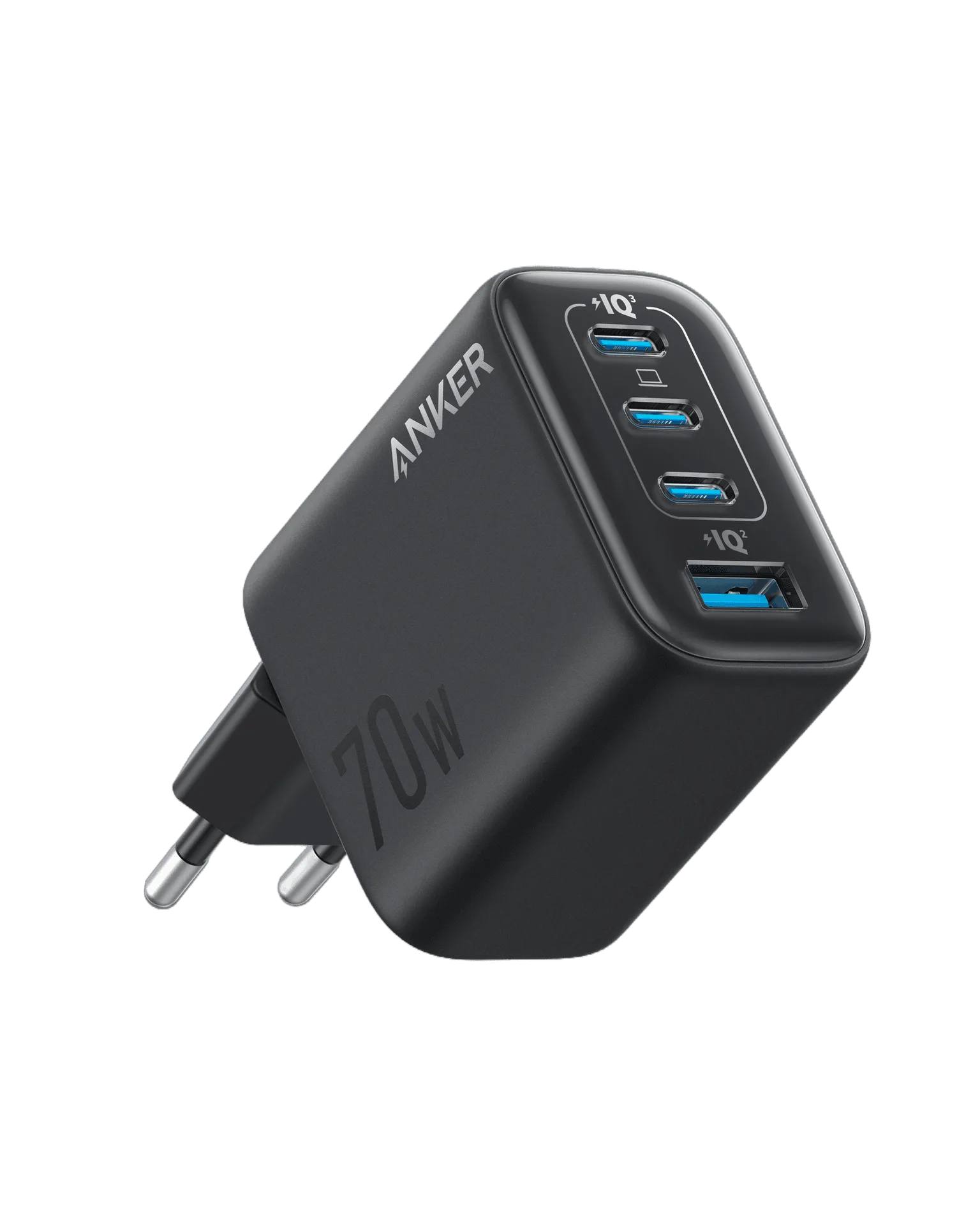
Anker Zolo Charger (70W, 4-Port, PD 3.0)
Who should buy a 70W 4-port charger
Best for
- Home users who want to charge a laptop, phone, and tablet from one outlet
- People with a mix of USB-C and USB-A devices who want future-proofing
Not for
- Travelers who need a compact, foldable plug design
- Users who need to charge two high-power laptops simultaneously