Quick Answer
Yes, 2 piece match-up puzzles are an excellent first puzzle for toddlers. They build matching, problem-solving, and fine motor skills with just enough challenge to keep little ones engaged without frustration.
Why Matching Beats Traditional Puzzles for Toddlers
Traditional puzzles with many interlocking pieces require a child to understand spatial relationships and trial-and-error fitting. Two-piece match-up puzzles simplify this by focusing on one clear goal: find the pair. This taps into a toddler's natural desire to sort and categorize, making the task intuitive and satisfying.
Match-up puzzles also encourage language development. As your child finds the animal pair, you can name the animal, the sound it makes, or the color. This turns a simple puzzle into a rich learning moment.
What to Look for in a Toddler Puzzle
Durability is key. Toddlers can be rough with toys, so thick, sturdy pieces that withstand bending and chewing are a must. Rounded corners and non-toxic finishes are also important for safety.
Engaging illustrations matter. Bright, colorful images that clearly represent the subject help hold attention and make the matching task easier. For example, a set featuring familiar animals with distinct colors and shapes is ideal for early learners.
A Trade-Off: Limited Pieces vs. Growing Skills
The simplicity of a 2 piece puzzle is its greatest strength, but also its limitation. Once your toddler masters matching pairs, they may quickly outgrow the set. That's a sign to move up to puzzles with more pieces or different concepts, such as numbers or letters.
To get more mileage, use the puzzle pieces for other activities. Ask your child to sort by color, name the animal, or build a story around the pair. This extends the life of the puzzle beyond just matching.
Decision Rules for Choosing a Toddler Match-Up Puzzle
- Age Check: If your child is between 18 months and 3 years and shows interest in matching or sorting games, a 2 piece match-up puzzle is a great fit. If they are younger than 18 months, look for puzzles with larger, chunkier pieces. Check the recommended age range on the box before buying.
- Skill Level: If your toddler is new to puzzles and easily frustrated, start with a small set of 3-4 pairs. If they already enjoy matching games, a larger set like 12 pairs offers more challenge and longevity. Start small if unsure, and gradually introduce more pairs.
- Interest Match: Choose a theme that matches your child's interests. If they love animals, a set like 'My First Animals' will be more engaging than a generic shape puzzle. Let your child's current obsession guide your choice.
- Quality Check: Look for thick, durable pieces with rounded corners and non-toxic materials. Avoid sets with small parts that could be a choking hazard. Inspect the puzzle for sturdiness before purchasing.
Product Spotlight
-
My First Animals 2 Piece Match-up Puzzles: This set includes 12 different animal pairs, perfect for developing matching skills and early learning. With 12 pairs, there's enough variety to keep your toddler engaged and to introduce new animals as they master the first few.
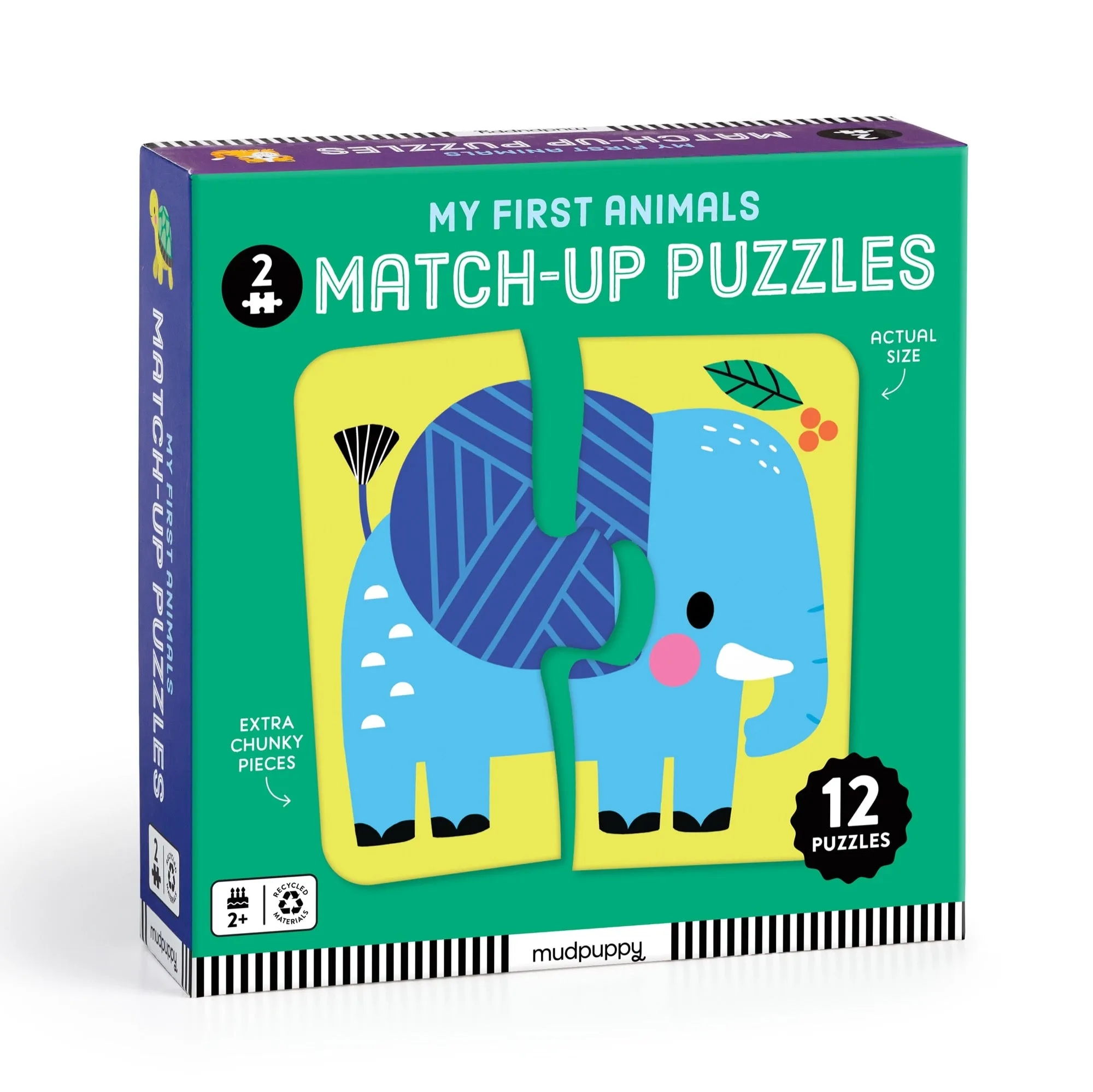
My First Animals 2 Piece Match-up Puzzles
Is a 2 Piece Match-Up Puzzle Right for Your Toddler?
Best for
- Toddlers aged 18 months to 3 years who are just starting to explore puzzles
- Parents looking for a simple, screen-free activity that builds matching and language skills
Not for
- Older children (4+) who need more challenging puzzles with more pieces
- Toddlers who already master 12-piece puzzles and need a next step up