Quick answer
Most dogs pull because the leash has never clearly taught them that a tight line stops forward movement. Fix it by rewarding slack, changing direction before the leash goes taut, and matching your gear to the job. If you walk two dogs or run with your dog, a double leash or a bungee leash can remove the tangled, jerky pulling that basic training alone cannot solve.
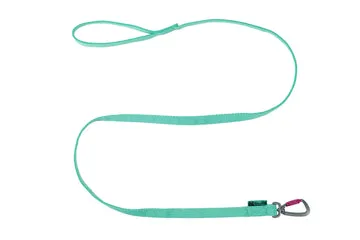
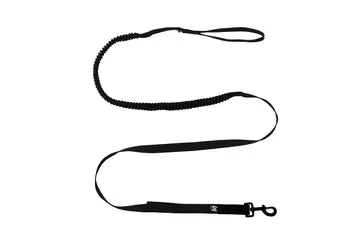
bungee leash
The pulling cycle you need to break
Pulling is a self-rewarding habit. Your dog leans forward, the walk continues, and the tension pays off. Every step you take while the leash is tight confirms that pulling works. The fix is not a stronger correction; it is making a loose leash the only way forward. Start in a low-distraction space and stop moving the instant the leash loses its slack. Wait, or turn and walk the other way. Your dog learns that forward motion is a privilege earned by a relaxed line, not a fight won by force.
Common causes behind leash pulling
Pulling rarely has a single cause. It usually comes from a mix of reinforcement history, arousal level, and equipment that makes tension feel normal. A dog who pulls only toward other dogs is overexcited, not stubborn. A dog who pulls from the first step may simply be moving faster than your pace. A dog who pulls after ten minutes may be tired, sore, or wearing a harness that changes their balance. Look at when the pulling starts, not just how hard it is, before you choose a fix.
- Reinforced habit: the dog has learned that tension equals progress.
- Arousal: the environment is more exciting than you are, so the dog forges ahead.
- Pace mismatch: your walking speed is slower than your dog's natural trot.
- Equipment: a fixed-length leash or poorly fitted harness can make steady tension feel unavoidable.
- Two-dog walks: one leash and two dogs often creates constant tangling and counter-pulling.
Fixes that work in daily walks
Teach a loose leash by rewarding position, not just absence of pulling. Keep a handful of treats at your hip and mark and reward every time your dog glances back or stays beside you. If your dog surges, stop, wait for the leash to soften, then move again. Practice this for five minutes in your yard or hallway before you try it on a busy street. Add a cue like 'with me' and reward heavily for the first few steps in the new position. If your dog can hold a loose leash for ten steps, you are ready to add a mild distraction, such as a quiet parking lot or a friend standing still at a distance.
When pulling is a gear problem, not a training problem
Some pulling is structural. If you walk two dogs on separate leashes, you will spend the whole walk untangling lines and correcting one dog while the other drags you forward. A double leash gives you one handle and two connection points, which removes the crossed-leash chaos and lets you manage both dogs with one hand. If you run or hike with your dog, a fixed leash transmits every sudden stop straight into your shoulder and your dog's neck. A bungee leash absorbs some of that shock and gives you a little more room to react. These tools do not replace loose leash training, but they make the training window calmer and safer.
Pulling diagnosis: symptom, cause, action, and when to stop
- Symptom: pulls from the first step of every walk: Likely cause is a reinforced habit: the dog has learned that forward tension equals forward motion. Corrective action is to stop moving the moment the leash tightens, wait for slack, then walk again. Practice in a low-distraction area first. If you see no improvement after two weeks of consistent stop-and-go, work with a trainer to rule out pain or arousal issues.
- Symptom: pulls only when another dog or person is visible: Likely cause is over-arousal, not disobedience. Corrective action is to increase distance from the trigger, reward your dog for looking back at you, and only move closer when the leash stays loose. Do not tighten the leash to hold your dog back; that adds tension and confirms the pulling. If your dog cannot eat treats or respond to their name near the trigger, you are too close. Move farther away and try again.
- Symptom: pulls harder with two dogs on separate leashes: Likely cause is line management, not training failure. Corrective action is to switch to a double leash so both dogs share one handle and you can reward slack without untangling. Keep training each dog individually for a few minutes before the group walk. If one dog still drags the other, walk them separately until each can hold a loose leash for ten steps on their own.
Leashes that help with pulling control
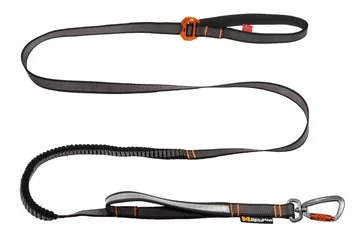
- Touring Double: The Touring Double leash from Nonstopdogwear is a double leash design that offers versatility for handling one or two dogs and is built to withstand regular wear and tear. If you walk two dogs and spend the whole walk untangling separate leashes, a double leash lets you keep both dogs on one handle and focus on loose leash training instead of line management.
- Bungee Leash Double: The Bungee Leash Double from Nonstopdogwear uses bungee construction to help absorb shock and reduce strain on both you and your dog, with a double design for hands-free use or attaching to a waist belt. For running or hiking with a dog who surges, the bungee reduces the sharp jolt that makes pulling feel worse and gives you both a smoother, more controlled line.
- Retriever Leash: The Retriever Leash from Nonstopdogwear is a simple, reliable leash design suited for daily walks and outdoor activities, built with quality materials for long-lasting performance. A straightforward leash is the right starting point for loose leash training. It gives you direct, predictable feedback without extra hardware while you build the habit.