Quick answer
Fringes on a fused silica lens are typically harmless Newton’s rings created by contact between the flat surface and a test plate, not a defect. The pattern is a sign of a well-made polish, not a flaw.
Why fringes appear and why they are usually normal
Interference fringes—concentric rainbow or monochromatic rings—occur when two nearly matching surfaces come into optical contact. In a plano-convex lens, the flat side is polished to a precise radius against a reference flat during quality inspection. The resulting fringe pattern tells the inspector how closely the surface matches the intended shape. A few uniform fringes actually confirm the polish quality; zero fringes would mean a perfect fit that is rarely required or cost-effective.
The confusion arises because users mistake this metrology artifact for a scratch, delamination, or coating defect. Fringes shift when you change viewing angle or pressure, whereas physical damage remains fixed. If the pattern is symmetrical and disappears when you lift the lens from its holder, it is almost certainly harmless interference.
When fringes signal a real problem
Fringes can indicate a problem if the pattern is irregular, has sharp breaks, or appears inside the glass, not at the surface. Internal fringes may suggest stress birefringence from uneven annealing or mounting pressure. Also, if the lens was coated and the fringe pattern changed after cleaning, the coating may be delaminating.
A quick test: place the lens on a clean, flat, dark background under a single light source. If the fringes remain fixed as you rotate the lens, the issue is likely surface contact. If they shift or distort, the substrate or coating could be compromised.
Diagnosis: Fringe pattern on your plano-convex lens
- Symptom: Concentric colored or monochromatic rings appear on the flat side of the lens when viewed under a point light source.
- Likely cause: Optical contact between the lens flat and a test plate or mounting surface creates Newton’s rings. This is a routine quality-inspection artifact, not a defect. If the pattern is symmetrical and changes with pressure or angle, it is harmless interference.
- Corrective action: Remove the lens, clean both surfaces with lens tissue and isopropyl alcohol, then re-place it on a clean, flat holder. If fringes disappear, the issue was contamination. If they persist uniformly, proceed with use.
- Stop and choose another option when: Fringes are irregular, have sharp discontinuities, or appear inside the glass rather than at the surface. Also stop if the pattern remains fixed after cleaning and rotation—this could indicate stress or coating damage. Contact your supplier with a photograph of the pattern under a single light source to determine if a replacement is needed.
Our recommendation
-
Plano-Convex Lenses, S1-UV Grade Fused Silica: Esco manufactures plano-convex lenses from S1-UV Grade Fused Silica, pitch polishing every optic for excellent surface quality. Pitch polishing produces a smooth surface that naturally shows clean, uniform interference fringes—confirming the lens is properly made, not defective.
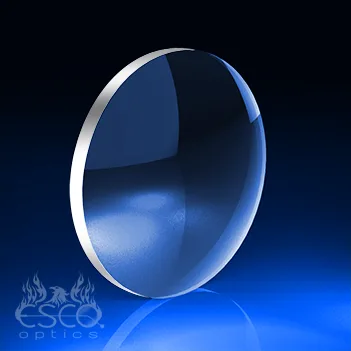
Plano-Convex Lenses, S1-UV Grade Fused Silica