Quick answer
Most scratchy lace robes feel that way because of starch or sizing left in the fabric, a stiff scalloped or eyelash trim, or a rough seam edge, not because the lace fiber is bad. Hand wash the robe in cool water with a drop of gentle detergent, rinse twice, and air dry flat; that removes the finish that makes lace prickly. If it still scratches after two washes, stop and treat it as a fit or trim problem rather than washing it again.
You put on a lace robe for the softness, and instead the neckline prickles, the sleeves catch on your arms, and you spend the morning tugging at it. That is frustrating, especially when the robe is meant for getting-ready photos or everyday lounging. The good news: in most cases the lace is not the problem, and you do not need to replace the robe.
Scratchiness has a short list of causes, and each one has a different fix. Work through them in order, from the least invasive to the most, and stop as soon as the robe feels comfortable against your skin.
Why lace feels itchy in the first place
New lace often arrives with a light starch or sizing applied by the mill or finisher to keep the pattern crisp through cutting and shipping. That coating is what you feel as a prickle. It softens with water, which is why a robe that feels rough out of the box usually improves after one or two gentle washes.
The second common cause is the trim itself. Scalloped edges, eyelash trim, and crochet eyelet finishes have raised threads that can catch on skin. On a robe like the Dreamer Eyelet crochet lace robe, the eyelet and broderie anglaise texture is part of the design, so the surface will always have a little dimension. That is different from a chemical stiffness, and it needs a different response.

Dreamer Eyelet crochet lace robe
- Test the fabric against your inner wrist before washing. If it feels rough there, it is the finish, not your skin.
- Check the seams and the tie belt. A stiff belt or a scratchy seam can irritate more than the lace body.
How to soften lace fabric safely
Fill a basin with cool water and add a small amount of gentle, pH-neutral detergent made for delicates. Submerge the robe and let it soak for ten to fifteen minutes, then move it gently through the water. Do not wring, twist, or scrub the lace. Rinse in cool water until the water runs clear, which usually takes two rinses, then press the water out between two towels.
Dry the robe flat on a clean towel, reshaping the lace as it dries. Hanging a wet lace robe can stretch the shoulders and distort the scallops. If the robe still feels stiff after drying, repeat the wash once. Two gentle washes are enough to remove normal sizing.
- Never use fabric softener on lace. It coats the fibers and can leave a residue that attracts dust.
- Skip the dryer entirely. Heat is the fastest way to shrink or distort a lace robe.
When the problem is the trim, not the fabric
If the body of the robe feels soft but the edges still scratch, the issue is the trim construction. Eyelash trim, scalloped hems, and crochet edges have loose or raised threads by design. You can soften the feel slightly by steaming the trim with a garment steamer held a few inches away, which relaxes the fibers without wetting the whole robe.
For a robe with a silk satin tie belt, check whether the belt is the culprit. A stiff satin ribbon can feel cool and slick rather than soft, and it may be what you notice at the waist. Loosening the belt or wearing the robe open solves that without any washing.
- Steam the trim only, not the whole robe, and let it dry completely before wearing.
- If the trim still scratches after steaming, the robe may simply not suit your skin sensitivity.
What not to do when a lace robe feels scratchy
Do not reach for hot water, bleach, or a heavy-duty detergent. Lace fibers, especially fine French Chantilly and leavers lace, are delicate and will weaken or yellow. Do not scrub the lace against itself to soften it, and do not soak it overnight. Long soaking can break down the finish on the threads and cause pilling.
Do not assume a scratchy robe is defective. In most cases the stiffness is temporary and expected. If you have washed it twice with cool water and gentle detergent and it still irritates your skin, the robe is not going to soften further, and you should stop.
- Avoid washing a lace robe with towels or jeans. The friction roughs up the lace surface.
- If the robe has 24k gold plated hardware, keep it away from harsh detergents that can dull the plating.
Choosing a lace robe that feels comfortable from the start
If you are shopping rather than fixing, look at the fiber content and the trim style. A robe made of 100% embroidered cotton, like the Dreamer Eyelet crochet lace robe, tends to feel breathable and softens well with washing, though the eyelet texture is intentionally dimensional. A robe made in French Chantilly lace, like the Swan Queen lace kimono bridal robe in Ivory, has a finer, lighter hand and a fully scalloped hem, so the trim is part of the design rather than an add-on.
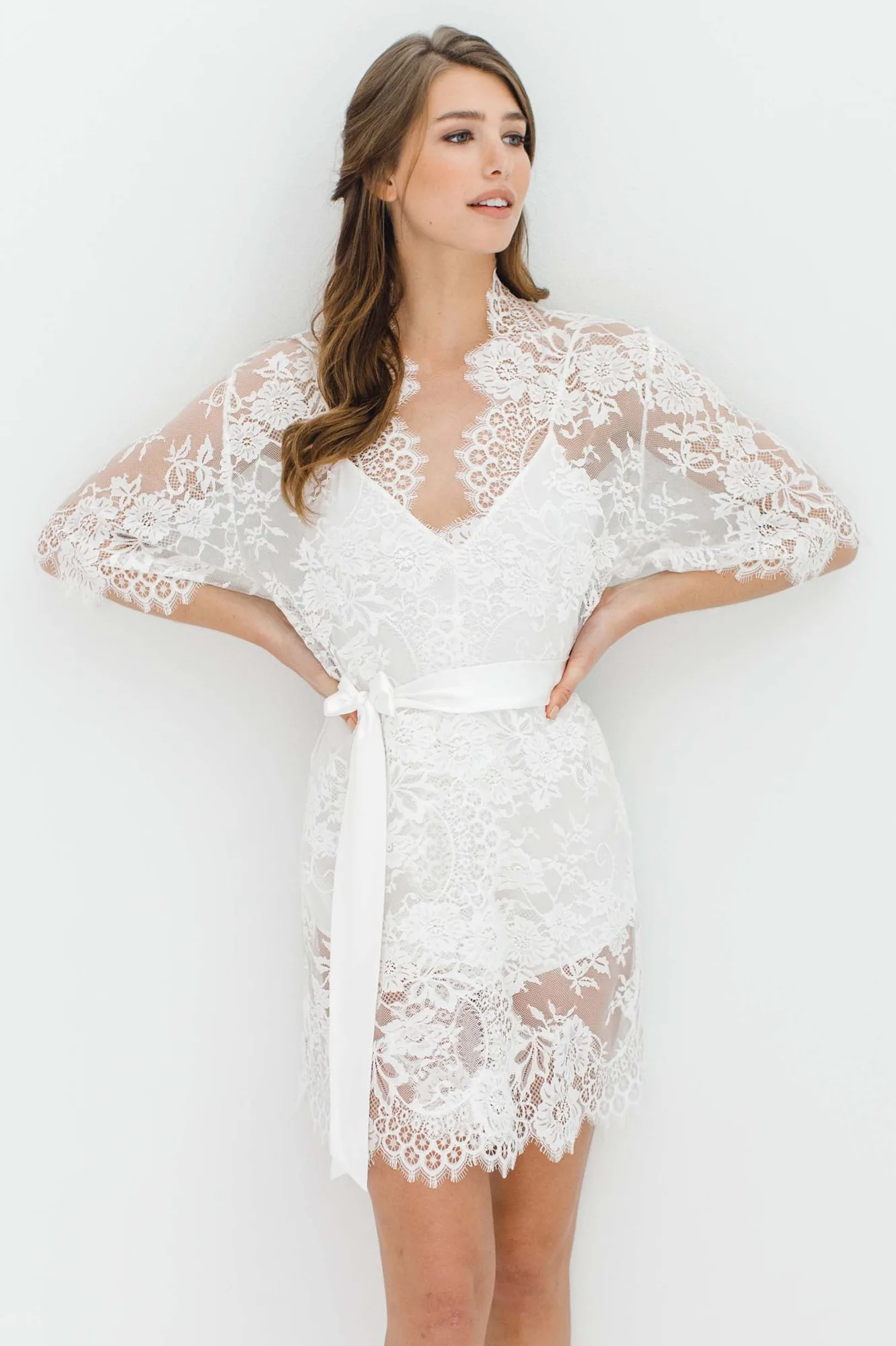
Swan Queen lace kimono bridal robe in Ivory
For a layer that sits closest to skin, a silk and lace piece such as the Marlene French Lace and silk chemise slip dress uses 100% silk with French Chantilly lace at the neckline and hem, which gives you a smooth body fabric with lace only where it shows. That combination is often the easiest on sensitive skin.
- Choose a robe with a smooth fabric body if your skin is easily irritated by textured lace.
- Check the care instructions before buying. Made-to-order pieces may have specific washing guidance.
Diagnose your scratchy lace robe
- Symptom: the whole robe feels stiff and rough: This is almost always leftover starch or sizing from manufacturing. Hand wash in cool water with gentle detergent, rinse twice, and dry flat. If it is still stiff after two washes, stop washing and consider a different fabric.
- Symptom: only the edges and neckline scratch: The trim, not the lace body, is the problem. Steam the trim lightly and check whether the tie belt is the real irritant. If steaming does not help, the trim style may not suit your skin.
- Symptom: you feel prickling along the seams: Inspect the seams and any hardware. A rough seam or exposed hook can scratch even when the lace is soft. If the seam is the cause, the robe needs a repair, not a wash.
- Symptom: the robe still scratches after two gentle washes: You have removed the sizing and relaxed the trim, and it still irritates. Further washing will only risk damaging the lace. Stop here. Choose a smoother fabric or a different trim style.
Product details that affect comfort
- Dreamer Eyelet crochet lace robe: Made in 100% embroidered cotton with broderie anglaise and eyelet details, side slits, and flared sleeves. Cotton softens with washing and breathes well, but the eyelet and crochet texture is raised by design, so expect some surface dimension against skin.
- Swan Queen lace kimono bridal robe in Ivory: Handmade in French Chantilly lace with a fully scalloped hem, scalloped edges with eyelash trim at the neckline, sleeves, and hem, and a silk satin tie belt. Chantilly lace is fine and lightweight, but the eyelash trim and scalloped edges are the parts most likely to feel scratchy if your skin is sensitive.
- Marlene French Lace and silk chemise slip dress: Made of 100% silk with delicate French Chantilly lace on the neckline and hem, made to order with a 2-8 week lead time. The silk body gives a smooth surface where it touches most of your skin, with lace limited to the neckline and hem, which reduces overall itch risk.
A scratchy lace robe is usually a temporary finish problem, not a permanent flaw. Wash it gently in cool water, dry it flat, and give it one more chance. If it still prickles after that, the fix is a different robe, not another wash.