Quick answer
Most inaccurate home blood pressure readings come from a cuff that does not match your arm, an unsupported arm, or measuring too soon after coffee, exercise, or a full bladder. Check cuff fit first, then your position, then your timing.
Why cuff size is the first thing to check
A cuff that is too small can squeeze the arm harder than it should and push the reading up; one that is too large can under-read. The fix is not a technique tweak, it is matching the cuff to your measured upper-arm circumference.
Measure around the middle of your upper arm, midway between shoulder and elbow, and compare that number with the cuff range printed on the cuff or in the manual. If your arm sits at the edge of a range, or your reading swings between visits, the cuff is a likely culprit.
Position and timing errors that mimic a real problem
An arm left hanging, a back unsupported, or feet dangling can each shift a reading. Rest for five minutes first, then sit with your back supported, feet flat, and the cuff at heart level.
Timing matters just as much. Caffeine, nicotine, exercise, and a full bladder can all raise a reading temporarily, so wait at least 30 minutes after those before measuring. For consistency, take readings at the same times each day and log them rather than judging from one number.
Diagnose the cause of your reading
- Symptom: readings swing widely between visits: Measure your upper-arm circumference at the midpoint and compare it with the range printed on your cuff. If it sits outside that range, or you are using a cuff that came with a different monitor, replace it with one sized to your arm. A cuff that is loose, tight, or outside its printed range is a measurement error, not a health trend.
- Symptom: readings are consistently higher at home than at the clinic: Sit for five minutes with back supported and feet flat, rest the cuff arm on a table so the cuff is at heart level, and avoid talking during the measurement. Take two readings a minute apart and average them. If your arm is unsupported or below heart level, the number will read higher even when your blood pressure has not changed.
- Symptom: one-off high reading after coffee, exercise, or a stressful morning: Wait at least 30 minutes after caffeine, nicotine, or exercise, and empty your bladder before measuring. Repeat at the same time on several days rather than reacting to a single result. Single spikes are common; a pattern across several days is what matters.
- Stop and seek advice when: Your monitor still gives inconsistent or implausible readings after you have corrected cuff size, position, and timing, or you feel unwell with a very high reading. Do not adjust medication based on home readings alone; speak to your pharmacist or GP. Home readings guide a conversation with a clinician, they do not replace one.
Product facts
-
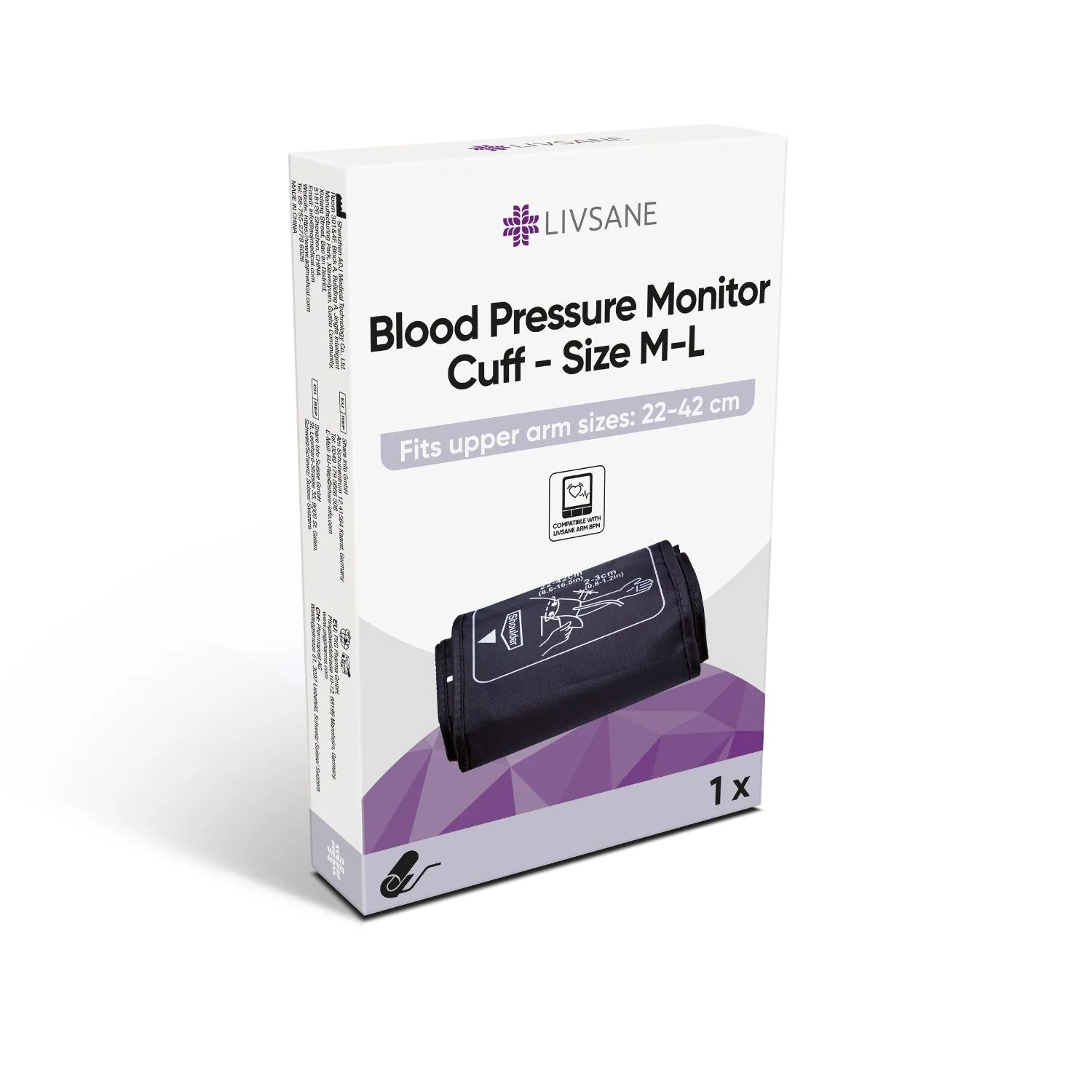
LIVSANE Blood Pressure Monitor Replacement Cuff M-L (22-42cm): The LIVSANE Blood Pressure Monitor Replacement Cuff M-L fits arm circumferences from 22cm to 42cm and is designed for compatible LIVSANE arm monitors. If your upper-arm measurement falls outside your current cuff's range, replacing it with a correctly sized cuff is often the simplest way to remove one source of error.
LIVSANE Blood Pressure Monitor Replacement Cuff M-L (22-42cm)