Quick Answer
For most homes over 1,500 square feet or with multiple floors, a Wi-Fi 6 mesh system like the TP-Link Deco X55 provides more consistent whole-home coverage than a single traditional router. If you have a small apartment or a tight budget, a traditional router can still be a practical choice.
Coverage: One Box vs. a Network
A traditional router broadcasts from a single point, so walls, floors, and distance create dead zones. A mesh system uses multiple units that talk to each other, blanketing your home with one seamless network. The TP-Link Deco X55 3-pack covers up to 6,500 square feet, which is far beyond what a single router can realistically handle.
Performance: Wi-Fi 6 in Both, But Mesh Adds Flexibility
Both modern traditional routers and mesh systems can support Wi-Fi 6, the latest standard that improves speed and handles more devices. The difference is how they deliver that performance. A mesh system places multiple access points throughout your home, so devices connect to the nearest unit instead of struggling with a weak signal from one router. This matters in homes with many smart devices, streaming, or gaming in different rooms.
Cost and Setup: The Trade-Off
Mesh systems generally cost more upfront because you're buying multiple units. The TP-Link Deco X55 3-pack is priced at $105.39 (compared to $169.98), which is competitive for a three-piece system. Traditional routers are often cheaper, but you may need to add a range extender later, which can reduce performance and complicate setup. Mesh systems like the Deco X55 are designed for easy setup and management through an app, while traditional routers often require more manual configuration.
Trade-Offs at a Glance
- Coverage: Mesh systems like the Deco X55 provide whole-home coverage with multiple units; traditional routers cover a limited area from one point. Measure your home's square footage and identify dead zones before choosing.
- Cost: Mesh systems cost more upfront but can replace extenders; traditional routers are cheaper but may need add-ons. Factor in future costs of extenders or additional mesh units.
- Setup and Management: Mesh systems typically offer app-based setup and management; traditional routers may require more manual configuration. Consider your comfort with networking setup—mesh is generally more user-friendly.
Product Facts
-
TP-Link Deco AX3000 WiFi 6 Mesh System(Deco X55) - Covers up to 6500 Sq.Ft. , Replaces Wireless Router and Extender, 3 Gigabit ports per unit, supports Ethernet Backhaul (3-pack): The TP-Link Deco X55 is a dual-band Wi-Fi 6 mesh system that covers up to 6,500 sq. ft. with three units. This coverage makes it suitable for larger homes or multi-story layouts where a single router would leave dead zones.
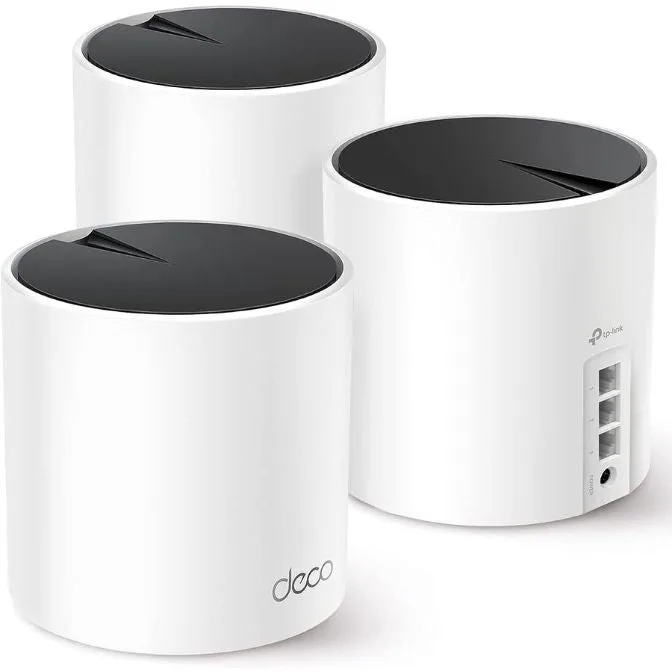
TP-Link Deco AX3000 WiFi 6 Mesh System(Deco X55) - Covers up to 6500 Sq.Ft. , Replaces Wireless Router and Extender, 3 Gigabit ports per unit, supports Ethernet Backhaul (3-pack)
Who Should Choose What
Best for
- Homes over 1,500 sq. ft. or with multiple floors
- Users who want seamless roaming and easy app management
- Households with many connected devices needing consistent Wi-Fi 6 performance
Not for
- Small apartments or single-room setups where a single router is sufficient
- Budget-conscious buyers who don't need whole-home coverage and prefer a single device