Quick answer
Use wild-caught salmon dog treats as a high-value reward for new or hard cues, not as a meal replacement. Break each treat into pea-sized pieces, reward within a second of the correct behavior, and count treats against your dog's daily food allowance.
Why salmon treats work as high-value rewards
Fish-based treats often carry a stronger smell than everyday biscuits, which can help a dog choose training over distractions. That matters most in new environments or when you are teaching a cue from scratch.
The trade-off is richness. Salmon treats are not automatically lower in calories than other rewards, and the catalog does not list calorie content per treat, so you need to judge portion size by your dog's response and overall daily food intake rather than by a fixed number.
When to skip salmon treats in training
If your dog has a sensitive stomach or a diagnosed food allergy, introduce any new treat slowly and check with your veterinarian before using it as a frequent training reward. Salmon is a fish protein, so it is not a substitute for a limited-ingredient plan your vet has set.
Also skip soft treats in a training pouch left in a hot car or direct sun. Texture changes quickly, and a treat your dog normally loves can become unappealing or messy.
Step-by-step: using salmon treats in training
- 1. Pick the right cue for a high-value reward: Reserve salmon treats for a cue your dog is still learning or one that is hard in a distracting place, such as recall or a settle on a mat. Use your regular kibble or a lower-value treat for easy, well-known behaviors. If your dog ignores the salmon treat, the environment is probably too distracting; move farther away before adding more reward value.
- 2. Break treats into pea-sized pieces before the session: Tear or cut each soft treat into small pieces and place them in a training pouch. A full treat is usually more than one reward, and pre-cutting keeps your reward timing fast. Do not reward with a whole treat for a simple repetition; you will slow the session and add unnecessary food.
- 3. Reward within one second of the correct behavior: Mark the moment your dog gets it right with a word or clicker, then deliver the salmon piece immediately. If you are late, your dog may associate the reward with standing up or looking away instead of the behavior you wanted. Keep the treat in your hand, not in the pouch, for the last second before you reward so you are not fumbling.
- 4. Count treats against the daily food allowance: Subtract the approximate amount of training treats from your dog's meals that day, or reduce the meal slightly on heavy training days. The catalog does not state calories per treat, so use piece count and your dog's body condition as your guide. Weigh your dog or check rib coverage weekly during intense training; adjust meal portions if weight starts to creep up.
- 5. Fade the salmon treat as the cue becomes reliable: Once your dog responds correctly in a quiet place, switch to a lower-value treat for most repetitions and save salmon for random surprise rewards or harder locations. This keeps the salmon treat special and prevents your dog from expecting it for every easy cue. Keep one salmon reward in five for maintenance, but do not use it as the only reward forever.
- 6. Store the bag for texture and freshness: Reseal the bag after each session and keep it out of heat and direct sun. Soft, chewy treats can dry out or become sticky if left open, which makes them harder to break into small pieces. If the treats become stiff or crumbly, break them over a bowl rather than in your pocket to avoid losing the reward mid-session.
Product facts
-
Be Good Bites Wild-Caught Salmon Recipe Treats: Be Good Bites Wild-Caught Salmon Recipe Treats use Ocean Wise recommended wild-caught salmon as the first ingredient and have a soft, chewy texture. The soft texture tears easily into small training pieces, so you can reward quickly without giving a full-size treat for every repetition.
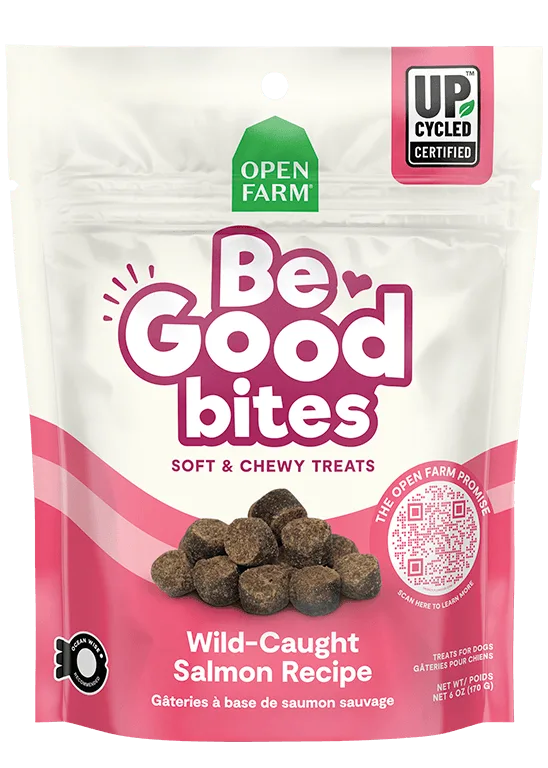
Be Good Bites Wild-Caught Salmon Recipe Treats