Quick answer
Use the Wooden Allotment Crate to spark open-ended pretend play that grows your child's language, empathy, and social confidence. These simple steps turn the crate into a garden, a market, or a kitchen.
Why pretend play matters
Pretend play helps toddlers develop communication skills and understand the world around them. A themed toy like the Wooden Allotment Crate gives them a familiar context—growing and selling vegetables—to practice real-life roles.
Because the crate comes with five wooden vegetables (aubergine, carrot, mushroom, turnip, and leek), children can sort, name, and count them while playing. This adds a gentle learning layer without feeling like a lesson.
What the Wooden Allotment Crate includes
The set contains one wooden crate and five play food pieces: an aubergine, a carrot, a mushroom, a turnip, and a leek. There are no extra accessories or tools, which keeps the play focused on the vegetables and the child's imagination.
Because the crate is open-ended, you can pair it with other toys like a play kitchen or shopping basket to extend the scenarios. The simple design means it works for both indoor and outdoor pretend play.
5 pretend play ideas with the Wooden Allotment Crate
- Set up a mini garden: Place the crate on a play mat or towel and pretend it is a garden bed. Let your child 'plant' each vegetable by pushing it into the mat or into a small bowl of dried beans. Say the name of each vegetable as they plant it. Common mistake: skipping the naming step. Saying the vegetable names out loud builds vocabulary naturally.
- Run a market stall: Arrange the vegetables in the crate and invite your child to be the seller. Take turns being the customer who asks for one vegetable at a time. Use phrases like 'I'd like a carrot, please.' Checkpoint: If your child is shy, start by being the seller yourself so they can watch and learn the dialogue.
- Sort and count vegetables: Empty the crate and ask your child to put all the vegetables back one by one. Count each piece as it goes in: 'One aubergine, two carrots…' You can also sort by color or size. Common mistake: expecting perfect counting. The goal is exposure to numbers, not accuracy.
- Cook a pretend meal: Pair the crate with a play kitchen or a simple bowl and spoon. Let your child 'wash' the vegetables, chop them with a play knife, and stir them in a pot. Narrate what they are doing: 'You are chopping the mushroom for soup.' Checkpoint: If you don't have a play kitchen, a cardboard box and a few utensils work just as well.
- Play a guessing game: Put one vegetable behind your back and describe it without naming it: 'I have something purple and long.' Let your child guess which vegetable it is. Switch roles so they describe and you guess. Common mistake: making the description too hard. Keep it simple: color, shape, or size.
Product facts
-
Wooden Allotment Crate: This wooden play food market basket contains an aubergine, a carrot, a mushroom, a turnip and a leek. The five distinct vegetables give your child enough variety to practice naming, sorting, and counting during pretend play.
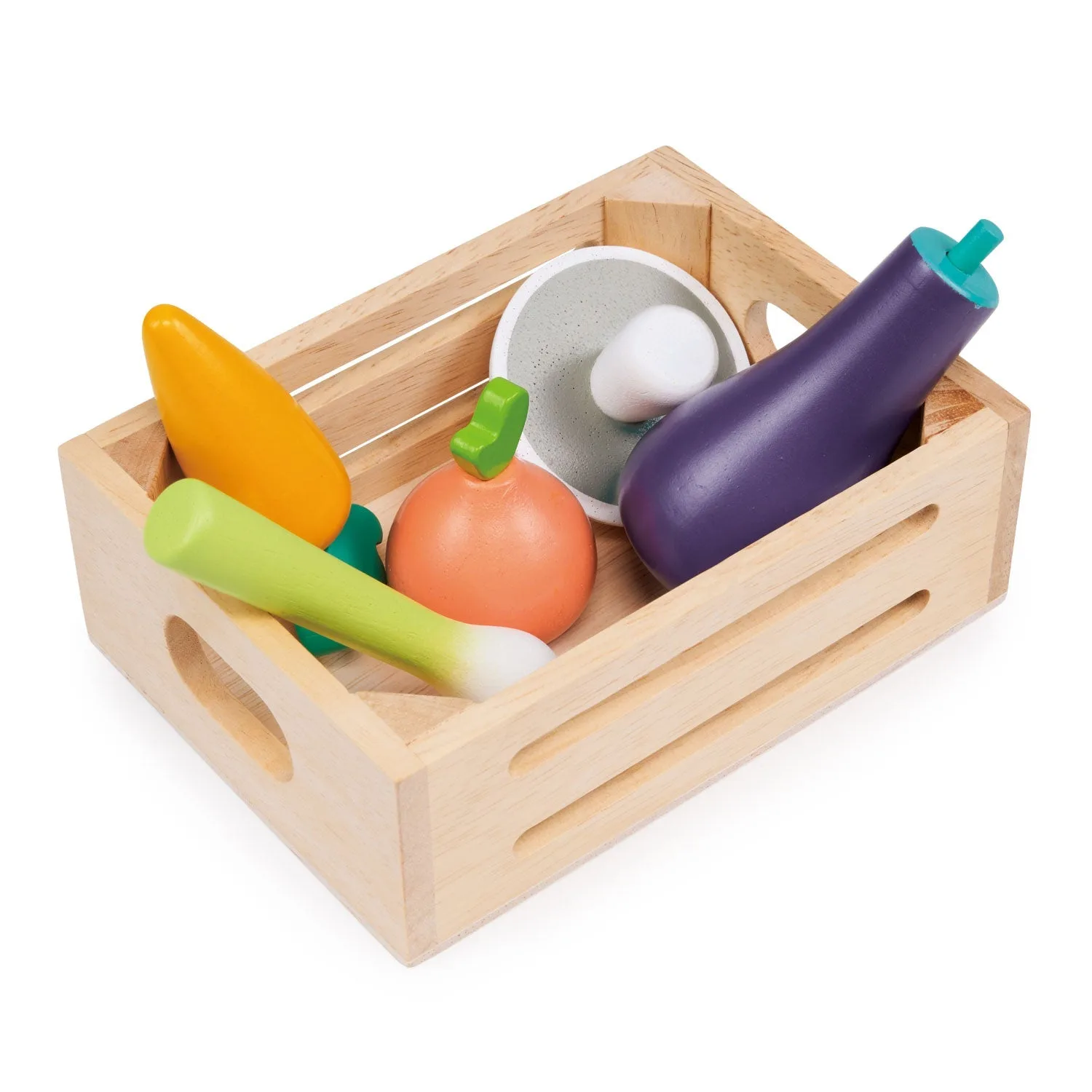
Wooden Allotment Crate