Quick answer
Use the Wooden Garden Lacing Fun Set to strengthen your toddler's hand muscles and coordination through guided threading, weaving, and pattern play.
Why lacing toys help more than puzzles
Threading a cord through small holes requires precise finger movements that build the same muscles used for writing, buttoning, and zipping. Unlike puzzles that rely on visual matching alone, lacing forces both hands to work together — one holding the board steady, the other guiding the cord. This bilateral coordination is a key milestone for children ages 2 to 4.
The garden theme adds a layer of storytelling. A child might pretend the butterfly needs a colorful trail or the flower is growing new petals. That narrative keeps them engaged longer than abstract lacing cards.
What the set includes and what it doesn't
The Wooden Garden Lacing Fun Set comes with three illustrated wooden boards (butterfly, flower, snail) and colored cords. The boards are pre-drilled with holes, and the cords have stiff tips that make threading easier for small hands. What you won't find is a storage bag or a pattern guide — the open-ended design is intentional, but you may want to keep the cords in a small container to avoid tangles.
How to use the lacing set for skill building
- Start with one board and one cord: Choose the simplest board (the snail has the fewest holes) and hand your child a single cord. Let them explore threading without instructions first. Common mistake: handing over all three boards at once overwhelms toddlers and leads to frustration. If your child drops the cord after one try, switch to the butterfly board — its larger holes are more forgiving.
- Demonstrate the pincer grip: Show your child how to hold the cord tip between thumb and index finger. Guide their hand through the first hole from front to back, then let them pull the cord through. Common mistake: adults pull the cord completely through, leaving nothing for the child to grasp. Always leave a tail. When they can thread three holes independently, introduce the second cord and let them weave two colors together.
- Add a pattern challenge: Once basic threading is mastered, suggest a simple pattern — 'red through the top row, yellow through the bottom row.' Point to the holes as you say the color. Common mistake: expecting perfect alternation. Toddlers often skip holes or repeat colors, which is fine. The goal is sequencing, not accuracy. If your child reverses the pattern, praise the effort and try again tomorrow. Pattern recognition develops unevenly.
- Turn it into a quiet-time activity: Place the boards and cords in a low basket near a small table. Let your child choose when to play. Common mistake: treating lacing as a structured lesson. The real benefit comes from repeated, self-directed practice — five minutes here, ten minutes there. After a few weeks, your child will likely thread without looking at their hands. That's the sign that fine motor control is becoming automatic.
Product facts
-
Wooden Garden Lacing Fun Set: Three illustrated boards — a butterfly, a flower, and a snail — with colored cords for threading and weaving. Each board offers different hole patterns, so your child practices varied hand movements instead of repeating the same motion.
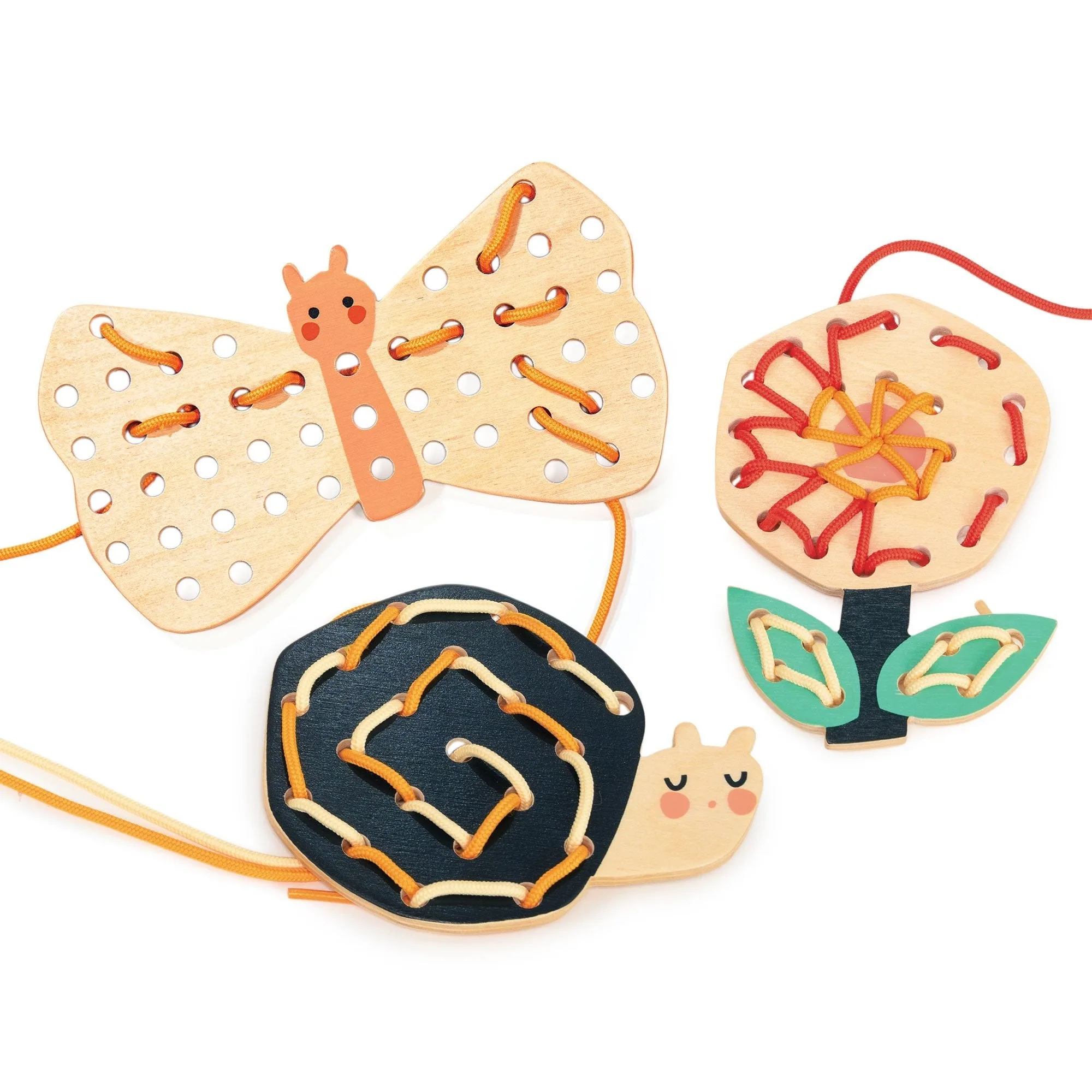
Wooden Garden Lacing Fun Set