Quick answer
For ages 3–6, choose a USA map puzzle when you want your child to learn states and landmarks close to home, and a world map puzzle when you want continents and oceans first. If you cannot decide, the QUOKKA Wooden Map Puzzle Set covers both in one purchase.
Match the map to what your child already knows
Geography puzzles work best when the child can connect a piece to something they have seen or heard about. A USA map puzzle builds on road trips, state names on license plates, or family members living elsewhere. A world map puzzle works better for children who already ask about other countries, animals, or oceans. Starting with the map that overlaps their current world keeps the puzzle a game rather than a test.
Piece count and size matter more than the map itself
A map puzzle for a 3-year-old and one for a 6-year-old can look similar in a photo but behave very differently at the table. Chunky wooden pieces are easier for small hands to grip, place, and pull out without tearing. If the pieces are small or thin, the puzzle tends to become a frustration exercise. Check the piece style before the theme, because a well-sized puzzle your child can finish will teach more geography than a harder one they abandon.
One map or two: the real trade-off
A single map keeps the focus on one region and usually costs less, but it runs out of new information once your child memorizes it. A two-map set adds variety and lets siblings work at different levels, but it takes more shelf space and may be more than a 3-year-old can manage at once. If you plan to use the puzzle for more than one year, the set often earns its place. If you only need a first introduction, one map is enough.
Decision rules for buying a wooden map puzzle
- Choose a USA map puzzle if...: Your child is 3–5, talks about states, landmarks, or places you have visited, and needs the first map to feel familiar. A puzzle for learning states works best when the child can point to somewhere they have been.
- Choose a world map puzzle if...: Your child is 5–6, already knows the basics of their own country, and asks about animals, oceans, or other countries. A world map puzzle for kids introduces continents before state-level detail. If your child is 3 and has no map experience, start with the USA map and add the world map later.
- Choose a two-map set if...: You want one purchase that grows with your child, or you have siblings at different ages. The QUOKKA Wooden Map Puzzle Set gives you both maps in one box, so you can rotate them instead of buying twice.
- Skip the map puzzle if...: Your child is under 3, still mouths small objects, or has no interest in places yet. A shape or animal puzzle is a better first step before geography.
Product facts
-
Wooden Puzzles for Kids - Realistic USA and World Map: The QUOKKA Wooden Map Puzzle Set includes one USA map puzzle with color-coded states, animals, and landmarks, plus one world map puzzle with continents, oceans, and global wildlife, made with smooth, chunky wooden pieces. The chunky pieces suit small hands, and the two maps let you start with states and add continents later without buying a second puzzle.
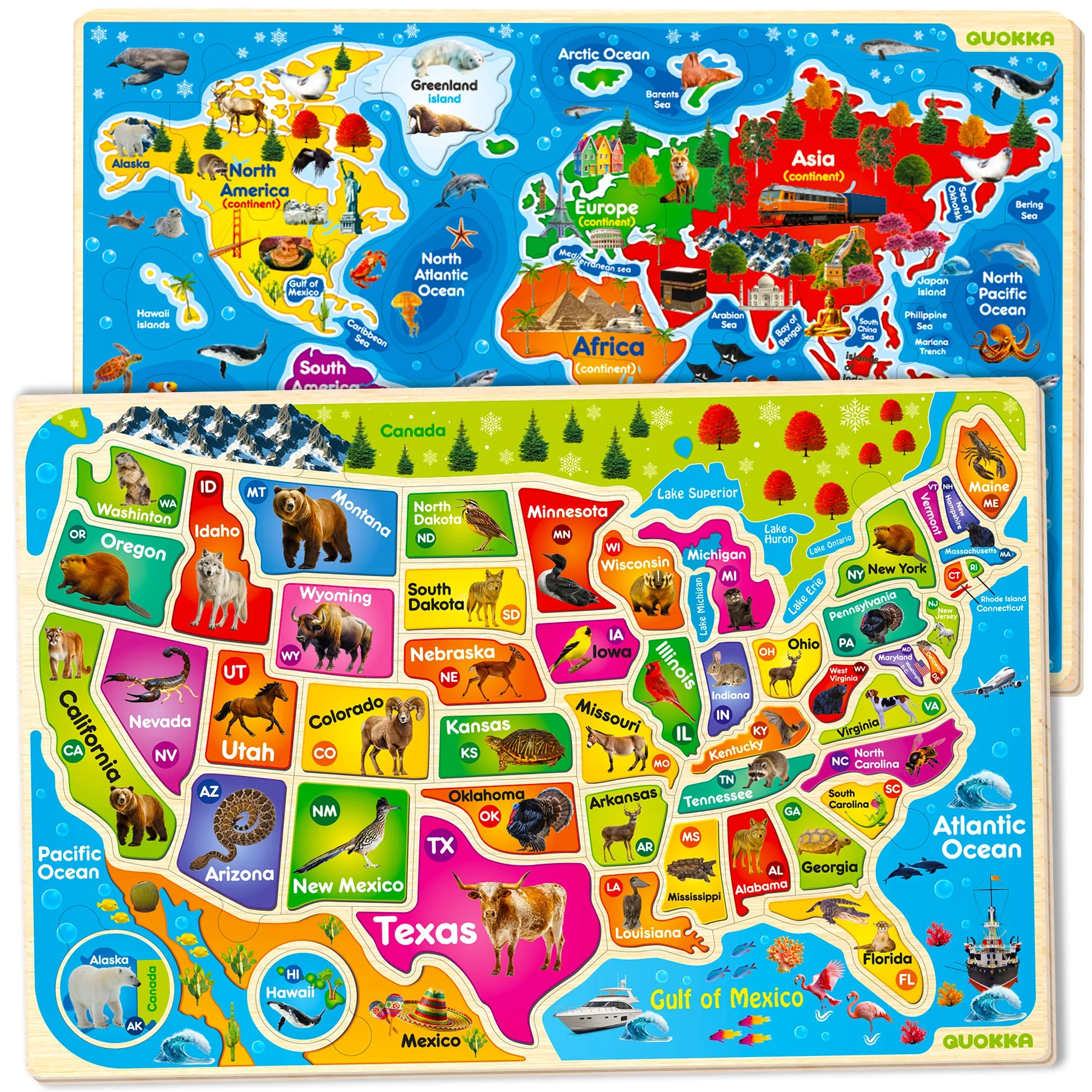
Wooden Puzzles for Kids - Realistic USA and World Map
Who this guide is for
Best for
- Parents of children ages 3–6 who want a first geography puzzle
- Families choosing between a USA map and a world map
- Buyers who want one set that works for siblings at different ages
Not for
- Toddlers under 3 who still put small pieces in their mouths
- Older children who already know states and continents and need a harder challenge
- Buyers looking for a screen-based or app-based geography toy