Quick answer
A 100-piece world map jigsaw is best for kids aged 6 to 9 who enjoy visual challenges and are ready to build patience and spatial reasoning. It also introduces geography in a hands-on way, but younger children or those who prefer open-ended play may need a simpler puzzle or a different activity.
Why a world map puzzle builds more than geography
A world map jigsaw for kids goes beyond naming continents. Assembling a 100-piece puzzle requires matching colors, shapes, and edge patterns, which strengthens visual discrimination and hand-eye coordination. As children search for where a country or landmark fits, they practice spatial reasoning and memory.
The educational value also comes from the content itself. A children's world map puzzle shows continents, countries, and landmarks, so kids absorb geography facts while they play. That combination of physical manipulation and visual learning makes it a genuinely educational puzzle for kids, not just a time-filler.
Trade-off: 100 pieces may frustrate younger kids
The main trade-off is difficulty. A 100-piece puzzle demands sustained attention and a strategy, such as sorting edge pieces first. Kids under 5 often lack the fine-motor control and patience for this piece count, so they may get frustrated and lose interest.
For older kids, the challenge is usually right. A 100-piece puzzle is substantial enough to feel rewarding but not so large that it overwhelms. If your child is new to puzzles, consider starting with a smaller piece count and working up to 100 pieces.
Decision rules for choosing a world map puzzle
- Age 4–5: Choose a puzzle with 24–50 pieces or a large-piece floor puzzle. A 100-piece world map is likely too hard and may discourage early learners. Look for puzzles with fewer pieces and bigger pieces for this age.
- Age 6–8: A 100-piece jigsaw is a good fit if your child has completed 50-piece puzzles before. It offers a satisfying challenge that builds patience and spatial skills. Check that your child can sort edge pieces and work independently for short periods.
- Age 9+: A 100-piece puzzle is still enjoyable, but your child may finish it quickly. If they want more challenge, look for a 200–500 piece map puzzle or a puzzle with smaller pieces. Consider a higher piece count to keep the challenge level appropriate.
- Interest in geography: If your child shows curiosity about countries or travel, a world map jigsaw is a great fit. If they prefer stories or building, they might enjoy a themed puzzle or a different interactive toy instead. Match the puzzle theme to your child's current interests for better engagement.
Product facts
-
World Map Jigsaw Puzzle – 100 Pieces (New): This 100-piece jigsaw features a bright and detailed world map with continents, countries, and landmarks. The visual detail gives children clear cues for matching pieces, which supports learning geography while building puzzle-solving skills.
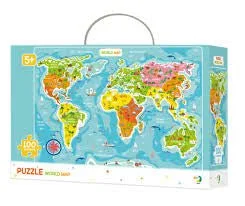
World Map Jigsaw Puzzle – 100 Pieces (New)
Who is this puzzle for?
Best for
- Kids aged 6–9 who have completed simpler puzzles and want a geography-themed challenge
- Families looking for a screen-free activity that combines learning and play
Not for
- Children under 5 who may find 100 pieces frustrating
- Kids who prefer open-ended building or imaginative play over structured puzzles