Quick answer
For large countertops, choose an XL dish drying mat that is at least 16 x 24 inches, made from highly absorbent microfiber with a non-slip backing, and that fits your sink-adjacent space without overhang.
Why size and shape matter for large countertops
A standard 12 x 18 inch mat often leaves gaps or forces you to stack dishes awkwardly. On a large countertop, an XL mat (typically 16 x 24 inches or larger) provides a continuous drying zone for pots, pans, and multiple plates. Measure your countertop width and depth before buying; a mat that extends past the counter edge can become a tripping hazard or collect crumbs.
Absorbency and drying speed trade-offs
Microfiber mats absorb several times their weight in water and dry quickly, but they require regular washing to prevent odors. Cotton mats feel soft but hold moisture longer and may develop mildew. The honeycomb weave pattern on some XL mats increases surface area for faster evaporation, but check if the backing is slip-resistant—some smooth-backed mats slide on granite or quartz.
When to choose a honeycomb design
Honeycomb drying mats use a textured weave that lifts dishes slightly off the surface, allowing air circulation underneath. This helps dishes dry faster and reduces water pooling. However, the raised pattern can be harder to clean if food particles get trapped. If you hand-wash heavily soiled pans, a flat-weave mat may be easier to rinse.
Decision rules for choosing your XL dish drying mat
- Measure your counter space first: Use a tape measure to find the width and depth of the area next to your sink. Add 2 inches on each side for easy placement. If the space is 24 inches wide, look for a mat that is 20–22 inches wide to avoid overhang.
- Choose absorbency based on dish volume: If you air-dry a full dishwasher load of dishes daily, pick a microfiber mat with at least 600 GSM (grams per square meter). For occasional hand-washing, a 400 GSM mat is sufficient. Higher GSM means more water capacity but longer drying time between uses.
- Check the backing for slip resistance: Look for a mat with a latex, silicone, or rubberized backing. Smooth-backed mats can shift when wet. On polished granite or quartz, even some rubber backings may leave residue—test in a small corner first.
- Decide between honeycomb and flat weave: Choose honeycomb if you want faster drying and less water pooling. Choose flat weave if you need easier cleaning or plan to use the mat under a dish rack. Honeycomb works best for direct dish placement; flat weave suits rack use.
Product highlights
-
XL honeycomb dish drying mat: This XL dish drying mat is the solution to the age-old tradition of placing dish towels on the counter when hand washing pots, pans, dishes and glassware. Set clean dishes directly on the mat or try it underneath your dish drying rack in place of the plastic drain board. It replaces multiple towels or a plastic drain board, giving you a dedicated, absorbent surface that fits large countertops and protects them from scratches.
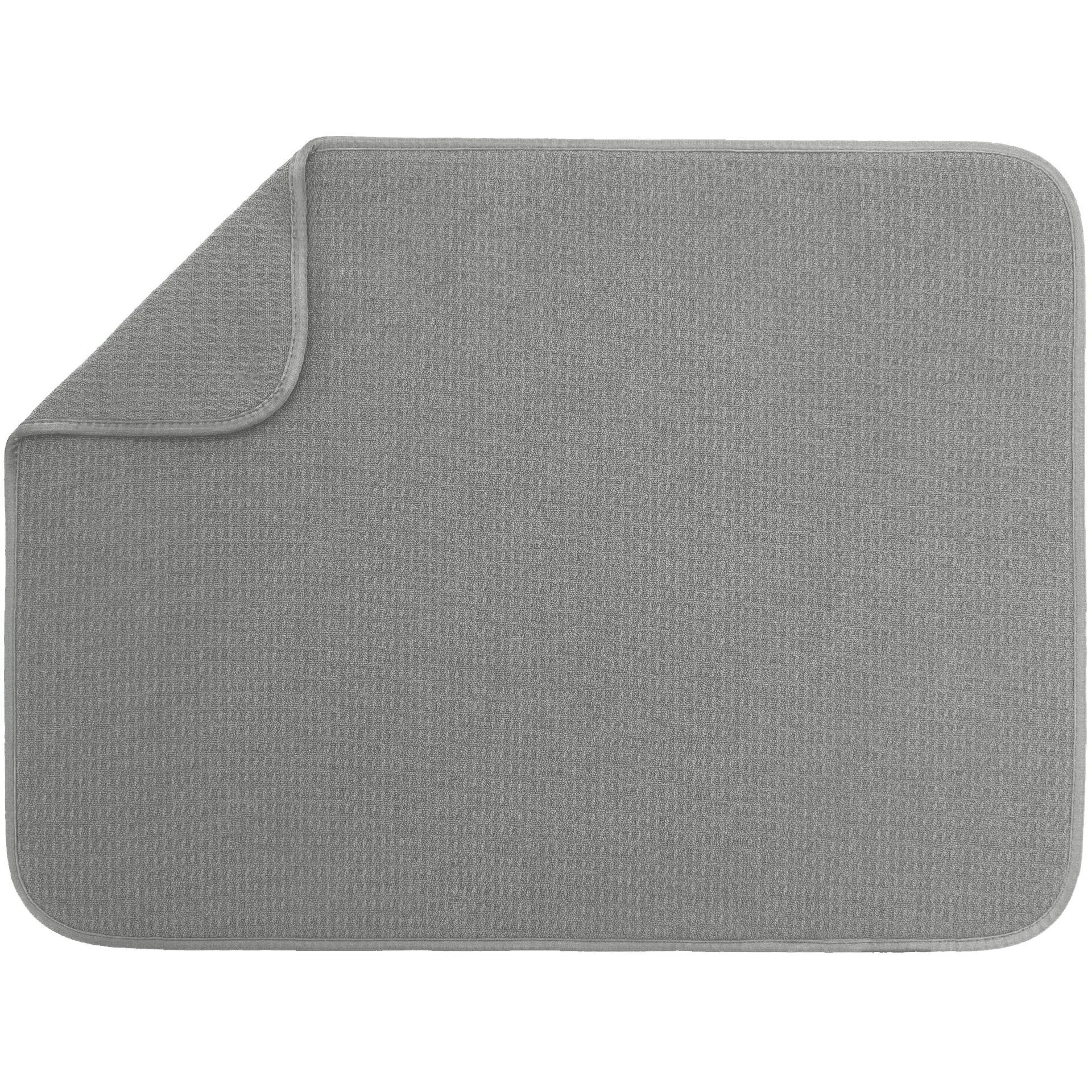
XL honeycomb dish drying mat
Who should choose this type of mat
Best for
- Home cooks who hand-wash large pots and baking sheets regularly
- Households with countertops at least 20 inches deep and 24 inches wide
- Anyone replacing plastic drain boards with a more absorbent, space-saving solution
Not for
- Small galley kitchens with less than 12 inches of counter space next to the sink
- Users who prefer a rigid drying rack over a flexible mat