Quick answer
For photographers prioritizing ultra-wide or standard prime sharpness and portability, the Zeiss Batis 18mm f/2.8 or 25mm f/2 are excellent stills choices. For video work or hybrid shoots needing a parfocal zoom with consistent t-stop, the Sigma 18-35mm t/2 Cine is the better tool.
Still photography vs. cinema lens design
Zeiss Batis lenses are built for stills with fast autofocus (linear motor on the 25mm f/2) and compact size. They include an OLED display for focus distance and depth of field, which is handy for manual focus but not essential for video. The Sigma 18-35mm t/2 Cine is a cinema zoom designed for Super 35mm sensors; it has a 180° focus rotation, gear positions, and standardized front diameter and filter size, making it easier for follow focus and matte box use. However, it lacks autofocus and is significantly larger and heavier.
If you shoot mostly stills and occasional video, the Batis lenses are more versatile. If video is your primary medium or you need a single zoom that covers a useful wide-to-normal range, the Sigma Cine is the pragmatic choice.
Aperture and low-light performance
The Zeiss Batis 25mm f/2 offers a full stop of extra light over the 18mm f/2.8, which matters in dim interiors or evening street photography. Both Batis lenses have a 9-blade aperture for smooth bokeh. The Sigma 18-35mm t/2 Cine has a constant t/2 (f/2) aperture across the zoom range, which is identical to the Batis 25mm f/2 in light transmission but without the extra stop of the f/2 vs f/2.8 difference.
If you regularly shoot in low light without flash, the Batis 25mm f/2 is the best choice among these. For controlled studio or daylight video, the Sigma Cine’s constant aperture is more than adequate.
Macro capability: a different use case
The Sony FE 90mm f/2.8 Macro G OSS is a dedicated macro lens with 1:1 magnification, internal focus, and Optical SteadyShot stabilization. It is not directly comparable to the wide-angle Batis or the cinema zoom, but it fills a specific need for close-up product or nature photography. Its OSS is valuable for handheld macro work, and the focus range limiter speeds up AF when shooting at close distances.
If macro or product detail shots are a regular part of your work, the Sony 90mm should be on your shortlist regardless of which wide or cine lens you choose.
Decision rules: choose your Sony E-mount lens
- Primary use is stills with wide-angle: Choose the Zeiss Batis 18mm f/2.8 for a true ultra-wide perspective or the 25mm f/2 for a standard wide that performs better in low light.
- Primary use is video or hybrid shooting: Choose the Sigma 18-35mm t/2 Cine for its parfocal zoom, smooth manual focus ring, and consistent t-stop across the range.
- You need macro capability: Add the Sony FE 90mm f/2.8 Macro G OSS for 1:1 magnification and built-in stabilization. The Sony 90mm complements any of the wide lenses but is a separate purchase.
- Budget and size are concerns: The Zeiss Batis 25mm f/2 is the most affordable of the three (catalog price USD 1443.94) and is also the smallest. The Sigma Cine is the largest and most expensive.
Lens specs at a glance
-
Zeiss Batis 18mm f/2.8 for Sony E-Mount: Aperture Range: f/2.8 to f/22, Distagon Optical Design, Four Aspherical Elements, Seven Special Glass Elements, Floating Elements System, Zeiss T* Anti-Reflective Coating, OLED Display for Focus Distance and DoF The f/2.8 maximum aperture is a stop slower than the 25mm, but the Distagon design and special glass elements deliver exceptional sharpness and contrast, ideal for landscape and architecture work.
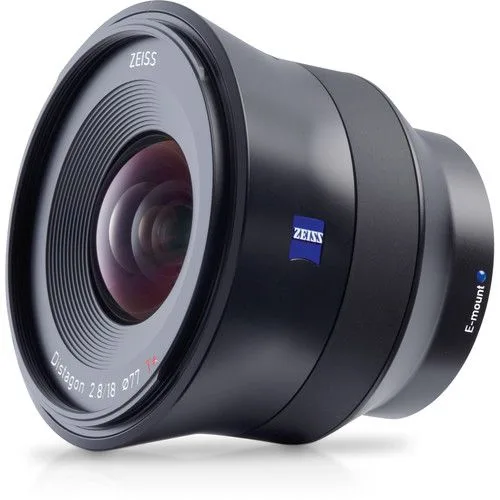
Zeiss Batis 18mm f/2.8 for Sony E-Mount
-
Zeiss Batis 25mm f/2.0 for Sony E-Mount: Aperture Range: f/2 to f/22, Distagon Optical Design, Four Double-Sided Aspherical Elements, Floating Elements System, Zeiss T* Anti-Reflective Coating, OLED Display for Focus Distance and DoF, Linear Autofocus Motor The f/2 aperture provides better low-light performance and shallower depth of field than the 18mm, while the linear autofocus motor ensures fast, quiet focusing for stills and occasional video.

Zeiss Batis 25mm f/2.0 for Sony E-Mount
Which lens fits you?
Best for
- Photographers who want a compact, sharp prime for landscapes or street photography
- Videographers who need a parfocal zoom with smooth manual focus for run-and-gun or narrative work
Not for
- Photographers who need autofocus for video (choose a native Sony prime instead)
- Budget-conscious buyers who only shoot stills (the Sigma Cine is overkill for stills-only use)