Snel antwoord
Als je crawler overslaat, schuurt of vermogen verliest onder belasting, controleer dan eerst het rondsel en het kroonwiel voordat je iets anders vervangt. De meeste tandwielproblemen komen neer op mesh, slijtage of het verkeerde aantal tanden, niet op een defect tandwiel. Voor duurzaamheid is een bewerkt gehard stalen rondsel zoals de Incision 32p Hardened Steel Pinion Gear de praktische upgrade ten opzichte van zachte standaardonderdelen, en het is verkrijgbaar in 12 tot en met 17 tanden, zodat je je eindoverbrenging kunt afstellen.
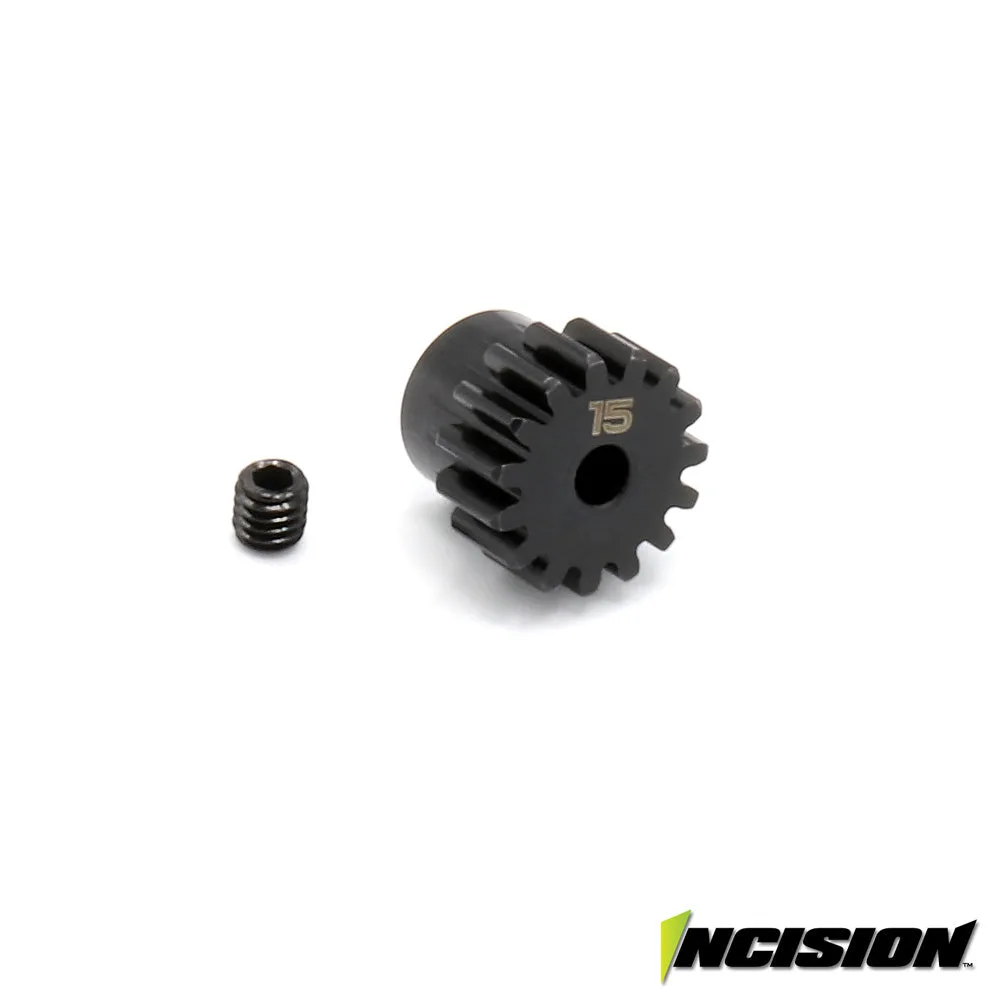
32p Hardened Steel Pinion Gear
Tandwielvragen komen constant naar voren omdat tandwielen het onderdeel van een crawler zijn dat stilletjes faalt. Een versleten pinion kondigt zichzelf niet aan; het klinkt gewoon anders en slipt wanneer de truck vastzit op een richel. Deze FAQ behandelt de vragen die we het vaakst horen, met antwoorden waar je direct mee aan de slag kunt.
Elk antwoord hieronder staat op zichzelf, dus je kunt direct naar het antwoord springen dat bij jouw symptoom past. Waar een specificatie van belang is, houden we ons aan wat er daadwerkelijk gepubliceerd is voor de betreffende onderdelen in plaats van te gokken.
Hoe ziet slijtage aan RC-crawler-tandwielen er eigenlijk uit?
Tandwielslijtage verloopt in drie fasen. Eerst polijsten en verkleuren de tandflanken doordat het geharde oppervlak schuurt. Daarna zie je een zichtbare vlakke of glanzende band over de aandrijfzijde van de tanden. Ten slotte verandert het tandprofiel zodanig dat de mesh losser wordt en het tandwiel onder koppel begint over te slaan. Tegen de tijd dat je een ritmisch klik hoort tijdens een klim, zit je meestal in fase drie.
Run your fingernail across the tooth faces. A healthy gear feels smooth and even. A worn gear catches or has a lip you can feel. Check both the pinion and the mating gear, because a worn pinion will chew up a new spur and vice versa.
- Inspect after any run where you heard grinding or felt the drivetrain bind.
- Compare tooth faces side by side; wear is much easier to see than to feel.
Is a machined gear set worth it over stock plastic or sintered parts?
Yes, if you are breaking or rounding gears regularly. Machined hardened steel holds its tooth profile far longer under the shock loads a crawler sees when a tire suddenly grabs. Sintered metal gears sit between plastic and machined steel: better than plastic, but with a grain structure that can chip at the edges.
The tradeoff is weight and noise. Steel gears are heavier and transmit more drivetrain sound into the chassis. On a light build where every gram matters, that is a real consideration. On a trail truck that sees rocks every weekend, the durability usually wins.
- Upgrade the pinion first; it is the cheapest and most frequently worn gear in the chain.
- Keep a spare set of the tooth count you run so a trail failure does not end your day.
How do I choose the right tooth count?
Tooth count sets your final drive ratio. Fewer teeth on the pinion generally means more reduction, which trades top speed for low-end control. More teeth does the opposite. If you crawl technical lines and rarely run flat out, lean toward the lower counts. If your truck doubles as a trail runner, a middle count keeps some wheel speed available.
The Incision 32p Hardened Steel Pinion Gear is offered in 12, 13, 14, 15, 16, and 17 tooth versions, all with the same 32 pitch profile and 1/8 inch bore. That range lets you make meaningful ratio changes without swapping the rest of the drivetrain. Change one variable at a time and test on the same obstacle so you can actually feel the difference.
- Write down your current pinion count before ordering so you know which direction you are moving.
- A one or two tooth change is usually noticeable; bigger jumps may require a different spur.
When should I replace a gear instead of just re-shimming it?
Re-shim when the teeth are intact but the mesh is loose or tight. Shimming fixes backlash and end play; it does not repair damaged tooth geometry. If you can see a wear band, a chip, or a rounded edge on the drive side, shimming will only delay the failure.
Replace when you find any of the following: missing or chipped teeth, a visible flat spot, a crack at the root of a tooth, or a set screw that will not hold torque on a hardened shaft. Also replace the mating gear if it shows matching wear, since two worn gears will wear a new part faster than a matched pair.
- Clean the gear before inspecting; grease hides the wear marks you are looking for.
- Replace pinion and spur together when both show wear bands.
Can I run a steel pinion against a plastic spur gear?
You can, and many stock trucks do, but understand the tradeoff. A hardened steel pinion will outlast a plastic spur, which means the spur becomes the wear item. That is sometimes intentional: a cheap spur is easier to replace than a transmission. It also means you should carry spares.
If you want to stop replacing spurs, move to a matched steel set. If you want a sacrificial part that protects the rest of the drivetrain, keep the plastic spur and check it often. Neither approach is wrong; they just fail in different places.
- Plastic spur plus steel pinion equals frequent spur checks.
- Matched steel gears run quieter and last longer but transfer shock further down the drivetrain.
What else should I check while the gear set is apart?
Gear wear rarely happens in isolation. While the gears are out, check the driveshafts for twist or slop, and look at the link ends and rod ends for play that lets the axle move under load. Worn links change pinion angle and can accelerate gear wear by loading the teeth unevenly.
If you are servicing an SCX10-II based build, the Incision SCX10-II 12.3 inch 1/4 Stainless Steel 10pc Link Kit includes a drag link, panhard link, upper and lower links, a tie rod, and rod ends, which covers the full link set in one package. Tight links and a properly meshed gear set together make the biggest difference in how a crawler puts power down.
- Check for play at the output shafts and yokes while the drivetrain is open.
- Replace worn rod ends before they oval out and change your geometry.
Gear set troubleshooting checklist
Symptom: rhythmic clicking under load
Inspect the pinion and spur for wear bands or chipped teeth. Check mesh and shimming before replacing parts. If teeth are damaged, replace the worn gear and its mate together.
Symptom: grinding that started suddenly
Look for a loose set screw, a backed out motor mount, or a shifted transmission. A sudden change is usually mechanical, not gradual wear. Tighten and re-shim before ordering new gears.
Symptom: drivetrain slop with intact gears
Check driveshafts, yokes, and link ends for play. Slop in the links changes pinion angle and loads gear teeth unevenly. Fix the slop first; gears are often the victim, not the cause.
Decision: replace or re-shim
Re-shim when teeth are smooth and even. Replace when you can see or feel a wear band, chip, or flat spot. When in doubt, replace the pinion. It is the cheapest part in the chain.
Parts referenced in this FAQ
- 32p Hardened Steel Pinion Gear: Machined hardened steel pinion with a 32 pitch tooth profile and 1/8 inch bore, available in 12, 13, 14, 15, 16, and 17 tooth counts, and includes a 4mm set screw. The tooth count range lets you change final drive ratio without replacing the rest of the drivetrain, and the included set screw means you can install it without hunting for hardware.
- Incision SCX10-II 12.3" 1/4 Stainless Steel 10pc Link Kit: A 10 piece stainless steel link kit for the Axial SCX10-II with a 12.3 inch wheelbase, including a drag link, panhard link, three upper links, four lower links, a tie rod, and 20 rod ends. Worn links let the axle shift under load, which changes pinion angle and accelerates gear wear. Replacing the full link set restores consistent geometry.
- Haal je vingernagel over de tandflanken. Een gezond tandwiel voelt glad en gelijkmatig aan. Een versleten tandwiel hapt of heeft een lip die je voelt. Controleer zowel het pinion als het tegenliggende tandwiel, want een versleten pinion zal een nieuwe spur opeten en andersom.: Inspecteer na elke rit waarin je knarsen hoorde of de aandrijflijn vastliep.
Vergelijk tandflanken naast elkaar; slijtage is veel makkelijker te zien dan te voelen.