Quick answer
Choose a 4-wheel full support dog wheelchair when your dog has weakness or loss of function in both the front and rear legs, not just the hind legs. If only the back legs are affected, a rear-wheel cart is lighter, cheaper, and easier to maneuver. For dogs with front and rear involvement, a quad setup keeps the body level, prevents the chest from tipping forward, and lets your dog stay active with balanced support.
What a full support dog wheelchair actually does
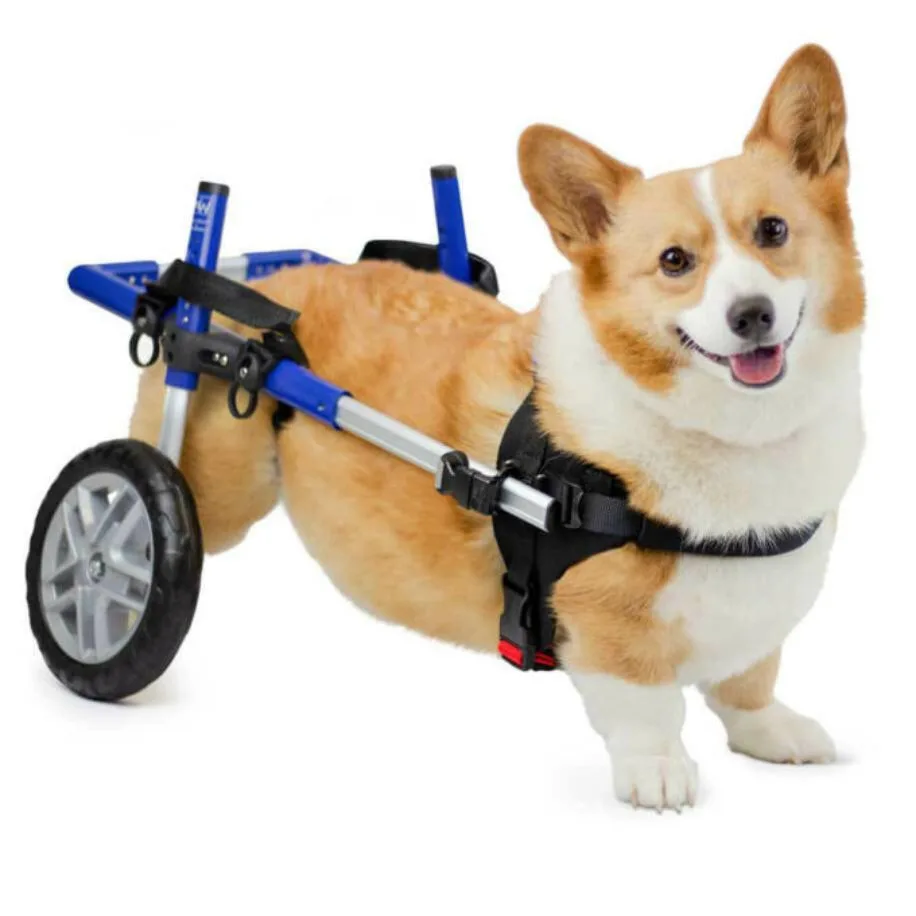
A rear-wheel dog wheelchair carries the hindquarters while the front legs still bear weight and steer. A 4-wheel full support dog wheelchair adds a front wheel assembly, so the frame supports the chest and front legs as well. That changes the physics: instead of your dog's shoulders doing the pulling and balancing, the cart shares the load across all four contact points.
This matters most when front-leg strength is fading. A dog that can still walk but stumbles, knuckles over, or tires after a few minutes may do fine in a rear-only cart on good days — but a full support setup gives consistent support on the days when the front end gives out. It also helps dogs with a hunched or curved spine by keeping the torso level.
When a 4-wheel cart is the right call
The clearest signal is involvement in both ends of the body. That can come from a single progressive condition, from two separate issues, or from age-related weakness that has moved forward. If your dog can still push up with the front legs but not hold steady for a full walk, a quad cart bridges that gap.
Another signal is fatigue. If your dog starts a walk strong and ends it with dragging front paws or a nose-down posture, the front end is working too hard. A full support cart takes over that work. Finally, if you already have a rear wheelchair and your dog's front legs are declining, an attachment can convert the existing cart rather than replacing it.
The trade-offs you should expect
A 4-wheel cart is heavier and longer than a rear-only cart. It turns in a wider arc, takes more effort to lift into a car, and can be harder to navigate in tight hallways. It also costs more, because you are buying a second wheel assembly and a longer frame.
There is a training curve too. Some dogs take to a full support cart immediately; others need short, positive sessions on a non-slip surface before they will move freely. And a quad cart is not a substitute for veterinary care — it is a mobility tool that works alongside your vet's treatment plan, not instead of it.
Sizing and fit: the part most owners get wrong
Full support carts are sized by weight range first, then adjusted to your dog's measurements. A cart that is too small will pinch the chest or restrict the shoulders; one that is too large will let the body sag and put pressure in the wrong places. Measure your dog's length from the front of the chest to the back of the hindquarters, and check the width at the widest point of the ribcage.
If you already own a rear Walkin' Wheels cart, check whether a front attachment is available for your size before buying a whole new cart. Attachments are designed to fit the same frame, which saves money and keeps the fit you already dialed in. If you are starting fresh, buy the size that matches your dog's current weight — not the weight you hope they will reach.
Decision rules for choosing a 4-wheel cart
- Front legs are affected at all: If your dog stumbles, knuckles over, or tires in the front legs, choose full support. A rear-only cart will let the chest drop and put more strain on the shoulders. Full support is the safer default once the front end is involved.
- Only the hind legs are affected: If the front legs are strong and steady, start with a rear-wheel cart. It is lighter, turns tighter, and costs less. You can add a front attachment later if needed. Rear-only first; upgrade only if the front end declines.
- You already own a rear Walkin' Wheels cart: Check whether a front attachment is available for your cart's size. An attachment converts the frame you already have, so you keep the fit and spend less than buying a new quad cart. Attachment before replacement whenever the size matches.
- Your dog is between two sizes: Size by current weight and chest-to-hindquarter length, not by breed reputation or hoped-for weight gain. A cart that is too large lets the body sag; too small restricts the shoulders. Measure, then match the weight range exactly.
Full support options in the Walkin' Wheels lineup
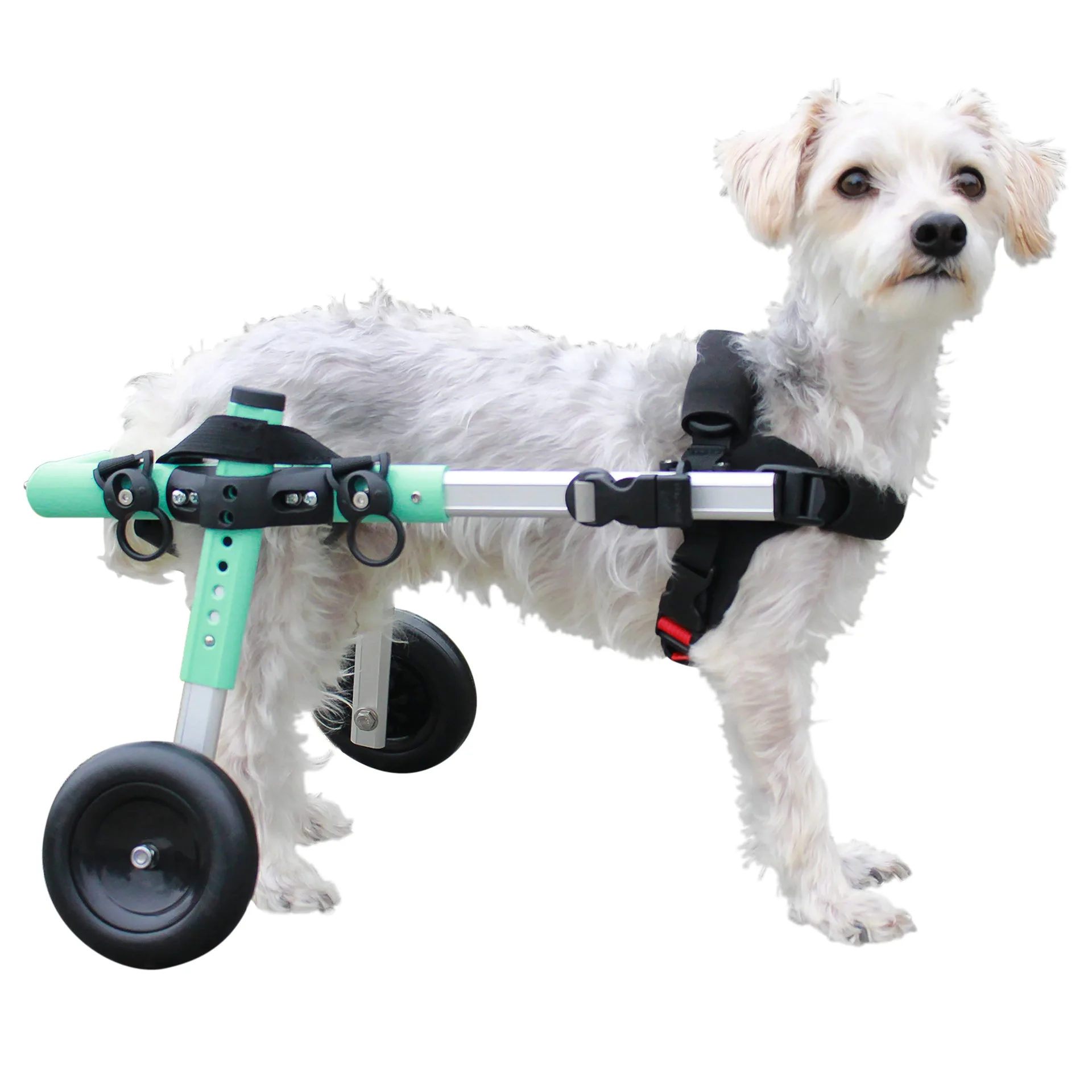
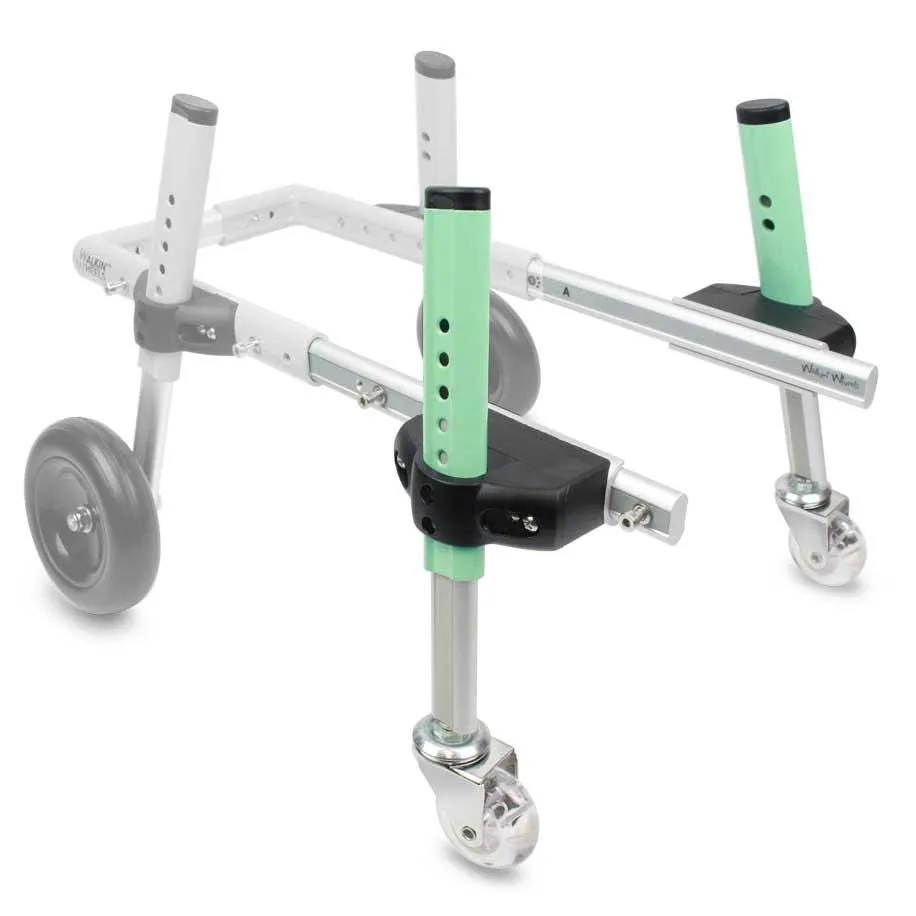
- Walkin' Wheels Full Support/4-Wheel SMALL: The Walkin' Wheels Full Support/4-Wheel SMALL is a complete quad wheelchair for pets between 11 and 25 lbs., providing both front and hind leg support in one frame. This is the simplest path for a small dog that needs full support from day one — no separate rear cart to buy first.
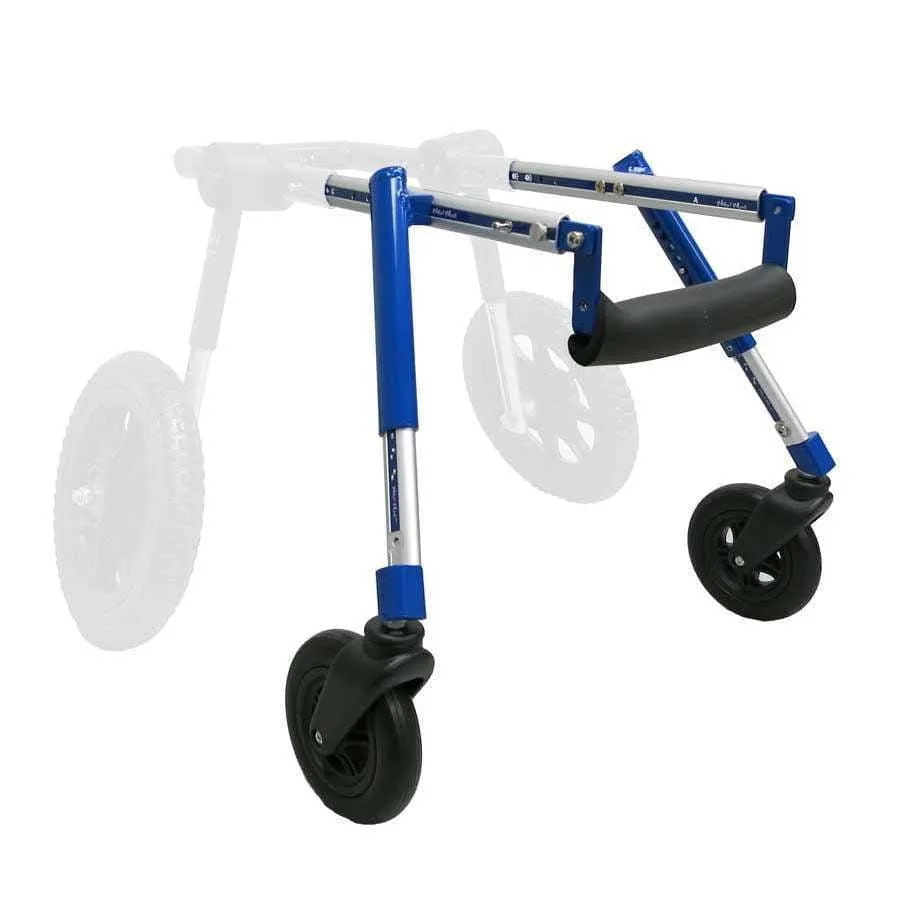
- Walkin' Wheels LARGE Front Wheel Attachment: The Walkin' Wheels LARGE Front Wheel Attachment is designed for pets weighing 70–180 lbs. and converts a LARGE Walkin' Wheels Rear Wheelchair into a Full Support (Quad) Wheelchair. Large-dog owners who already have a rear cart can add front support without replacing the whole wheelchair, which is usually the lower-cost route.
- Walkin’ Wheels SMALL Front Wheel Attachment: The Walkin' Wheels SMALL Front Wheel Attachment fits pets weighing 11–25 lbs. and transforms a SMALL Walkin' Wheels Rear Wheelchair into a Full Support (Quad) Wheelchair. If your small dog's front legs are weakening after you already bought a rear cart, this attachment extends the life of your existing setup.
- Walkin' Wheels SMALL Dog Wheelchair: The Walkin' Wheels SMALL Dog Wheelchair provides hind-leg support for pets weighing 11–25 lbs., helping with rear-leg weakness, paralysis from IVDD or DM, and difficulty walking. This is the rear-only starting point. If your dog's front legs are still strong, it is lighter and less expensive than a quad cart — but it will not support the chest if front weakness develops.
Is a 4-wheel full support wheelchair right for your dog?
Best for
- Dogs with weakness or loss of function in both front and rear legs
- Dogs whose front legs tire or knuckle over during walks
- Owners who already have a rear Walkin' Wheels cart and need to add front support
- Small dogs (11–25 lbs.) or large dogs (70–180 lbs.) that need balanced four-leg support
Not for
- Dogs with strong, steady front legs — a rear-only cart is lighter and cheaper
- Owners who need a cart that folds small or turns in tight indoor spaces
- Dogs that have not been evaluated by a veterinarian for the underlying condition