Quick answer
Mount the AT-VM95E in the headshell, set the stylus tip to the arm maker's overhang, then balance the arm and apply 2.0 g of tracking force with matching anti-skate. Give the elliptical stylus 15-20 hours to break in before judging the sound.
Why the AT-VM95E Is an Easy First Cartridge Swap
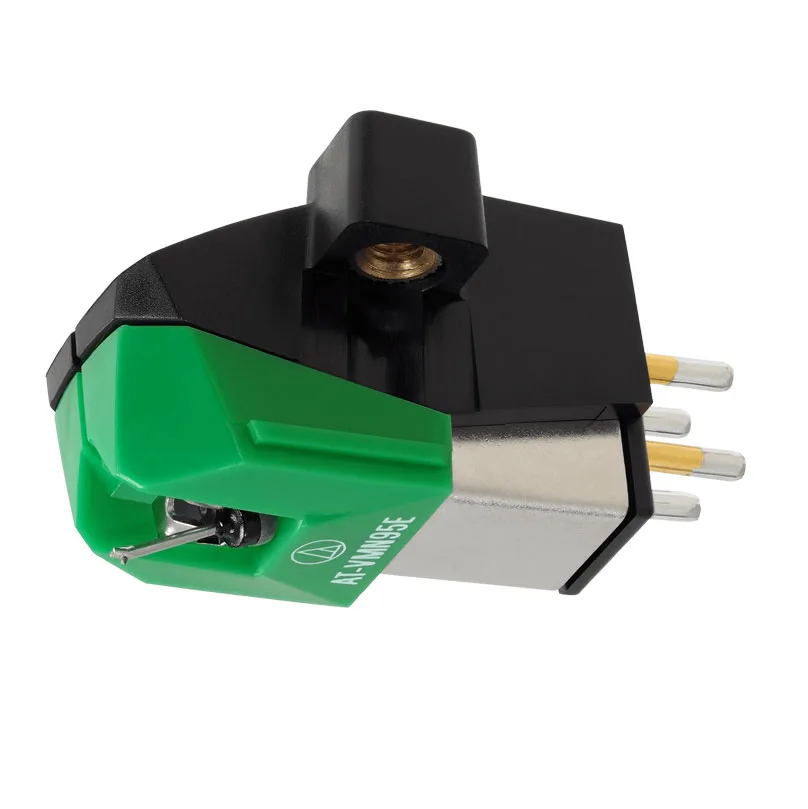
The AT-VM95E uses a threaded body, so you don't need a nut on the far side of the headshell. Two screws pass down through the headshell slots and thread straight into the cartridge, which keeps the small parts count low and makes a turntable cartridge replacement far less fiddly.
It also tracks at a moderate 2.0 g and carries a 0.3 x 0.7 mil elliptical stylus on an aluminum cantilever, so it reads groove detail without demanding a heavy or exotic tonearm. If your table has a standard removable headshell, the swap is a 20-minute job with basic tools.
Tools and Prep Before You Start
Gather a small flathead screwdriver, needle-nose pliers, an alignment protractor, a digital stylus gauge, and a small mirror or bright light. Work on a stable surface with the platter locked or removed so the arm can't swing while you're handling it.
Power down the turntable and unplug the RCA cables before touching the headshell. If you're replacing an existing cartridge, note the color-coded lead positions as you remove them so the new wiring goes back the same way.
Set Overhang and Vertical Tracking Angle
Overhang is the distance from the tonearm pivot to the stylus tip, and it's the single biggest factor in whether the AT-VM95E tracks cleanly across a record. Use your arm maker's specified overhang or an alignment protractor; if neither is available, a 52 mm headshell-to-stylus measurement is a common starting point for many S-shaped arms.
Vertical tracking angle (VTA) should put the tonearm roughly parallel to the record surface when the stylus is in the groove. Small VTA changes shift tonal balance, so set it once, then leave it alone while you dial in tracking force.
Tracking Force, Anti-Skate, and Break-In
Balance the tonearm to zero first, then dial in 2.0 g on the counterweight and confirm it with a digital gauge at the stylus tip. Set anti-skate to match the tracking force as a starting point, then reduce it slightly if you hear distortion on the right channel during loud passages.
A new elliptical stylus needs roughly 15-20 hours of play before it settles. If the sound is bright or thin on day one, that's often the suspension loosening up rather than a setup error.
AT-VM95E Setup Steps
- 1. Mount the cartridge in the headshell: Slide the two screws through the headshell slots and thread them into the AT-VM95E body. Leave them snug but not fully tight so you can still nudge the cartridge for alignment. Checkpoint: the cartridge should sit square in the headshell with no gap between the top plate and the shell.
- 2. Connect the four headshell leads: Attach the color-coded clips to the cartridge pins: white to left channel positive, blue to left negative, red to right positive, green to right negative. Use pliers gently and avoid pulling on the wire itself. Mistake to avoid: forcing a clip onto the wrong pin can bend the pin or short the channel.
- 3. Set overhang with a protractor: Place the stylus on the protractor's outer grid and adjust the cartridge forward or back in the slots until the tip lands on the mark. Tighten the screws once it's aligned. Checkpoint: re-check overhang after tightening, since the cartridge can shift slightly.
- 4. Balance the tonearm and set tracking force: Float the arm to zero, then rotate the counterweight to 2.0 g and verify with a digital gauge at the stylus tip. Adjust the counterweight in small increments rather than guessing. Mistake to avoid: trusting the counterweight dial alone; gauges catch errors the dial hides.
- 5. Set anti-skate to match: Dial anti-skate to the same value as tracking force, then fine-tune by ear on a loud inner-groove passage. If the right channel distorts, reduce anti-skate slightly; if the left does, increase it. Checkpoint: a well-set anti-skate keeps the stylus centered in the groove without pulling to either side.
- 6. Play a test record and confirm: Spin a familiar LP and listen for sibilance, channel imbalance, or mistracking on loud passages. If something sounds off, revisit overhang and tracking force before touching VTA. Next step: after 15-20 hours of play, re-check tracking force, since the stylus suspension settles with use.
Product facts
- Audio-Technica AT-VM95E Cartridge | Elliptical Stylus: The AT-VM95E uses a 0.3 x 0.7 mil elliptical stylus and aluminum cantilever, with specially wound coils for a stronger output signal and a low-resonance polymer housing to reduce vibration. The elliptical profile and aluminum cantilever give you more groove detail than a basic conical stylus, while the polymer body helps keep resonance from muddying the midrange.
- Audio-Technica AT-VM95E Cartridge | Elliptical Stylus: The threaded body design lets you mount the cartridge with just two screws, without a nut on the far side of the headshell. Fewer loose parts means less chance of dropping a nut into the platter well or stripping threads during installation.