Quick answer
Move up a nipple stage when your baby consistently finishes a feed in much less time than usual, gets frustrated or falls asleep before finishing, or starts collapsing the nipple. If feeding is calm, steady, and comfortable, stay at the current stage. Stage B cross cut nipples work well for established breastfeeding babies who need to actively nurse, while slow-flow nipples suit newborns and babies who still need a slower pace.
Why nipple stages exist and what they change
Nipple stages are not about age milestones; they are about flow rate. A stage number or letter tells you how quickly milk leaves the bottle when your baby sucks. A slower flow gives a newborn time to coordinate suck, swallow, and breathe. A faster flow matches a stronger, more efficient suck. The right stage is the one that lets your baby feed calmly without gulping, coughing, or fighting the bottle.
Flow rate is separate from nipple shape or material. Two nipples can look identical but deliver milk at different speeds. That is why watching your baby's behavior during a feed is more reliable than comparing nipple labels across brands.
How to tell your baby is ready for the next stage
The clearest sign is a change in feeding rhythm. If your baby used to take 15–20 minutes per feed and now finishes in 5–10 minutes while staying comfortable, the current nipple may be too slow. Other signs include pulling off repeatedly, arching the back, or falling asleep before the feed is finished because the effort outweighs the reward.
A common mistake is moving up a stage because a feed took longer than you expected. Babies cluster feed and comfort suck, especially during growth spurts. A single long feed is not a reason to change flow. Look for a pattern across several days.
Cross cut vs slow flow: what the difference means at the bottle
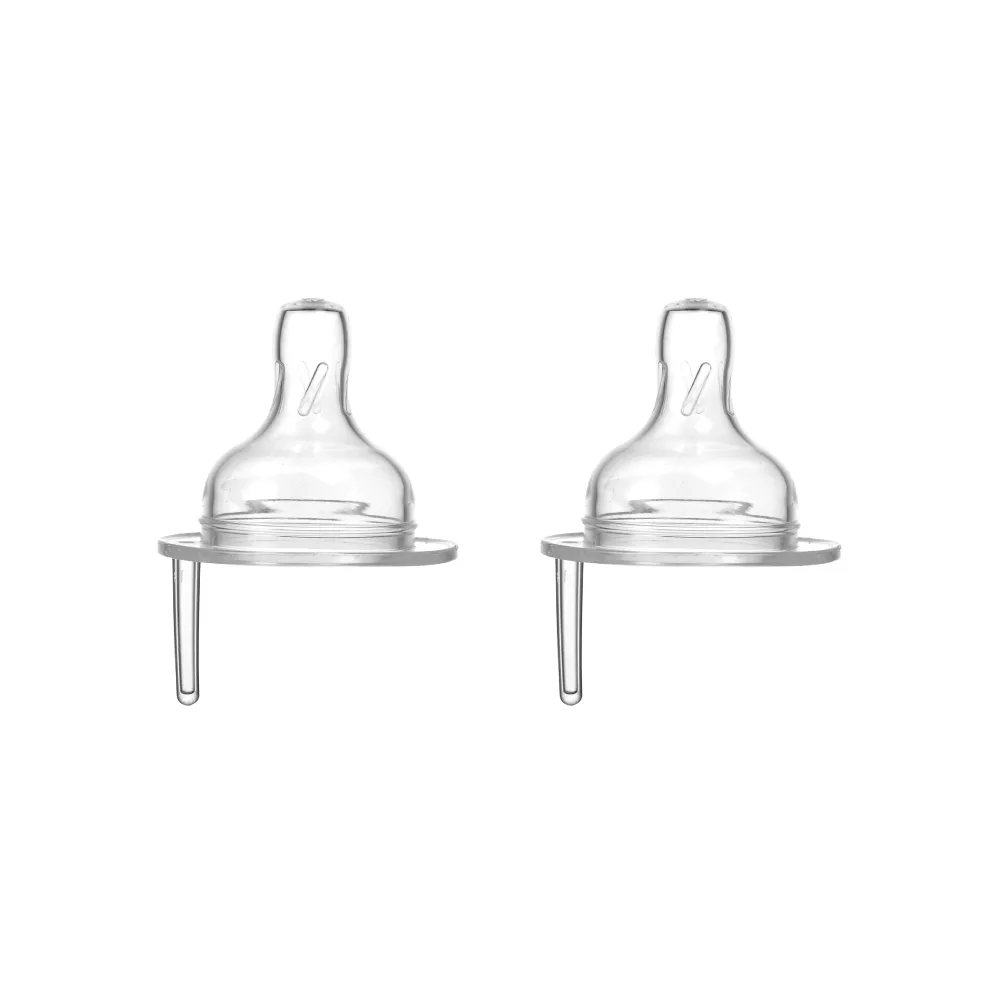
A cross cut nipple has a small X-shaped slit that opens only when your baby compresses it during nursing. That design mimics breastfeeding because milk does not drip out when the bottle is tipped; your baby has to actively nurse to receive fluid. Slow-flow nipples usually have a small round hole that releases milk with less effort.
For a breastfed baby who is used to working for milk, a cross cut nipple can feel more familiar and may reduce nipple confusion. For a bottle-fed newborn or a baby who tires easily, a slow-flow round-hole nipple may be easier to manage at first. Neither is universally better; the choice depends on your baby's feeding style.
What to check before you change anything
Before moving up a stage, rule out other causes of feeding frustration. A clogged nipple hole, a loose collar, or a bottle that is too warm can all change how milk flows. Check that the nipple is fully seated and the vent, if your bottle has one, is clear. If your baby is teething or congested, feeding behavior can change temporarily without any need for a new nipple.
Also consider the milk itself. Thicker liquids like formula with added cereal or pumped milk with a high fat content move more slowly through any nipple. If you recently changed what you are feeding, that alone can explain a slower feed.
Step-by-step: how to move up a nipple stage
- Observe three consecutive feeds: Watch how long each feed takes, whether your baby seems satisfied afterward, and whether they pull off or cough. Write down the times if you are unsure. Checkpoint: if two or more feeds are calm and comfortable, stay at the current stage.
- Check the nipple for wear or clogs: Hold the nipple up to a light and squeeze it gently. If the hole is blocked or the silicone is sticky or torn, replace it before assuming the flow is wrong. Common mistake: buying a faster nipple when the real problem is a worn-out one.
- Try the next stage for one full day: Use the new nipple for all daytime feeds, but keep the old one for night feeds if that feels safer. Note whether your baby finishes without gulping or sputtering. Checkpoint: if feeding becomes frantic, coughs appear, or milk pools in the mouth, go back a stage and try again in a week or two.
- Match the nipple to your feeding goal: If you are transitioning from breast to bottle, a cross cut nipple like the Thinkbaby Stage B may suit your baby better than a standard slow flow. If you are combination feeding, you can use different nipples for different feeds. Next step: once bottle feeding is steady, introduce a small open cup like the Think Cup for one meal a day to build cup-drinking skills.
Products that support a smooth nipple transition
- Thinkbaby 2 Pack Cross Cut Stage B Nipples: Thinkbaby 2 Pack Cross Cut Stage B Nipples are free of BPA, phthalates, nitrosamines, lead, PVC, PET, and biologically harmful chemicals, and feature a cross cut design that requires nursing to receive fluid. The cross cut design supports a breastfeeding-like feeding rhythm, which can help breastfed babies transition to a bottle without losing the active suck they are used to.
- BPA Free Think Cup - Lt. Green: BPA Free Think Cup - Lt. Green is designed for beginning cup drinking, holds 200ml / 7oz, and has a detachable handle that loops around a travel bag. When your child is ready to move beyond bottles, a small open cup helps practice a new drinking skill without losing the routine of sitting down to feed.