Quick answer
For day hikes, choose a low-profile dog pack or harness that carries water, waste bags, and a small bowl without changing your dog's stride. For overnight trips, move up to a pack with larger saddlebags and a load that stays under roughly 10-15% of your dog's body weight. Fit matters more than capacity: measure girth, check shoulder clearance, and confirm the pack does not slide when your dog trots.
Capacity: match the load to the trip, not the label
Day hikes rarely need more than 2-4 liters of combined saddlebag space. That covers a collapsible bowl, a liter of water, waste bags, and a small first-aid pouch. Overnight trips add food, a sleeping layer, and sometimes a share of group gear, which pushes most dogs into the 5-10 liter range. If your dog is carrying more than that, split the load with a human pack rather than overloading the dog.
The practical ceiling is weight, not volume. A common guideline is 10-15% of body weight for a conditioned adult dog, and less for puppies, seniors, or dogs new to wearing a pack. Weigh the loaded pack on a kitchen scale before you leave. If your dog slows down, lags, or shifts weight off one side, the pack is too heavy or poorly balanced.
Fit: measure twice, adjust four points
A pack that fits well stays centered when your dog trots, turns, and sits. Start with a girth measurement around the widest part of the ribcage, then compare it to the manufacturer's size chart. Saddlebags should sit behind the shoulder blades, not on top of them, so the front legs can swing freely. You want two fingers of clearance under each strap.
Look for at least four adjustment points: two at the chest and two at the belly or girth. Adjust the chest straps first, then the belly straps, and recheck after a five-minute walk. If the pack rotates to one side, the load is uneven or the belly strap is too loose. If the pack rides up into the throat, the chest straps are too tight. Refit with the pack loaded, because empty packs sit differently than full ones.
Day-hike setup: keep it light and out of the way
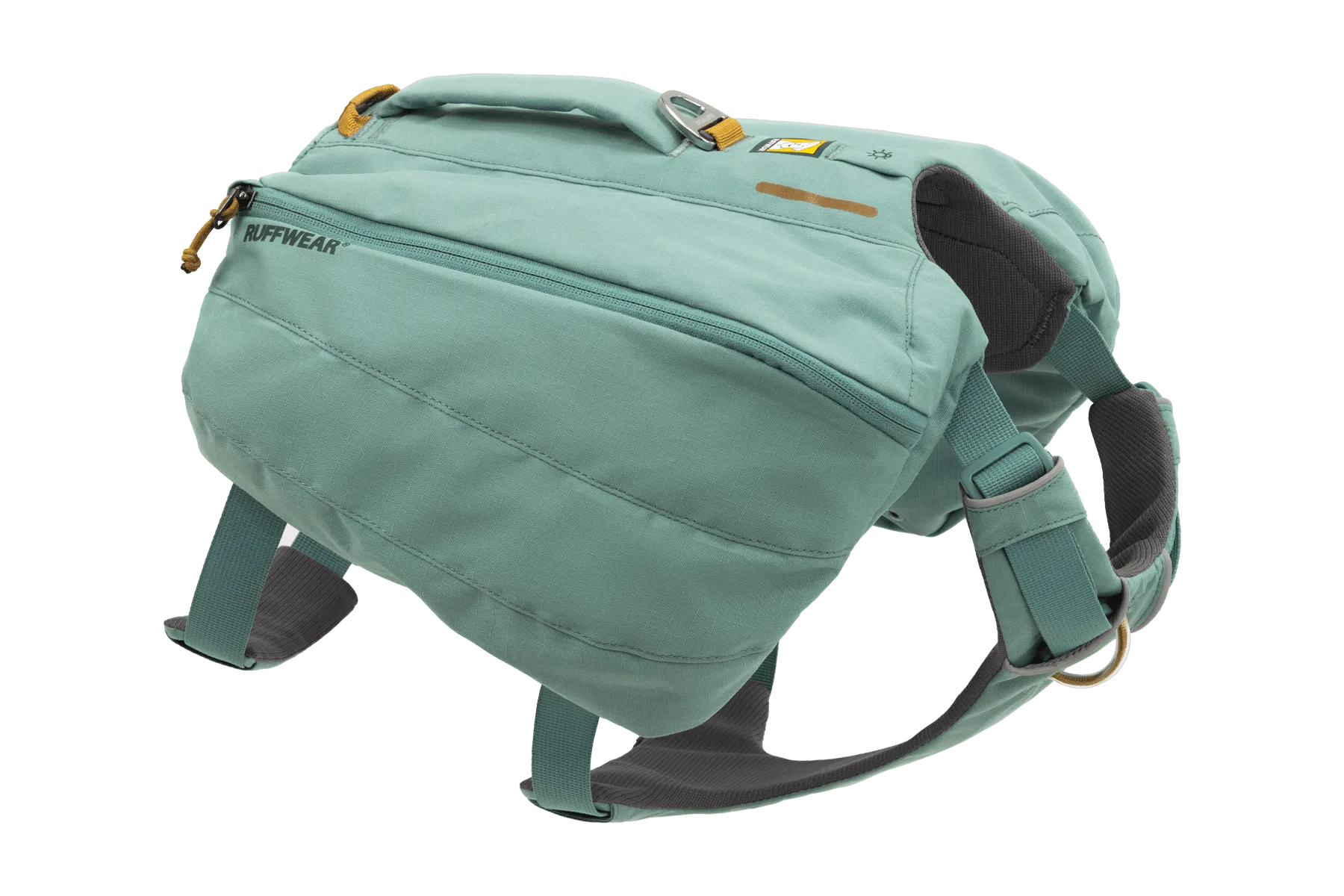
For fast day hikes, a lightweight harness with a small removable pack or a low-profile pack works better than a full saddlebag system. The goal is to carry essentials without adding bulk that catches on brush or shifts on descents. A harness that doubles as a leash attachment point means you are not layering gear.
Pack items you will actually use: a collapsible bowl, 1 liter of water per 10 pounds of dog for a half-day hike in mild weather, waste bags, and a small towel if water crossings are likely. Keep the heaviest items close to the dog's spine and centered. Test the setup on a short local walk before you rely on it on a real trail.
Overnight setup: stability and weather protection
Overnight dog backpacking gear adds bulk, so stability becomes the main concern. Choose a pack with compression straps so you can cinch down a partially empty bag, and load it so both sides weigh the same. Food is the heaviest item most dogs carry; repackage it into a stuff sack and place it low and centered. If your dog wears a rain shell or insulating layer, pack it on top for quick access.
On multi-day trips, check your dog's fur and skin at each rest stop. Long-haired dogs can mat under straps, and wet straps can rub. A post-hike rinse and towel-dry of the pack and dog prevents grit from working into the webbing. If your dog is new to packing, start with an empty pack on training walks and add weight gradually over several weeks.
Decision rules for choosing a dog pack
- Trip length rule: If you are out for less than a full day, choose a harness or low-profile pack with 2-4 liters of capacity. If you are sleeping out, choose a pack with 5-10 liters and compression straps. Day hikes reward minimalism; overnight trips reward stable, compressible capacity.
- Weight ceiling rule: Keep the loaded pack at or under 10-15% of your dog's body weight. Weigh it before you leave. Reduce the load if your dog lags, shifts weight, or pants harder than usual on flat ground. If you cannot get under the ceiling, carry the extra weight yourself.
- Fit check rule: Measure girth, confirm saddlebags sit behind the shoulder blades, and adjust chest straps before belly straps. Recheck after five minutes of walking with the pack loaded. A pack that rotates or rides up is a fit problem, not a training problem.
- Load balance rule: Place heavy items low and centered against the spine, and match the weight on both sides within a few ounces. Use compression straps to stop contents from shifting on descents. Even loading prevents rubbing and keeps your dog moving in a straight line.
Products that solve common pack-day problems
- Dirtbag™ Dog Towel: The Dirtbag Dog Towel is a two-sided post-adventure coat with a quick-dry microfiber lining that soaks up moisture, mud, sand, and grit, plus a waterproof shell to contain it. After a wet or muddy hike, you can dry and contain the mess before your dog gets into the car or tent, which matters more on overnight trips where space is tight.
- Hi & Light™ Lightweight Dog Harness: The Hi & Light Lightweight Dog Harness is a low-profile harness with four points of adjustment, sizes down to XXXS, and two leash attachment points including an aluminum V-ring. A low-profile harness is a strong base for day hikes when you want freedom of movement and a secure leash connection without a bulky pack.
- Roamer Lock™ Bungee Dog Leash: The Roamer Lock Bungee Dog Leash uses adjustable stretch webbing and a locking Talon Clip, with hands-free versatility for technical descents or busy trailheads. On uneven or crowded trails, a locking clip and stretch webbing give you control and shock absorption while your dog wears a pack.
- Camp Flyer™ Toy: The Camp Flyer Toy is a lightweight, puncture-resistant disc with welded construction that doubles as a bowl between fetch sessions around camp. It replaces a separate bowl and toy in your dog's pack, saving space and weight on both day hikes and overnight trips.
Who each setup is right for
Best for
- Day hikers who want a lightweight harness or low-profile pack for water, bowls, and waste bags
- Overnight backpackers whose dog is conditioned to carry 5-10 liters of food and gear under 15% of body weight
- Owners of small dogs who need sizes down to XXXS with four-point adjustment
Not for
- Dogs with orthopedic issues, puppies, or seniors who should carry no added weight
- Hikes where the total load would exceed 15% of your dog's body weight, even if the pack has room
- Owners who want a single pack to handle both fast day hikes and heavy overnight loads without adjusting capacity