Quick Answer
Match the blade number to your dog's coat thickness and the finish you want: lower numbers (like #10) leave hair shorter and cut through thick coats easily, while higher numbers (like #5F) leave more length and suit medium to thick coats. For most double-coated or thick-coated breeds, a #5F blade is a versatile choice that leaves about 1/4 inch of hair.
Blade numbers and what they mean
Clipper blade numbers indicate how close the cut is: the higher the number, the shorter the hair left behind. For example, a #10 blade leaves about 1/16 inch, while a #5F leaves about 1/4 inch. Lower numbers also have wider teeth that can power through thick or matted coats without clogging, but they leave a very short finish that may be too harsh for some breeds.
The 'F' in #5F stands for 'full' or 'fine'—it means the blade has closely spaced teeth that leave a smooth, even finish, unlike a standard #5 which has wider teeth and leaves a slightly more textured look. This makes #5F a good middle ground for groomers who want to remove bulk without shaving the dog bald.
Trade-offs: speed vs. finish
Lower-number blades (like #10) cut faster and are better for heavily matted or very thick coats, but they can cause skin irritation if used without a guard comb, especially on sensitive areas. Higher-number blades (like #5F) are cooler-running and less likely to irritate, but they require more passes on extremely thick coats and may not glide through heavy mats.
If you groom multiple breeds, you'll likely need more than one blade. A #10 is essential for sanitary trims and pads, while a #5F or #7F works well for body trims on many double-coated breeds. Owning a few sizes lets you switch without constantly changing blades mid-groom.
Decision Rules for Choosing a Blade
- Coat thickness: For thick, double coats (like Golden Retrievers or Huskies), choose a lower-number blade (#10 or #7F) to cut through dense fur efficiently. For medium coats (like Labradors or Beagles), a #5F works well. For fine or silky coats (like Poodles or Bichons), a higher-number blade (#7F or #5F) gives a smooth finish without risking irritation. Match the blade to the coat's density, not just the desired length.
- Desired length: Decide how much hair you want to leave. #10 leaves about 1/16 inch (very short), #7F leaves about 1/8 inch, #5F leaves about 1/4 inch, and #4 leaves about 3/8 inch. For a natural look on most breeds, aim for #5F or #7F. If unsure, choose #5F for a versatile medium length.
- Coat condition: If the coat is matted or tangled, start with a lower-number blade (like #10) to remove mats safely. Once the coat is clean and brushed, switch to a higher-number blade for the final finish. Never use a high-number blade on matted hair—it will pull and cause discomfort. Always demat or clip mats first with a lower blade.
Featured Blade
-
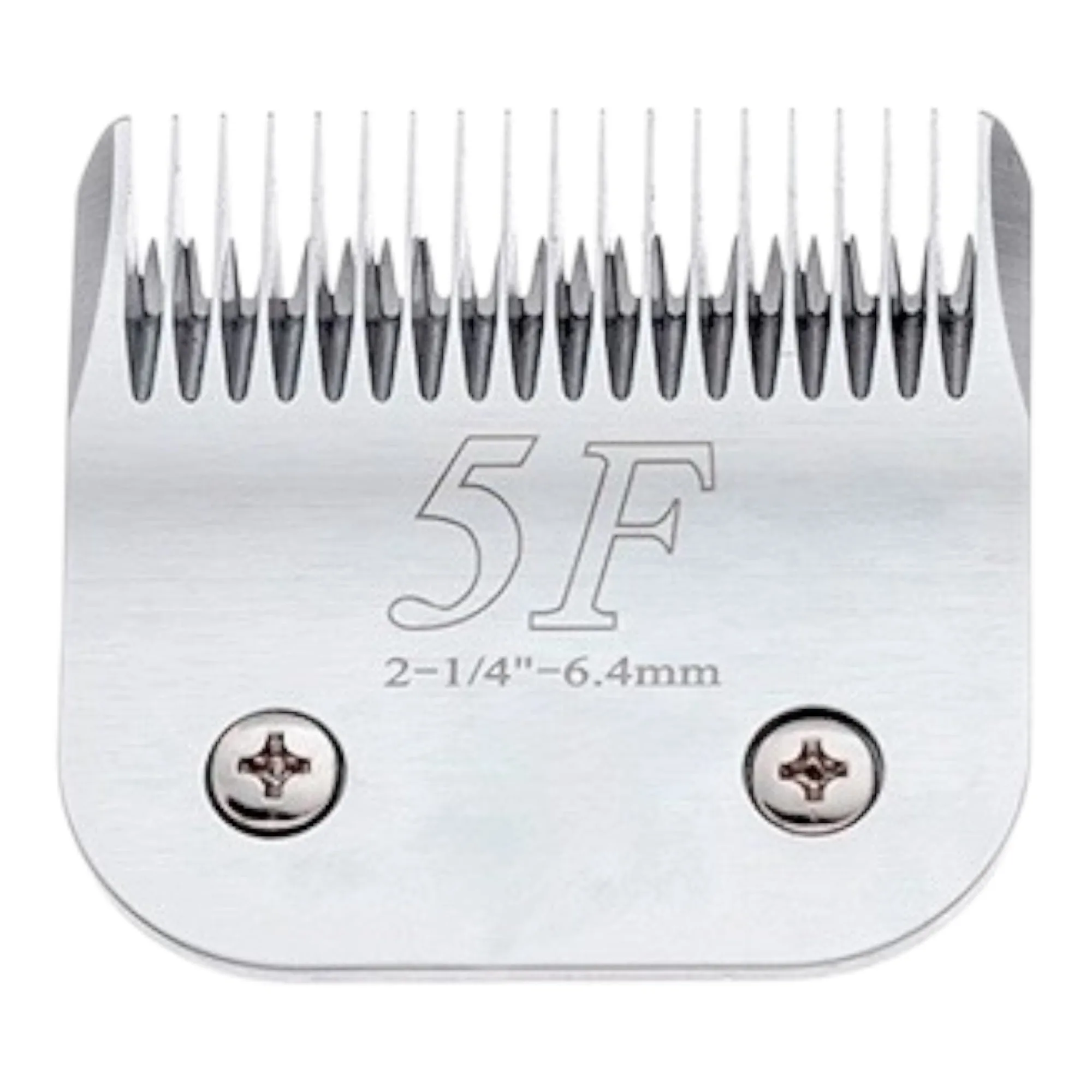
Groomer's Warehouse #5F Clipper Blade: Made from Japanese high carbon steel, heat treated and ice tempered for longer life, and rated at HRC62 on the Rockwell hardness scale. This blade stays sharp longer and handles thick coats without dulling quickly, so you get consistent cuts across multiple grooms.
Groomer's Warehouse #5F Clipper Blade
-
Groomer's Warehouse #5F Clipper Blade: Fits most pet and equine clippers with a snap-on A5 blade system, including Oster and Andis models. If you already own a compatible clipper, you can upgrade to this blade without buying a new machine—just snap it on.
Who Should Use This Guide?
Best for
- Groomers working with thick-coated breeds like Golden Retrievers, Huskies, or German Shepherds who need a blade that cuts through dense fur and leaves a neat finish.
- Pet owners who want to do home trims and need a versatile blade that suits medium to thick coats without shaving too close.
Not for
- Groomers who need to shave very close for medical or show purposes—consider a #10 or #15 blade instead.
- Dogs with extremely sensitive skin or those prone to clipper burn—choose a higher-number blade and use a guard comb.