Quick answer
Commercial mirrors from Esco Optics provide a practical, cost-effective solution for everyday reflection tasks, while precision mirrors are needed for high-accuracy applications requiring tighter flatness tolerances and specialized coatings.
Flatness: The defining spec
The single biggest difference between commercial and precision mirrors is surface flatness. Commercial quality mirrors are made from soda-lime float glass with a commercial polish on the rear surface. They are ideal for general illumination, projection, and visual inspection where sub-micron accuracy isn't required. Precision mirrors, on the other hand, are typically made from borosilicate or fused silica and polished to λ/10 or better flatness for laser beam steering, interferometry, and imaging systems.
Coating and reflectance performance
Commercial mirrors use an aluminum-plus-silicon monoxide (Al-SiO) coating that delivers over 85% average reflectance from 350-800 nm. This cost-effective coating is durable and works well for broadband visible and near-UV applications. Precision mirrors often use enhanced aluminum, protected silver, or dielectric coatings tailored for specific laser wavelengths or higher reflectance at particular angles. For most lab or industrial setups, Al-SiO is perfectly adequate; for high-power lasers or critical metrology, a precision coating is essential.
Available shapes: Square vs circular
Commercial quality mirrors come in both square and circular formats. Square mirrors are common in mounting frames, optical breadboards, and rectangular beams. Circular mirrors suit round beam paths, OEM instruments, and optical tubes. The choice is often driven by the geometry of your system and mechanical constraints. Precision mirrors are more frequently found in circular form because they are easier to center and rotate in kinematic mounts.
Trade-offs at a glance
- Cost vs accuracy: Commercial mirrors cost significantly less but offer only commercial-grade flatness. Precision mirrors cost more per unit but ensure sub-λ surface quality.
- Coating suitability: Al-SiO coatings are robust and broadband but not optimized for a single laser line or extreme reflectance. Precision coatings can target >99% reflectance at a specific wavelength. Let your wavelength and power level guide the coating choice.
- Shape flexibility: Commercial mirrors are available in both square and circular shapes. Precision mirrors are predominantly circular in standard catalogs, though custom squares are possible. Check your mechanical envelope before selecting shape.
- Application threshold: If you need a simple 90° fold or image relay, commercial mirrors work fine. If you are building a laser interferometer or imaging with sub-micron resolution, select precision mirrors.
Product facts
-
Mirrors, Commercial Quality Square: Square commercial mirror with Al-SiO coating providing >85% average reflectance from 350-800 nm. Ideal for rectangular optical paths or mounting into standard breadboards and frames.
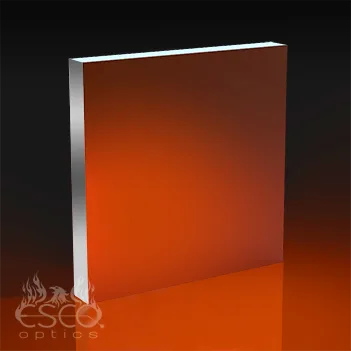
Mirrors, Commercial Quality Square
-
Mirrors, Commercial Quality Circular: Circular commercial mirror with same Al-SiO coating and reflectance performance. Fits round beam paths and tube assemblies better than square formats.
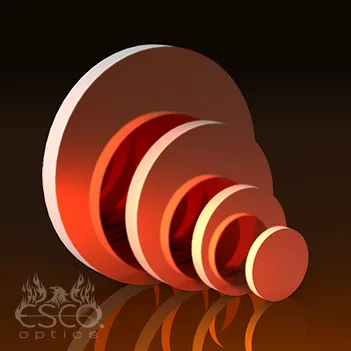
Mirrors, Commercial Quality Circular
Which mirror fits your project?
Best for
- Cost-sensitive projects needing general reflection, illumination, or simple optical paths
- Applications where commercial grade flatness and >85% reflectance are acceptable
- Mechanical setups requiring either square or circular mirror formats
Not for
- High-precision laser beam steering, interferometry, or imaging systems demanding λ/10 flatness or better
- Applications requiring >99% reflectance at a single laser wavelength