Choosing a Cylindrical Lens for Beam Shaping
When you need to shape a laser beam into a narrow line or image a linear array, a cylindrical lens is the right tool. Unlike a spherical lens that focuses to a point, a cylindrical lens produces a focal line parallel to its cylindrical axis. This makes it essential for applications like laser alignment, optical data storage, and spectroscopic slit imaging.
Two common material options for plano-convex cylindrical lenses are N-BK7 optical glass and S1-UV grade fused silica. Each has strengths depending on your wavelength, power, and budget. Here is how they compare.
Cylindrical Lens Options at a Glance
-
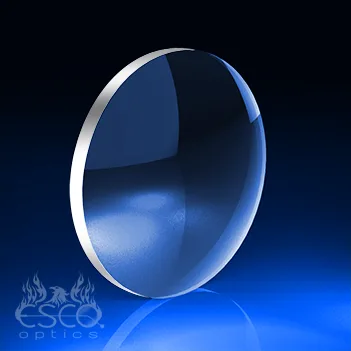
Cylindrical Lenses, N-BK7 Optical Glass*: Esco manufactures standard plano-convex N-BK7 optical glass or equivalent glass cylinder lenses. All lenses are pitch polished for precision surface quality and accuracy. N-BK7 is an economical choice for visible and near-infrared applications where high transmission and good surface quality are needed without the cost of fused silica.
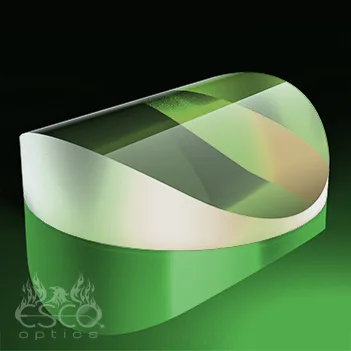
Cylindrical Lenses, N-BK7 Optical Glass*
-
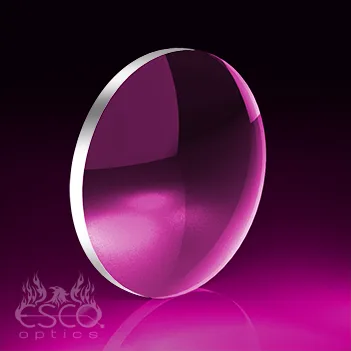
Cylindrical Lenses, S1-UV Grade Fused Silica: Esco manufactures standard plano-convex S1-UV Grade Fused Silica cylinder lenses. All lenses are pitch polished for precision surface quality and accuracy. S1-UV grade fused silica offers superior UV transmission and lower thermal expansion, making it ideal for UV laser line shaping and high-power applications.
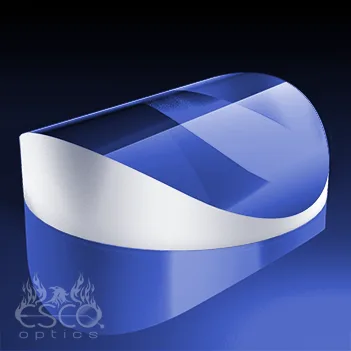
Cylindrical Lenses, S1-UV Grade Fused Silica
N-BK7 vs Fused Silica: Key Tradeoffs
Both materials are pitch polished for precision surface quality, but they differ in optical performance and durability.
- Wavelength Range: N-BK7 optical glass transmits well from the visible through the near-infrared (roughly 350 nm to 2 μm). S1-UV grade fused silica extends into the deep UV, down to about 185 nm, making it necessary for UV laser line shaping.
- Thermal Stability: Fused silica has a very low coefficient of thermal expansion, so it maintains its shape better under thermal load. N-BK7 expands more, which can shift the focal line in high-power or temperature-varying setups.
- Cost: N-BK7 cylindrical lenses are significantly more affordable. For pricing, please refer to the product instructions or catalog for the specific diameter and focal length required.
- Surface Quality: Both are pitch polished for precision surface quality and accuracy, so you can expect similar scratch-dig and surface figure from either material in standard plano-convex designs.
When to Choose Each Material
For visible or near-IR laser line shaping where budget matters, N-BK7 optical glass is a practical choice. It performs well in spectroscopic instrumentation and optical data storage systems that operate above 350 nm.
If your beam shaping involves UV wavelengths, high power, or demanding thermal environments, S1-UV grade fused silica is the better option. Its UV transmission and low thermal expansion help maintain consistent focal line quality.
Both materials are available in a range of diameters and focal lengths. Esco also offers custom cylindrical lenses, including negative designs and other materials, if your application has specific requirements.