Quick Answer
Commercial grade for G1 fused quartz plano-convex lenses means they are pitch-polished for general-purpose focusing and simple imaging, offering good optical quality at a lower cost than precision or laser-grade alternatives.
What Does 'Commercial Grade' Imply for a Plano-Convex Lens?
Commercial grade is a broad classification used in optics to describe components manufactured to standard tolerances suitable for non-critical applications. For a plano-convex lens, this typically means surface quality (scratch-dig) of 80-50 or similar, and surface irregularity in the range of several fringes. The lens is designed to perform adequately where extreme precision is not required, such as focusing light from an LED or creating a simple image.
The 'G1' designation in the product name refers to the specific grade of fused quartz used. G1 is a commercial grade fused quartz, which offers good transmission in the UV and visible spectrum but may have slightly higher bubble content or inclusions compared to higher grades like G2 or G3. This makes it a cost-effective choice for many applications.
When Should I Choose a Commercial Grade Lens Over a Precision or Laser-Grade Lens?
Choose a commercial grade plano-convex lens when your application does not demand tight wavefront error or extremely low scatter. Common uses include:
- Focusing light from a broadband source onto a detector or into a fiber.
- Collimating the output of an LED or lamp.
- Simple imaging tasks where slight aberrations are acceptable.
- Prototyping or educational setups where budget is a primary concern.
If your application involves high-power lasers, interferometry, or requires diffraction-limited performance, a precision or laser-grade lens would be more appropriate, though at a higher cost.
Are There Any Trade-offs with Commercial Grade Lenses?
Yes. The main trade-offs are in surface quality and figure accuracy. Commercial grade lenses may have more surface defects (scratches, pits) and a less perfect spherical surface compared to precision grades. This can lead to increased light scatter and slightly lower image sharpness. Additionally, the G1 fused quartz material may have more bubbles or inclusions, which can cause localized scattering or absorption, particularly problematic in high-power laser systems.
However, for many standard applications, these differences are negligible, and the cost savings are significant. The Esco Plano-Convex Lenses made from G1 Fused Quartz are pitch polished, which provides a good surface finish for general use.
Frequently Asked Questions
What is the difference between G1 and other fused quartz grades?
G1 is a commercial grade fused quartz with standard purity and bubble content. Higher grades like G2 or G3 have tighter specifications for inclusions and homogeneity, used in more demanding optical systems.
Can I use a commercial grade plano-convex lens for laser focusing?
Yes, for low to moderate power lasers where beam quality is not critical. For high-power lasers or applications requiring minimal wavefront distortion, a laser-grade lens is recommended. Always check the laser's power density and your beam quality requirements before selecting a commercial grade lens.
How do I choose the right diameter and focal length for my application?
Select a diameter that is large enough to accommodate the beam or object without vignetting. The focal length should match the desired focusing distance or magnification. Esco's Plano-Convex Lenses offer various diameter and focal length options to suit different setups. Ensure the lens diameter is at least as large as the clear aperture needed for your application.
Product Facts
-
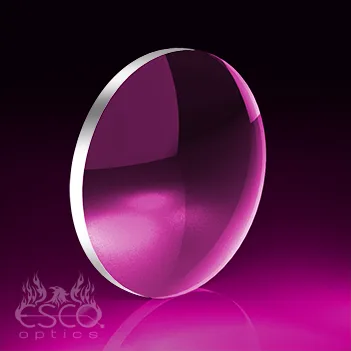
Plano-Convex Lenses, G1 Commercial Grade Fused Quartz: Esco manufactures Plano-convex lenses from G1 Fused Quartz, Commercial Grade. Every optic is pitch polished. Pitch polishing provides a smooth surface finish suitable for general-purpose focusing and simple imaging, balancing quality and cost for commercial-grade optics.
Plano-Convex Lenses, G1 Commercial Grade Fused Quartz