Quick answer
Use 70% dark chocolate discs for melting, baking, and eating straight from the bag. Melt them gently over a double boiler or in short microwave bursts, stir until smooth, and keep all tools completely dry. Their wide, flat shape melts evenly and gives you more control than standard chocolate chips.
Why discs outperform chips for melting and baking
Chocolate discs are designed for melting. Their wide, flat shape provides more surface area than chips, so they melt faster and more evenly. Most chips also contain stabilizers to help them hold their shape in cookies, which can leave a grainy texture in sauces or ganache. Discs are pure chocolate, so they melt into a glossy, smooth liquid ideal for dipping, drizzling, or folding into batters. For baking, discs incorporate cleanly into brownies, cakes, and mousse without the waxy finish chips sometimes leave behind.
How to melt dark chocolate discs without seizing
The biggest risk when melting chocolate is seizing—when a single drop of water turns the chocolate into a stiff, grainy paste. Always start with a completely dry bowl, dry spatula, and dry double boiler. If using a microwave, heat in 15-second intervals at 50% power, stirring between each burst. Stop when most discs are melted and stir until the residual heat melts the rest. For a double boiler, keep the water simmering, not boiling, and make sure the bowl doesn't touch the water. If you do seize the chocolate, you can sometimes rescue it by stirring in a teaspoon of neutral oil, but prevention is easier.
Everyday uses: from snacking to desserts
Beyond melting, 70% dark chocolate discs are excellent for eating by the handful—the 70% cacao content gives a rich, not-too-sweet flavor that pairs well with coffee or wine. For baking, chop discs roughly and fold into cookie dough or brownie batter for pools of melted chocolate. You can also melt discs and dip fresh fruit, pretzels, or biscotti. For a quick dessert sauce, melt discs with a splash of warm cream and a pinch of salt, then drizzle over ice cream. The discs' consistent size also makes them easy to portion: one disc is roughly a quarter-ounce, so you can count them for recipes that call for ounces.
Choosing the right dark chocolate for your recipe
Not all dark chocolate is interchangeable. A 70% disc offers a balanced intensity—dark enough for grown-up desserts but not so bitter that it overwhelms delicate flavors. If you're making a ganache or mousse, 70% is a safe starting point. For baking, the discs' cocoa butter content helps create a smooth batter. When a recipe specifies chocolate chips, you can substitute discs ounce for ounce, but expect a softer set in cookies. Always check the ingredient list: quality dark chocolate should list cocoa mass, cocoa butter, sugar, and maybe vanilla—not vegetable oils or artificial flavors.
Step-by-step: melting dark chocolate discs
- Prep your workspace: Ensure all bowls, spatulas, and surfaces are completely dry. Water is the enemy of melted chocolate. Checkpoint: no visible moisture or steam near your bowl.
- Set up a double boiler or microwave: For a double boiler, fill the bottom pot with 1 inch of water and bring to a simmer. For microwave, use a microwave-safe bowl. Mistake to avoid: letting the bowl touch the water, which can overheat the chocolate.
- Add discs and melt gently: Double boiler: stir constantly until melted. Microwave: heat in 15-second bursts at 50% power, stirring between each. Checkpoint: chocolate should be smooth and glossy, not hot to the touch.
- Stir until fully smooth: Remove from heat when small lumps remain and stir until they melt from residual heat. Mistake to avoid: overheating, which can cause scorching or seizing.
- Use immediately or cool for later: Use melted chocolate for dipping, drizzling, or baking. If storing, cool to room temperature and refrigerate in an airtight container. Next step: re-melt gently when ready to use.
Product facts
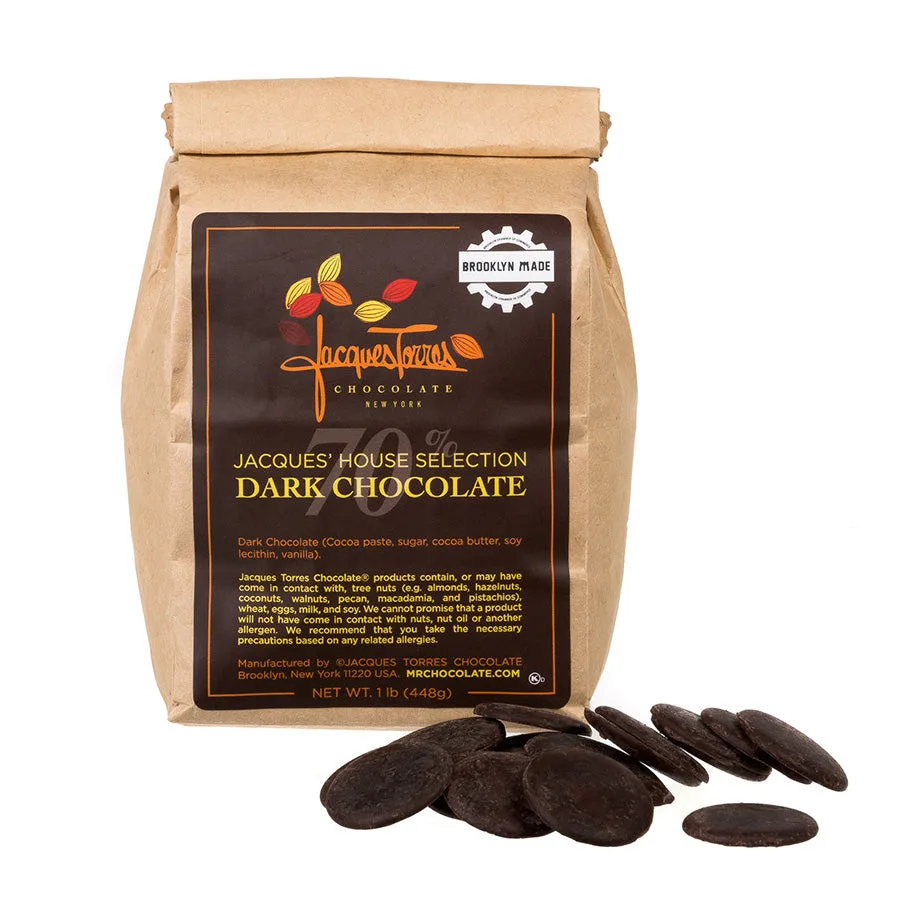
- 70% Dark Chocolate Discs: 70% Belgian dark chocolate discs, net weight 1 pound. Great to bake, eat by the handful, or melt for covered fruit. A versatile 1-pound bag covers multiple uses—baking, snacking, and melting—so you can keep one product on hand for different projects.